Prison System
p. 12 · Read in the full issue
Gaol Escapees Destroy Rarotonga's
Biggest Store
Extraordinary Crime Wave and Farcical Prison System
From Our Own Correspondent
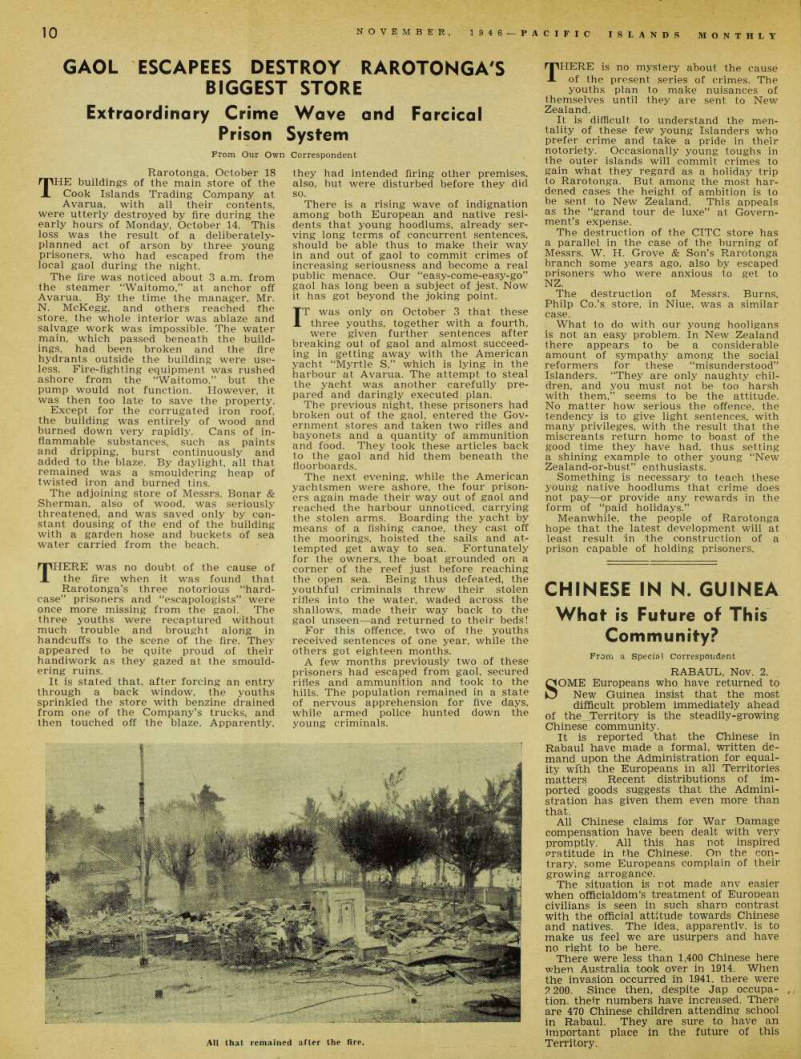
Rarotonga, October 18 THE buildings of the main store of the Cook Islands Trading Company at Avarua, with all their contents, were utterly destroyed by fire during the early hours of Monday, October 14. This loss was the result of a deliberatelyplanned act of arson by three young prisoners, who had escaped from the local gaol during the night.
The fire was noticed about 3 a.m. from the steamer “Waitomo,” at anchor off Avarua. By the time the manager, Mr.
N. McKegg, and others reached the store, the whole interior was ablaze and salvage work was impossible. The water E" n - h W a d C Ven SS hr„k b P e n nea inri th .h P bU flV d ; mgS, nad boon brokon and tho firo hydrants outside the building were usei e shore Fir frnm ht ;!; 8 e 3“ ip !? ent a ?, r t usl ad 17. ™ the "Waitomo; but the n l ot , function. However it ™' h ‘°° ate t 0 save , ‘ he . Property.
E x cePt £ or the corrugated iron root hnrnoH 1 entl roJ y of wood and fc d^° Wn u e + y rapidly - Cans of msul3s^ anc f s > su £ h as Paints tan d r ip P* ng ’ burs t> eoimnuouriy and added to the blaze. By daylight, all that t«^fl^ ed r.ry WaS smoa l dering hea P of T>u od iron and burned tms. er,^ 8 adjoining store of Messrs. Bonar & Sherman, also of wood, was seriously threatened, and was saved only by constant dousing of the end of the building with a garden hose and buckets of sea water earned from the beach. mHERE was no doubt of the cause of X the fire when it was found that Rarotonga’s three notorious “hardcase” prisoners and “escapologists” were once more missing from the gaol. The three youths were recaptured without much trouble and brought along in handcuffs to the scene of the fire. They appeared to be quite proud of their handiwork as they gazed at the smouldering ruins.
It is stated that, after forcing an entry through a back window, the youths sprinkled the store with benzine drained from one of the Company’s trucks, and then touched off the blaze. Apparently,
they had intended firing other premises, also, but were disturbed before they did so.
There is a rising wave of indignation among both European and native resi dents that young hoodlums, already ser ving long terms of concurrent sentences, should be able thus to make their way in and out of gaol to commit crimes of increasing seriousness and become a real public menace. Our “easy-come-easy-go” gaol has long been a subject of jest. Now it has got beyond the joking point.
T-p was on iy on October 3 that these I th vmiths tnc?Pthpr with a fourth A ree ’ further sentences after breaking out of gaol almost succeed ;np - in p'pftinp’ pwpiv with thp Ampriran yacht “Mvrtle Ivinein the harbour at Avaraa. The attempt to steal th ht was another ca refully pre / and daringly executed plan, The previous nig ht, these prisoners had brok en out of the gaol, entered the Gov ernment stores and taken two rifles and bayonets and a quantity of ammunition and f ood . They took these articles back to the gaol and hid them beneath the floorboards.
The next even i ng) while the American yachtsmen were ashore, the four prison ers aga i n made their way out of gaol and reached the harbour unnoticed, carrying the stolen arms. Boarding the yacht by means of a fishing canoe, they cast off the moorings, hoisted the sails and at tempted get away to sea. Fortunately for the owners, the boat grounded on a corner of the reef just before reaching the open sea. Being thus defeated, the youthful criminals threw their stolen rifles into the water, waded across the shallows, made their way back to the gaol unseen—and returned to their beds!
For this offence, two of the youths received sentences of one year, while the others got eighteen months, A few months previously two of these prisoners had escaped from gaol, secured rifles and ammunition and took to the hills. The population remained in a state of nervous apprehension for five days, while armed police hunted down the young criminals.
THERE is no mystery about the cause of the present series of crimes. The youths plan to make nuisances of themselves until they are sent to New Zealand.
It is difficult to understand the men tality of these few young Islanders who prefer crime and take a pride in their notoriety. Occasionally young toughs in the outer islands will commit crimes to gain what they regard as a holiday trip to Rarotonga. But among the most har dened cases the height of ambition is to be sent to New Zealand. This appeals as the “grand tour de luxe” at Govern ment’s expense.
The destruction of the CITC store has a parallel in the case of the burning of Messrs. W. H. Grove & Son’s Rarotonga branch some years ago, also by escaped prisoners who were anxious to get to NZ.
The destruction of Messrs. Burns, Philp Co.’s store, in Niue, was a similar case.
What to do with our young hooligans is not an easy problem. In New Zealand there appears to be a considerable amount of sympathy among the social reformers for these “misunderstood”
Islanders. “They are only naughty chil dren, and you must not be too harsh with them,” seems to be the attitude.
No matter how serious the offence, the tendency is to give light sentences, with many privileges, with the result that the miscreants return home to boast of the good time they have had, thus setting a shining example to other young “New Zealand-or-bust” enthusiasts.
Something is necessary to teach these young native hoodlums that crime does not pay—or provide any rewards in the form of “paid holidays.”
Meanwhile, the people of Rarotonga hope that the latest development will at least result in the construction of a prison capable of holding prisoners.
All that remained after the fire.