Pacific
pp. 7-8 · Read in the full issue
Uncertain Future for Inarticulate Europeans in the Pacific
FOR 150 years, and until the Japa nese invasion upset our standards and dislocated our economy, it was accepted that the most valuable man in the Pacific Islands was the Euro pean individualist—the hard-working type who induced the natives to barter, who visualised new industries, and made ten good coconuts grow in the place of one.
To-day a combination of Socialist politicians, scientific idealists and im practical missionaries is proceeding— whether by deliberate plan or not is not clear—to drive European enter prise out of the Pacific, with a view to the establishment there of “free nations of native Islanders.” It is an extraordinary spectacle—and it is not confined alone to the Australian Territories of Papua and New Guinea.
In this issue of the “PIM” there are references to various events, which show that European private enter prise definitely is on the defensive against political and nationalist move ments in (from west to east) the Netherlands Indies, Malaya, Papua- New Guinea, the British Solomons, Fiji, Gilbert and Ellice Colony, Western Samoa and the Cook Islands —in other words, in all the Islands ruled over by the more-or-less Pink Governments of Britain, Holland, Australia and New Zealand.
The fact that no such movements are yet discerned in the French terri tories of New Caledonia, Tahiti and New Hebrides is surprising, in view of the strong Red element in metro politan France. But the French
always were realists. The British, on the other hand, will on occasion let down their back hair and literally wallow in sentimentalism—and pre sent trends and events in the Pacific Islands suggest that this is one of those occasions.
WE take second place to no one in our admiration of the qualities of the Pacific Islands races, and be lief in their future. In fact, for years, the lonely voice of the “PIM” was the only voice demanding a. better deal for the Polynesians, Micronesians and the more advanced sections of Melanesians. It is more than gratifying to see that so much now is to be done to provide these people with better educational and health facilities, and to assist them to take control of the affairs of their own countries.
But why should all these Govern ments, and mission bodies and learned institutions go so suddenly and drastically from one extreme to the other? Why should they be per mitted, in their enthusiasm over policies for the betterment of natives, to commit cruel injustices against Europeans?
The task of raising the standards of individual and communal life in the Islands is one to be approached warily, and carried out gradually. It cannot be successfully accomplished without the co-operation and good will of the elements that our youth ful post-war bureaucrats now treat with disdain and try to ignore—the
common, everyday planters and traders. If there is one thing com mon to all the attacks upon Euro pean enterprise in the Territories named above, it is the bureaucrats’ determination to have no truck with and accept no advice from money grubbing, non-official civilians.
The record of the native Islanders’ progress during the past 50 years is by no means a discreditable one; and that progress was made by the vari ous Administrations in close partner ship with European commerce, in dustry and trade.
At the turn of the century, every indigenous race in the Pacific—except the primitive Melanesians, who were still practically untouched by “Euro peanisation”—had been reduced ter ribly in numbers, and seemed on the way to extinction. That was the result of unchecked debauchery and exploitation by irresponsible Euro peans. To-day as the outcome of a long, happy and profitable co-opera tion between Governments and private enterprise, every one of the Island races is increasing satisfactorily in numbers, and attaining standards of life that guarantee an increasing measure of self-government.
JUDGED on results, there was noth ing wrong with that system. But that was the system that was peremptorily dismissed by the present Australian Government in New Guinea —although there had not been one word of serious criticism directed against it. It represented orderly control and ordered progress; happy and protected natives; a prosperous and contented European community; and a Territory which, blessed with
£ood, sound industries, paid its own way and was no charge upon the Australian taxpayer.
The native labour system of New Guinea was swept away by a com bination of Leftist politicians and whooping anthropologists, and we were given in its place the present set-up; A very large organisation of very earnest officials, wallowing in public money; a confused mass of natives who do not know what to do with their new-found wealth and privileges; and a few hundred former traders, planters and miners, whose hearts are being broken by Govern mental indifference to their attempts to rehabilitate themselves and their industries.
We have a similar condition of af fairs in other Territories. The un happy non-official Europeans in New Guinea and in other Territories have no newspapers and no voice in Par liament to ventilate their grievances.
Private enterprise in Australia and New Zealand is being similarly at tacked; but in those countries it can at least lift its voice in a howl that ultimately will receive attention.
EARLY in 1947, in Canberra, repre sentatives of all the nations with territorial interests in the South Pacific will meet to discuss matters which interest them in common.
For many years prior to the war, the "PIM” urged the establishment of some sort of South Pacific co ordinating authority. It was pointed out, many times, that the dozen separate and independent Pacific Islands Administrations south of the equator had many problems in com mon—especially those relating to native health, native education, agri culture, European industries, trans port, Asiatic communities, control of pests—and that a great deal could be done for the benefit of Europeans and natives if common action could be agreed upon.
Therefore, the organisation of this South Seas Conference by the Aus tralian Minister, Dr. Evatt —it seems to be a logical step, following upon the 1944 Pacific Pact between Aus tralia and New Zealand—is a most satisfactory development. From the conference, it is expected, there will come a South Seas Regional Com mission, which will have some co ordinating authority over all South Pacific Territories; and that Commis sion ultimately should receive recog nition by the United Nations.
But, already, those who* at first warmly applauded the idea are look ing upon the movement with sus picion. It is feared that, unless its purpose and objects are clarified, it will be only another instrument for the attack upon private enterprise and the deification of Fuzzy-wuzzy.
A well-balanced approach to the South Pacific’s manifold problems could accomplish incalculable good, for all interests concerned —and. most of all, for the interests of the in digenous neoples. A one-eyed ap proach, with a conference dominated by what cynical journalists call “would-to-godders,” will simply create new injustices and a wider area of political and economic confusion.
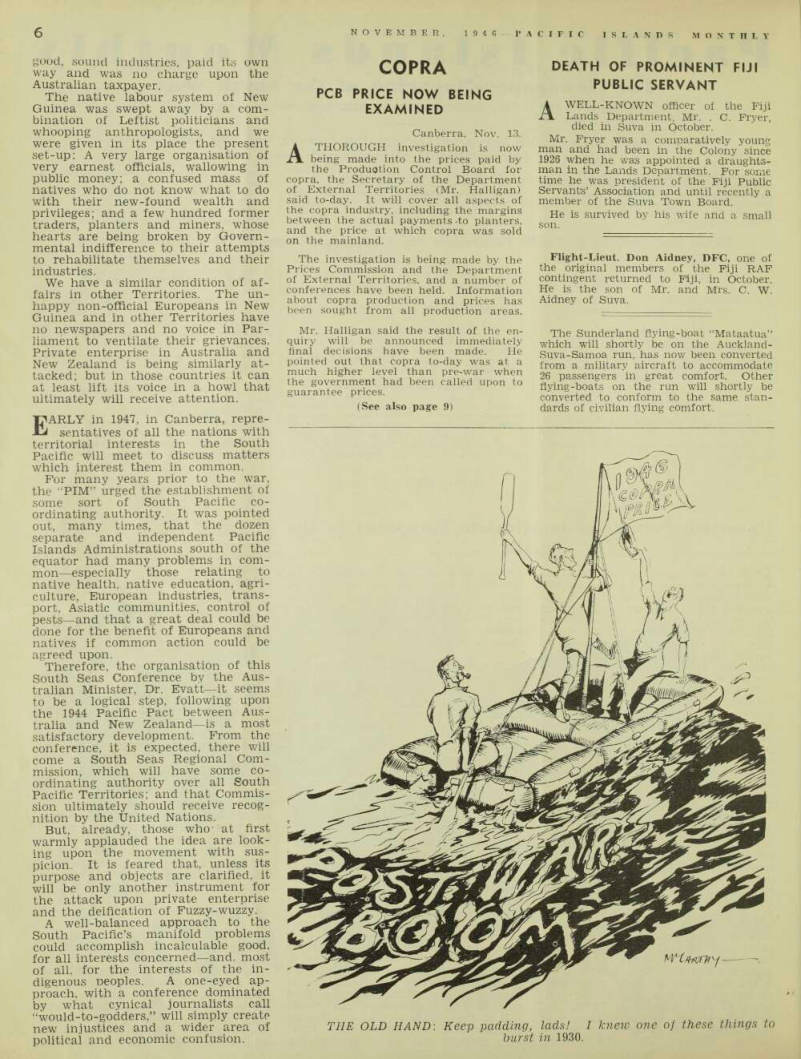
THE OLD HAND : Keep padding, lads! I knew one of these things to burst in 1930.