Marsters Clan
pp. 73-74 · Read in the full issue
Palmerston's Romantic History Recalled by Recent Death of William Marsters II.
By William S. Bond
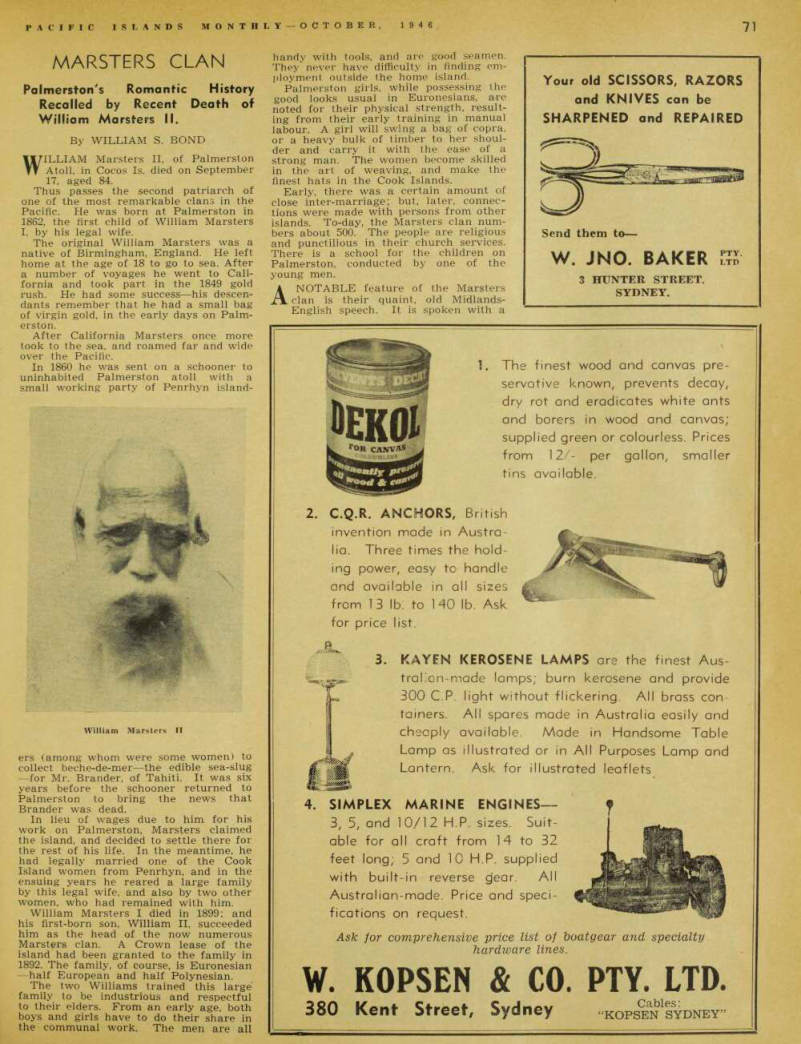
WILLIAM Marsters 11, of Palmerston Atoll, in Cocos Is. died on September 17, aged 84.
Thus passes the second patriarch of one of the most remarkable clans in the Pacific. He was born at Palmerston in 1862, the first child of William Marsters I, by his legal wife.
The original William Marsters was a native of Birmingham, England. He left home at the age of 18 to go to sea. After a number of voyages he went to Cali fornia and took part in the 1849 gold rush. He had some success—his descen dants remember that he had a small bag of virgin gold, in the early days on Palm erston.
After California Marsters once more took to the sea, and roamed far and wide over the Pacific.
In 1860 he was sent on a schooner to uninhabited Palmerston atoll with a small working party of Penrhyn island-
ers (among whom were some women) to collect beche-de-mer —the edible sea-slug —for Mr. Brander, of Tahiti. It was six years before the schooner returned to Palmerston to bring the news that Brander was dead.
In lieu of wages due to him for his work on Palmerston, Marsters claimed the island, and decided to settle there for the rest of his life. In the meantime, he had legally married one of the Cook Island women from Penrhyn, and in the ensuing years he reared a large family by this legal wife, and also by two other women, who had remained with him.
William Marsters I died in 1899: and his first-born son, William 11, succeeded him as the head of the now numerous Marsters clan. A Crown lease of the island had been granted to the family in 1892. The family, of course, is Euronesian —half European and half Polynesian.
The two Williams trained this large family to be industrious and respectful to their elders. From an early age, both boys and girls have to do their share in the communal work. The men are all
handy with tools, and are good seamen.
They never have difficulty in finding em ployment outside the home island.
Palmerston girls, while possessing the good looks usual in Euronesians, are noted for their physical strength, result ing from their early training in manual labour. A girl will swing a bag of copra, or a heavy bulk of timber to her shoul der and carry it with the ease of a strong man. The women become skilled in the art of weaving, and make the finest hats in the Cook Islands.
Early, there was a certain amount of close inter-marriage; but, later, connec tions were made with persons from other islands. To-day, the Marsters clan num bers about 500. The people are religious and punctilious in their church services.
There is a school for the children on Palmerston, conducted by one of the young men.
A NOTABLE feature of the Marsters clan is their quaint, old Midlands- English speech. It is spoken with a
William Marsters II
slow drawl, and is quite difficult to follow at first acquaintance.
At one time, the little colony was quite prosperous, partly on account of their own industry, but partly due to other people’s misfortunes. During the period of the Marsters occupation, there have been a number of ships wrecked on the atoll, and salvage from these vessels was valuable. Several of the ships carried cargoes of timber, and large quantities of salvaged timber were sold for ship ment to Rarotonga and other places.
Some of the timber was used for build ing a substantial village, complete with church. The houses were comfortably equipped with handsome furniture, and
a great variety of other fittings, saved from the wrecks.
IN 1926, the sea took back all that it had given. In that year, a bad hurri cane struck Palmerston, sweeping away practically the whole settlement and removing even a part of the islet on which it stood.
The people barely escaped with their lives, by crowding together on a small mound in the centre of the low-lying islet. This mound, which had been created by the excavation of an area for planting taro, has several times afforded a place of refuge from the sea, and is referred to as “the mountain.”
The big wooden church was carried bodily several hundred yards inland by the sea. Due to its substantial construc tion of heavy, full-length timbers, it re mained intact. With the church far re moved from its original position, there was no water supply, as this depended on catchment from the corrugated iron roof, run off into concrete cisterns.
The cisterns could not be moved —so the only way was to bring the church back to the cisterns. The islanders suc ceeded in jacking the church up on to a skidway of coconut trunks and working it back to its original position, with the aid of an old ship’s capstan and rope tackles There had been earlier disasters. In 1883, a hurricane destroyed all the coco nut trees and a fresh start had to be made. The tidal wave of 1914, which caused much trouble in the central Paci fic, damaged houses and crops on Palm erston.
SINCE 1926, there has been a continu ous series of misfortunes, several bad hurricanes in succession striking the island and making it impossible for the islanders to recover, with their resources so low.
The people depend almost entirely upon copra-making as a source of in come; but, with so much damage to the trees during the past twenty years, very little copra has been possible. They also
have to depend largely upon coconuts for their own food supply. Fish are plentiful, and the islanders are expert at smoking and salting. Palmerston pre served fish sells readily in Rarotonga, but lack of shipping handicaps this in dustry.
Palmerston is very isolated. With so little to sell at present, the islanders rarely get more than one visit in a year.
It is little wonder, therefore, that the community is steadily dwindling. As the children of the present generation grow up, they are anxious to see better oppor tunities in Rarotonga and other islands.
At the same time, all the Marsters re tain a great affection for Palmerston, and try to make a visit to the old home whenever possible.
When the schooner “Tiare Taporo” called at Palmerston in August, 1948, there were only 66 persons on the island, and more than half of these were chil dren of school age, or under. The schooner picked up a further 15 of this group and brought them on to Raro tonga.
The writer had the pleasure of visiting William Marsters, on Palmerston, on this occasion, only a few weeks before his death. The old man was mentally alert and still was the master of Palmerston.
He had a fine set of teeth, and could read without glasses. He was respected by all who knew him. The “Old Man” will be deeply mourned by the many members of the Marsters clan through out the Cook Islands.