Tropicalities
p. 45 · Read in the full issue
DON’T throw away your orange-peel.
We, here, on this Polynesian island, never do. The peel, dried in the sun upon an iron roof, makes first-class fire lighters, owing to the orange-skins con taining a highly inflammable oil. Dried peel has newspaper, etc., beaten to a frazzle. On a wet day it saves matches, too —one light suffices, the oil in the peel burning as fiercely as that in dry coconut shells. It has often occurred to me that this oil has commercial possibilities in the scent line, also, being very fragrant.
A fire started as described perfumes the whole house, and even the street. —G. ♦ A HARD luck story comes to hand.
John D. Wilkinson, of Samarai, after waiting for the Australian War Dis posals Commission to show signs of life, eventually bought a boat. It was one that the Provisional Govt, had taken over; the Disposals Commission sent Mr.
Wilkinson the papers binding the con tract of sale to him. The D. 0., Samarai, would not release it.
Messages to Moresby burnt the ether, and eventually the official sanction to hand it over was sent to the DO.
Then John D. set to work and he found that the engine had a cracked cylinder head. Signals to Sydney brought word that one would have to be obtained from England. Local welders could not do much.
Then one was found and passed to “Wilkie” by the Catholic Mission. Fitted and started, the engine then developed more faults, which took more time to rectify. Then, after running for several days, a gear wheel broke, and a new one had to be obtained. Fortunately, one is available in Sydney, so “Wilkie” will not lose much more time; but his remarks on engines and life generally added something to the gaiety of Samarai.
He is not the only one to have trouble with engines and boats in this area. His boat apparently was ANGAUED. ♦ THE Battle of Waterloo was fought in 1815; but it’s still great news at Man gaia, by grace of early missionaries, who lost no time in instilling patriotism into the flock. “Na Poriona,” chieftain of the then-hostile “Varani,” is still a household word; and we have a slang phrase, still in circulation. “Kua ruti koe Vataru” (“You’ve lost Waterloo!”) when anyone meets with a bad setback. This latter is considered a most-knowing “jeu d’esprit,” and may be applied to a lost court-case, a divorce, or the demise of one’s pet pig. Mangaians “lose Water loo,” where a dinkum Aussie would call the matter a Flaming (or ensanguined) Cow.—ETI. ♦ ONE of the results of peace has been a spate of torch batteries suddenly made available to us on isolated islands as it used to be in good old ’3B.
But they are made in NZ and not Hong Kong. Polynesians are notoriously care less with torches, especially disused ones.
So many are without the holders. Those canny islanders who kept their “shoot lamps” carefully in their sea-chests over the six battery-less years of war, are now able to swagger about at night in a blaze of publicity. A Mangaia’s ambi tious encompass ownership of a watch, a torch, and a bicycle. After that, only Heaven remains!—B.
“I>ANANA figs,” described in May PIM O as a new confection, are as old as the “Saragossa’s” great anchor that lies on the shore here —and she was wrecked in 1903! In Cl, the fruit has been dehydrated on an iron roof in the midday sun, so often and so long that the resulting article is a commonplace native food. It certainly does taste fig like, and is a very agreeable and whole some dessert. An aged friend of mine, now deceased, lived on it during the last seven years of his long life. The stuff has vitamins. It is well-known at Mauke Island, where boys go out to the ships to sell it at 1/- per bundle. How our dried banana comes now to appear as a nov elty (by grace of a little icing sugar) is a Pacific mystery.—E.G., Mangaia. * ADDRESSING a group of Naval Offi cers at the Stanford School of Administration in California, in August, Mr. Karl M. Geiselhart, former Director of Education of American Samoa, lauded the “new approach” of the United States Navy to the problems of military administration. When such a group of 140 officers worked together in an effort to orient themselves, an under standing between different departments should result and that it should be pos sible to carry on a continuous and pro gressive programme whether it be in the field of education or in any other field.
Speaking highly of the Samoans, Mr.
Geiselhart said that first there must be the desire of the administrative heads to understand the Polynesian in his environment, and then they must work together to assist him in meeting the problems thrust upon him by the impact of Western Civilisation helping the Polynesian at the same time to retain the desirable elements of his own culture. • A TALL old man, not far off 80 now. is Mr. George R. Crummer, who lives in retirement at Rarotonga.
“Tioti” was the first cinema showman in the Cook Islands, and for many years combined a travelling picture-show with photography (his collection of negatives and prints is a practical Cl history and “Who’s Who” in one, covering 40-odd years). His show was, of course, of the “silent” variety, operated, according to requirements, by a motor-driven gener ator and a limelight set. His patrons had to sit upon planks, or, in the case of Europeans, bring their own chairs; but no one minded things being a little rough.
The screenings were always crowded; and when Mr. Crummer in late years retired from the show business, the island missed their only entertainment. So far, no one has succeeded George in showing films in the group, although audiences would rush this form of entertainment (especially if it were of the talkie type) which has never yet been shown there).
The veteran showman still enjoys good health, and is a very active resident of Rarotonga, with a good fund of remin iscences. ♦ KINDLY letter to the editor, from an old (and embittered) Pacific planter; “Islands men will be eternally in your debt for the great fight you have fought on their behalf these last seven or eight years—particularly during the War Years.
“Press work is a hard, and usually a thankless task. Plenty of kicks, whether
you win or fail. If you win, it is never owing to the efforts of the press—but owing to the magnanimity or graciousness of the interests attacked. Should you lose, obloquy and derision are your re ward for fighting for those who never fight for themselves.
“There are scabs of the right as well as of the left. By their apathy, the former lost the Federal elections and they are selling out the right all over the world. They are too darned com fortable, and dumb and won’t realise it until it is too late and freedom is lost.” • APROPOS “Planter Pete’s” par in Tropicalities, August PIM, stating that mother-of-pearl buttons were on sale in Australian cities at prices ranging from 1/1 to 2/9 per button: He doesn’t know the half of it. A current catalogue issued by a well-known Sydney mail-order house quotes mother-of-pearl buttons at prices ranging from to 10 6 each! Who would be a “pearly king” in Australia? KAI COLO
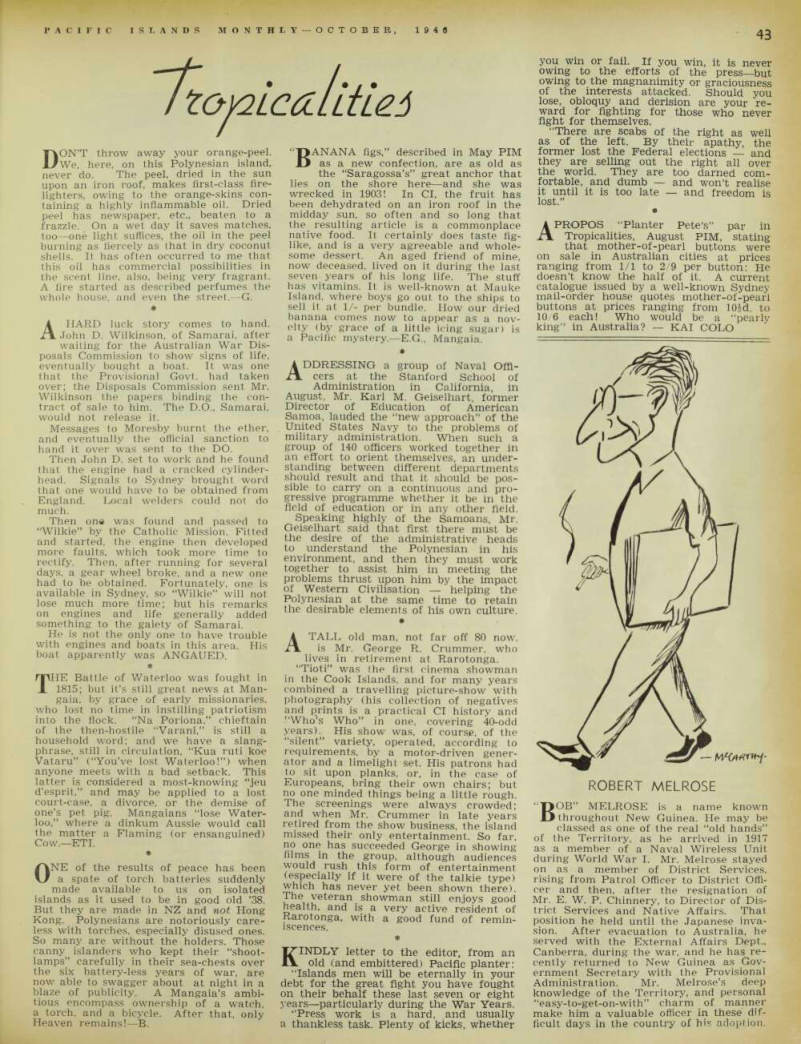
T>OB” MELROSE is a name known O throughout New Guinea. He may be classed as one of the real “old hands” of the Territory, as he arrived in 1917 as a member of a Naval Wireless Unit during World War I. Mr. Melrose stayed on as a member of District Services, rising from Patrol Officer to District Offi cer and then, after the resignation of Mr. E. W. P. Chinnery, to Director of Dis trict Services and Native Affairs. That position he held until the Japanese inva sion. After evacuation to Australia, he served with the External Affairs Dept., Canberra, during the war, and he has re cently returned to New Guinea as Gov ernment Secretary with the Provisional Administration. Mr. Melrose’s deep knowledge of the Territory, and personal “easy-to-get-on-with” charm of manner make him a valuable officer in these dif ficult days in the country of his adoption.