Territories
pp. 14-72 · Read in the full issue
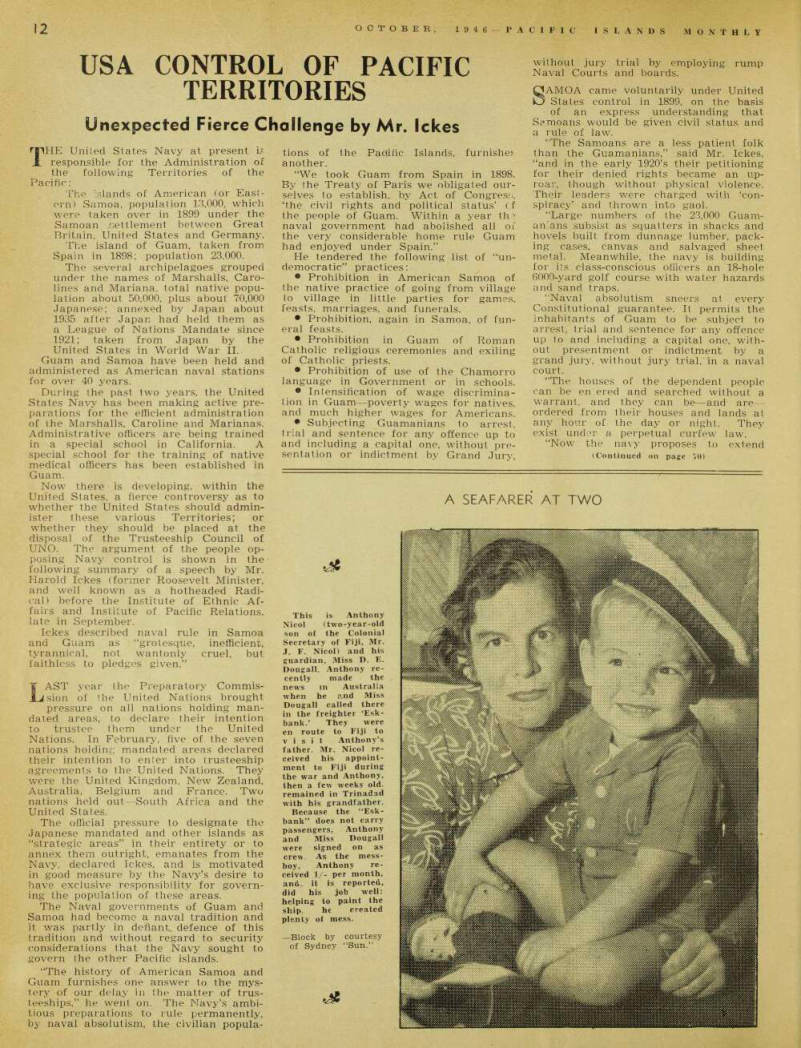

Usa Control Of Pacific
Unexpected Fierce Challenge by Mr. Ickes
THE United States Navy at present i? responsible for the Administration of the following Territories of the Pacific: The Islands of American (or East ern) Samoa, population 13,000, which were taken over in 1899 under the Samoan settlement between Great Britain, United States and Germany.
The island of Guam, taken from Spain in 1898; population 23,000.
The several archipelagoes grouped under the names of Marshalls, Caro lines and Mariana, total native popu lation about 50,000, plus about 70,000 Japanese; annexed by Japan about 1935 after Japan had held them as a League of Nations Mandate since 1921; taken from Japan by the United States in World War 11.
Guam and Samoa have been held and administered as American naval stations for over 40 years.
During the past two years, the United States Navy has been making active pre parations for the efficient administration of the Marshalls, Caroline and Marianas.
Administrative officers are being trained in a special school in California. A special school for the training of native medical officers has been established in Guam.
Now there is developing, within the United States, a fierce controversy as to whether the United States should admin ister these various Territories; or whether they should be placed at the disposal of the Trusteeship Council of UNO. The argument of the people op posing Navy control is shown in the following summary of a speech by Mr.
Harold Ickes (former Roosevelt Minister, and well known as a hotheaded Radi cal) before the Institute of Ethnic Af fairs and Institute of Pacific Relations, late in September.
Ickes described naval rule in Samoa and Guam as “grotesque, inefficient, tyrannical, not wantonly cruel, but faithless to pledges given.”
LAST year the Preparatory Commis sion of the United Nations brought pressure on all nations holding man dated areas, to declare their intention to trustee them under the United Nations. In February, five of the seven nations holding mandated areas declared their intention to enter into trusteeship agreements to the United Nations. They were the United Kingdom, New Zealand, Australia, Belgium and France. Two nations held out —South Africa and the United States.
The official pressure to designate the Japanese mandated and other islands as “strategic areas” in their entirety or to annex them outright, emanates from the Navy, declared Ickes, and is motivated in good measure by the Navy’s desire to have exclusive responsibility for govern ing the population of these areas.
The Naval governments of Guam and Samoa had become a naval tradition and it was partly in defiant, defence of this tradition and without regard to security considerations that the Navy sought to govern the other Pacific islands.
“The history of American Samoa and Guam furnishes one answer to the mys tery of our delay in the matter of trus teeships,” he went on. The Navy’s ambi tious preparations to rule permanently, by naval absolutism, the civilian popula
tions of the Padihc Islands, furnishes another.
“We took Guam from Spain in 1898.
By the Treaty of Paris we obligated ourselves to establish, by Act of Congress, ‘the civil rights and political status’ c f the people of Guam. Within a year th > naval government had abolished all of the very considerable home rule Guam had enjoyed under Spain.”
He tendered the following list of “undemocratic” practices: ® Prohibition in American Samoa of the native practice of going from village to village in little parties for games, feasts, marriages, and funerals. • Prohibition, again in Samoa, of funeral feasts. • Prohibition in Guam of Roman Catholic religious ceremonies and exiling of Catholic priests. • Prohibition of use of the Chamorro language in Government or in schools. ® Intensification of wage discrimination in Guam—poverty wages for natives, and much higher wages for Americans. • Subjecting Guamanians to arrest, trial and sentence for any offence up to and including a capital one, without presentation or indictment by Grand Jury,
without jury trial by employing rump Naval Courts and boards.
SAMOA came voluntarily under United States control in 1899, on the basis of an express understanding that Samoans would be given civil status and a rule of law.
“The Samoans are a less patient folk than the Guamanians,” said Mr. Ickes, “and in the early 1920’s their petitioning for their denied rights became an up roar, though without physical violence.
Their leaders were charged with ‘con spiracy’ and thrown into gaol.
“Large numbers of the 23,000 Guam anians subsist as squatters in shacks and hovels built from dunnage lumber, pack ing cases, canvas and salvaged sheet metal. Meanwhile, the navy is building for its class-conscious officers an 18-hole 6000-yard golf course with water hazards and sand traps.
“Naval absolutism sneers at every Constitutional guarantee. It permits the inhabitants of Guam to be subject to arrest, trial and sentence for any offence up to and including a capital one, with out presentment or indictment by a grand jury, without jury trial, in a naval court.
“The houses of the dependent people can be en ered and searched without a warrant, and they can be—and are — ordered from their houses and lands at any hour of the day or night. They exist under a perpetual curfew law.
“Now the navy proposes to extend
(Continued on page ;o)
these abuses into the newly acquired Pacific islands, although Australia and New Zealand have already declared their intention of trusteeing nearby islands which also have international status.
“The navy is arbitrary, dictatorial and totally disregardful of civilian rights.
“Democracy will enter on its swift de cline if we do not firmly adhere to the principle that our armed forces are for defence in times of war and not for civilian administration in times of peace.”
WE know nothing about conditions in Guam; but, so far as Eastern Samoa is concerned, we can state positively that there exists a picture very different from that painted in such gloomy col ours by the unhappy Mr. Ickes.
Representatives of the PIM have been in and near American Samoa on many
occasions during the last 15 years; and never once have been heard, through native or European channels, any sug gestion that the American Samoans were misgoverned or oppressed. On the contrary, American Samoa is regarded as one of the best governed and happiest communities in the South Seas. In con trast with Western Samoa, there had been no agitation in American Samoa against the administrative officials, and the achievements of the United States Navy in native welfare (especially health and education) have at times been warmly praised.