Pacific Territories
pp. 7-8 · Read in the full issue
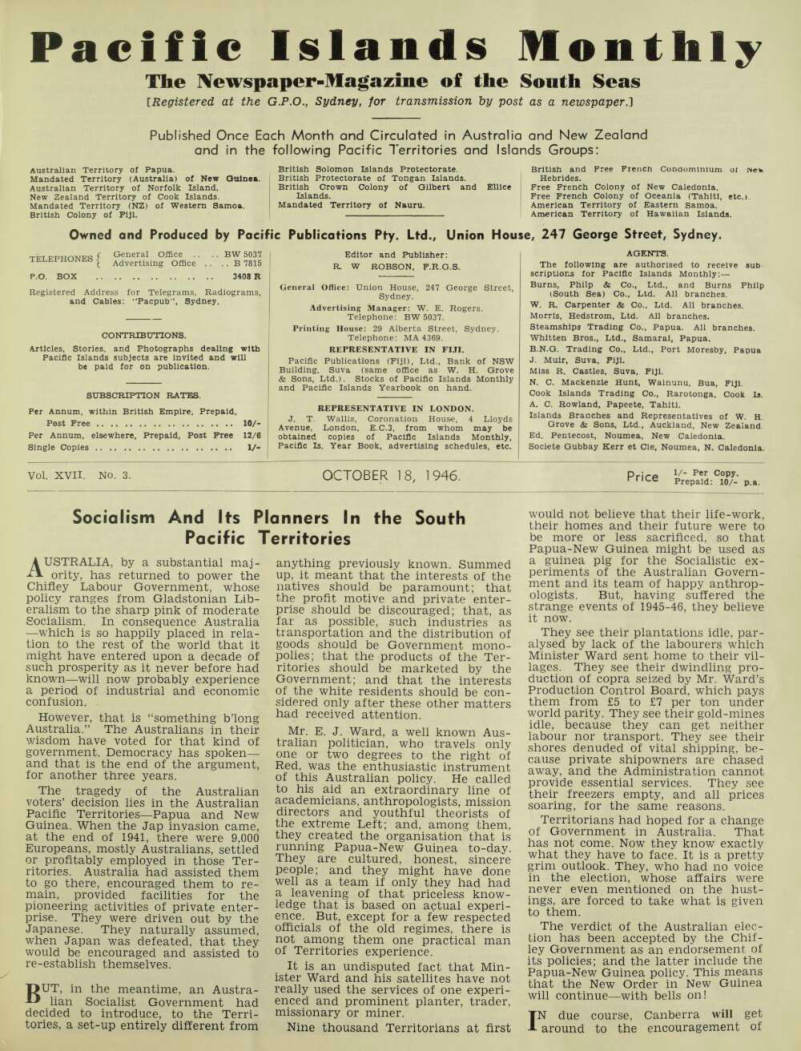
Socialism And Its Planners In the South Pacific Territories
AUSTRALIA, by a substantial maj ority, has returned to power the Chifley Labour Government, whose policy ranges from Gladstonian Lib eralism to the sharp pink of moderate Socialism. In consequence Australia —which is so happily placed in rela tion to the rest of the world that it might have entered upon a decade of such prosperity as it never before had known—will now probably experience a period of industrial and economic confusion.
However, that is “something b’long Australia.” The Australians in their wisdom have voted for that kind of government. Democracy has spoken— and that is the end of the argument, for another three years.
The tragedy of the Australian voters’ decision lies in the Australian Pacific Territories—Papua and New Guinea. When the Jap invasion came, at the end of 1941, there were 9,000 Europeans, mostly Australians, settled or profitably employed in those Ter ritories. Australia had assisted them to go there, encouraged them to re main, provided facilities for the pioneering activities of private enter prise, They were driven out by the Japanese. They naturally assumed, when Japan was defeated, that they would be encouraged and assisted to re-establish themselves.
BUT, in the meantime, an Austra lian Socialist Government had decided to introduce, to the Terri tories, a set-up entirely different from
anything previously known. Summed up, it meant that the interests of the natives should be paramount; that the profit motive and private enter prise should be discouraged; that, as far as possible, such industries as transportation and the distribution of goods should be Government mono polies; that the products of the Ter ritories should be marketed by the Government; and that the interests of the white residents should be con sidered only after these other matters had received attention.
Mr. E. J. Ward, a well known Aus tralian politician, who travels only one or two degrees to the right of Red, was the enthusiastic instrument of this Australian policy. He called to his aid an extraordinary line of academicians, anthropologists, mission directors and youthful theorists of the extreme Left; and, among them, they created the organisation that is running Papua-New Guinea to-day.
They are cultured, honest, sincere people; and they might have done well as a team if only they had had a leavening of that priceless know ledge that is based on actual experi ence. But, except for a few respected officials of the old regimes, there is not among them one practical man of Territories experience.
It is an undisputed fact that Min ister Ward and his satellites have not really used the services of one experi enced and prominent planter, trader, missionary or miner.
Nine thousand Territorians at first
would not believe that their life-work, their homes and their future were to be more or less sacrificed, so that Papua-New Guinea might be used as a guinea pig for the Socialistic ex periments of the Australian Govern ment and its team of happy anthrop ologists. But, having suffered the strange events of 1945-46, they believe it now.
They see their plantations idle, par alysed by lack of the labourers which Minister Ward sent home to their vil lages. They see their dwindling pro duction of copra seized by Mr. Ward’s Production Control Board, which pays them from £5 to £7 per ton under world parity. They see their gold-mines idle, because they can get neither labour nor transport. They see their shores denuded of vital shipping, be cause private shipowners are chased away, and the Administration cannot provide essential services. They see their freezers empty, and all prices soaring, for the same reasons.
Territorians had hoped for a change of Government in Australia. That has not come. Now they know exactly what they have to face. It is a pretty grim outlook. They, who had no voice in the election, whose affairs were never even mentioned on the hust ings, are forced to take what is given to them.
The verdict of the Australian elec tion has been accepted by the Chif ley Government as an endorsement of its policies; and the latter include the Papua-New Guinea policy. This means that the New Order in New Guinea will continue—with bells on!
IN due course, Canberra will get around to the encouragement of
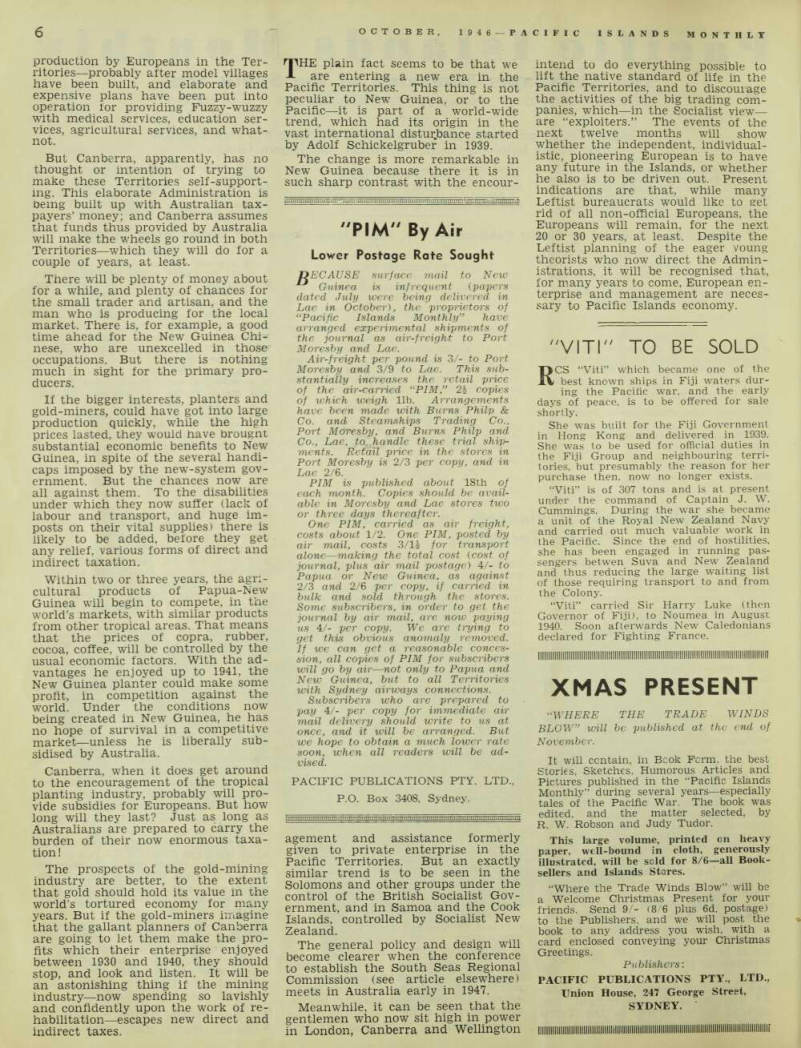
production by Europeans in the Ter ritories—probably after model villages have been built, and elaborate and expensive plans have been put into operation for providing Fuzzy-wuzzy with medical services, education ser vices, agricultural services, and what not.
But Canberra, apparently, has no thought or intention of trying to make these Territories self-support ing. This elaborate Administration is being built up with Australian tax payers’ money; and Canberra assumes that funds thus provided by Australia will make the wheels go round in both Territories—which they will do for a couple of years, at least.
There will be plenty of money about for a while, and plenty of chances for the small trader and artisan, and the man who is producing for the local market. There is, for example, a good time ahead for the New Guinea Chi nese, who are unexcelled in those occupations. But there is nothing much in sight for the primary pro ducers.
If the bigger interests, planters and gold-miners, could have got into large production quickly, while the high prices lasted, they would have brougnt substantial economic benefits to New Guinea, in spite of the several handi caps imposed by the new-system gov ernment. But the chances now are all against them. To the disabilities under which they now suffer (lack of labour and transport, and huge im posts on their vital supplies) there is likely to be added, before they get any relief, various forms of direct and indirect taxation.
Within two or three years, the agri cultural products of Papua-New Guinea will begin to compete, in the world’s markets, with similar products from other tropical areas. That means that the prices of copra, rubber, cocoa, coffee, will be controlled by the usual economic factors. With the ad vantages he enjoyed up to 1941, the New Guinea planter could make some profit, in competition against the world. Under the conditions now being created in New Guinea, he has no hope of survival in a competitive market—unless he is liberally sub sidised by Australia.
Canberra, when it does get around to the encouragement of the tropical planting industry, probably will pro vide subsidies for Europeans. But how long will they last? Just as long as Australians are prepared to carry the burden of their now enormous taxa tion!
The prospects of the gold-mining industry are better, to the extent that gold should hold its value in the world’s tortured economy for many years. But if the gold-miners imagine that the gallant planners of Canberra are going to let them make the pro fits which their enterprise enjoyed between 1930 and 1940, they should stop, and look and listen. It will be an astonishing thing if the mining industry—now spending so lavishly and confidently upon the work of re habilitation—escapes new direct and indirect taxes.
THE plain fact seems to be that we are entering a new era in the Pacific Territories. This thing is not peculiar to New Guinea, or to the Pacific—it is part of a world-wide trend, which had its origin in the vast international disturbance started by Adolf Schickelgruber in 1939.
The change is more remarkable in New Guinea because there it is in such sharp contrast with the encour
agement and assistance formerly given to private enterprise in the Pacific Territories. But an exactly similar trend is to be seen in the Solomons and other groups under the control of the British Socialist Gov ernment, and in Samoa and the Cook Islands, controlled by Socialist New Zealand.
The general policy and design will become clearer when the conference to establish the South Seas Regional Commission (see article elsewhere) meets in Australia early in 1947.
Meanwhile, it can be seen that the gentlemen who now sit high in power in London, Canberra and Wellington
intend to do everything possible to lift the native standard of life in the Pacific Territories, and to discourage the activities of the big trading com panies, which—in the Socialist view— are “exploiters.” The events of the next twelve months will show whether the independent, individual istic, pioneering European is to have any future in the Islands, or whether he also is to be driven out. Present indications are that, while many Leftist bureaucrats would like to get rid of all non-official Europeans, the Europeans will remain, for the next 20 or 30 years, at least. Despite the Leftist planning of the eager young theorists who now direct the Admin istrations, it will be recognised that, for many years to come, European en terprise and management are neces sary to Pacific Islands economy.