Fine Record Of New Guinea Native Soldiers
pp. 59-60 · Read in the full issue
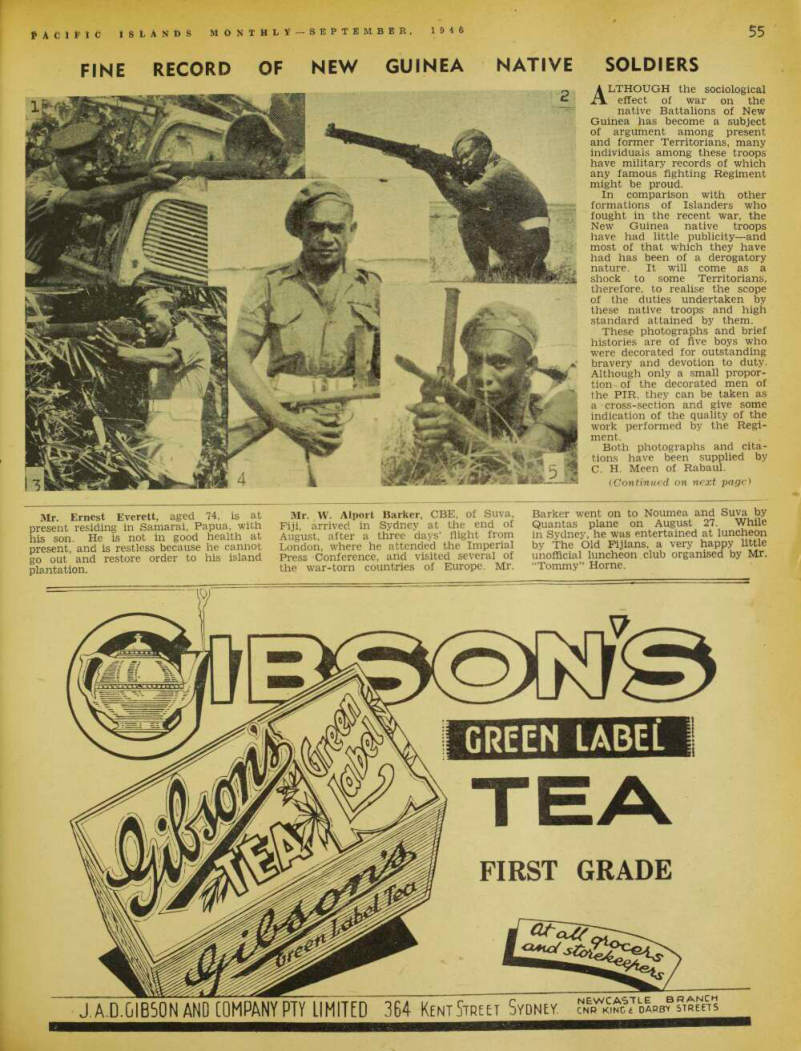
Although the sociological effect of war on the native Battalions of New Guinea has become a subject of argument among present and former Territorians, many individuals among these troops have military records of which any famous fighting Regiment might be proud.
In comparison with other formations of Islanders who fought in the recent war, the New Guinea native troops have had little publicity—and most of that which they have had has been of a derogatory nature. It will come as a shock to some Territorians, therefore, to realise the scope of the duties undertaken by these native troops and high standard attained by them.
These photographs and brief histories are of five boys who were decorated for outstanding bravery and devotion to duty.
Although only a small propor tion of the decorated men of the PIR. they can be taken as a cross-section and give some indication of the quality of the work performed by the Regi ment.
Both photographs and cita tions have been supplied by C. H. Meen of Rabaul.
(Continued on next page)
Mr. Ernest Everett, aged 74, is at present residing in Samarai, Papua, with his son. He is not in good health at present, and is restless because he cannot go out and restore order to his island plantation.
Mr. W. Alport Barker, CBE, of Suva, Fiji, arrived in Sydney at the end of August, after a three days’ flight from London, where he attended the Imperial Press Conference, and visited several of the war-torn countries of Europe. Mr.
Barker went on to Noumea and Suva by Quantas plane on August 27. While in Sydney, he was entertained at luncheon by The Old Fijians, a very happy little unofficial luncheon club organised by Mr.
“Tommy” Horne.
(1) SGT.-MAJOR MATPI is a native of Manus Island, and was formerly employed by the Lands Department in Rabaul. He escaped from the Japanese and enlisted in January, 1943, with the Papuan Infantry Battalion. He fonght at Kokoda, Salamaua and Finschhafen (where he was wounded), and is credited with killing 110 Japanese. On one occasion, in the company of another native soldier, he was cut off from his unit. % He fought his way back by killing 44 of the enemy—six of them by clubbing them with his rifle when he had run out of ammunition. He later performed similar feats.
He was awarded the Distinguished Conduct Medal for bravery and distinguished service outside the requirements of duty. (2) SGT.-MAJOR BENGARI is a native of the Waria, and was formerly employed by the Bulolo Gold Dredging Co., Ltd. He enlisted in the PIR in 1942. He saw action at Salamaua, and once, when Australian troops were stopped by Japanese machine-guns, operating from a fox-hole, Bengari volunteered and dashed for ward alone, armed with an Owen gun and
grenades and, in spite of enemy Are, wiped out every Japanese with his grenades, thus enabling the Australians to advance. For outstanding courage and devotion to duty he was awarded the Military Medal in 1943. He has an officially confirmed kill of 100 Japanese to his credit. (3) CORPORAL YAL is a native of Siassi, New Britain, and was formerly employed by a miner at Bulolo, He enlisted with the PIR at Siassi, and fought in New Guinea and New Britain. Once, during the fighting in the Ramu area, he was advancing with his platoon under the charge of an Australian officer when they were ambushed by the Japanese, and the officer was seriously wounded. In the face of heavy fire, and at the risk of his own life, Cpl. Yal went forward into the open, alone, and carried the officer to safety. For this act he was men tioned in despatches. (4) SGT. RAYMOND is a native of New Ire land and, before the war, was employed by the Administration in Kavieng. He escaped from there on the schooner “Guinia” and, with four natives and seven Europeans, reached Tulagi just before the Japanese landed there in 1942. Later in the year he was at Vila, New Hebrides, and here he enlisted in the AIB. In 1943 he carried out a dangerous mission in enemy-occupied New Ireland and there, under great difficulties, he rescued two Australian officers and successfully brought them back to the Britisti Solomon Islands. He was mentioned in despatches for saving these officers, although he continued to display outstanding bravery in other actions.
He took part in the fighting on Guadalcanal and also at Manus, Bougainville and New Britain. (5) SGT.-MAJOR TAPIOLI is a native of Arawe, New Britain. He was formerly employed by the Department of Agriculture, Rabaul. He enlisted in the PIR in 1942. He fought in the campaigns in New Guinea, New Britain, and Bougainville, and, while attached to an American platoon at Nassau Bay, Tambu Bay, and at Salamaua, he led numerous patrols from which valuable information was gained. On one of these patrols he killed seven Japanese single handed; and, on another, again single-handed, he attacked a pill-box and killed three Jap machine-gunners. These actions enabled the Americans to advance. He is credited with killing a total of 74 of the enemy. He was awarded the Military Medal for “extraordinary heroism and firm faith in the face of all danger.”