50 Million Franc
pp. 49-50 · Read in the full issue
Loan
To Boost and Modernise New Caledonian Nickel Industry
mHE French Nickel Company, which JL controls most of New Caledonia’s nickel production, besides owning the great Doniambo Point smelters in Noumea, is raising a loan of fifty million francs in the Colony.
The loan, which is meeting with a favourable reception in Noumea, takes the form of an issue of 5,000 bonds, each of a value of 10,000 Caledonian francs (worth twice the value of French francs).
It will be repayable in 10 years, and net interest is to be at the rate of 4 per cent per annum.
The issue is timelv. Owing to the pre sence in the Colony of 500,000 Allied troops during the war years, citizens have ac cumulated a great deal of money which they have been unable to put to good use since the war ended. The bonds promise to be readilv negotiable.
The Companv states that the principal purpose of the loan is to modernise the smelting and mining industry, towards which a start has already been made in the chief mining area known as the Plateau, at Thio. on the east coast, where the company has big installations. Docks
and loading equipment have been so modernised as to be considered a model
of mechanisation.
During the war, the company main tained its output for the Allied cause, although the price received for nickel left no margin of profit. The purchasing or ganisation, the US War Department, after lengthy discussion, agreed to a price higher than the current world price, and
included in the sums paid contributions by the nickel industry in the form of wartime taxes. In this way the Nickel Co. alone contributed annually, 25 million francs in direct taxation to the Colony’s exchequer.
The company has now. after a break of some years, resumed export to France, where the final refining of matte is be ing again undertaken for the European market.
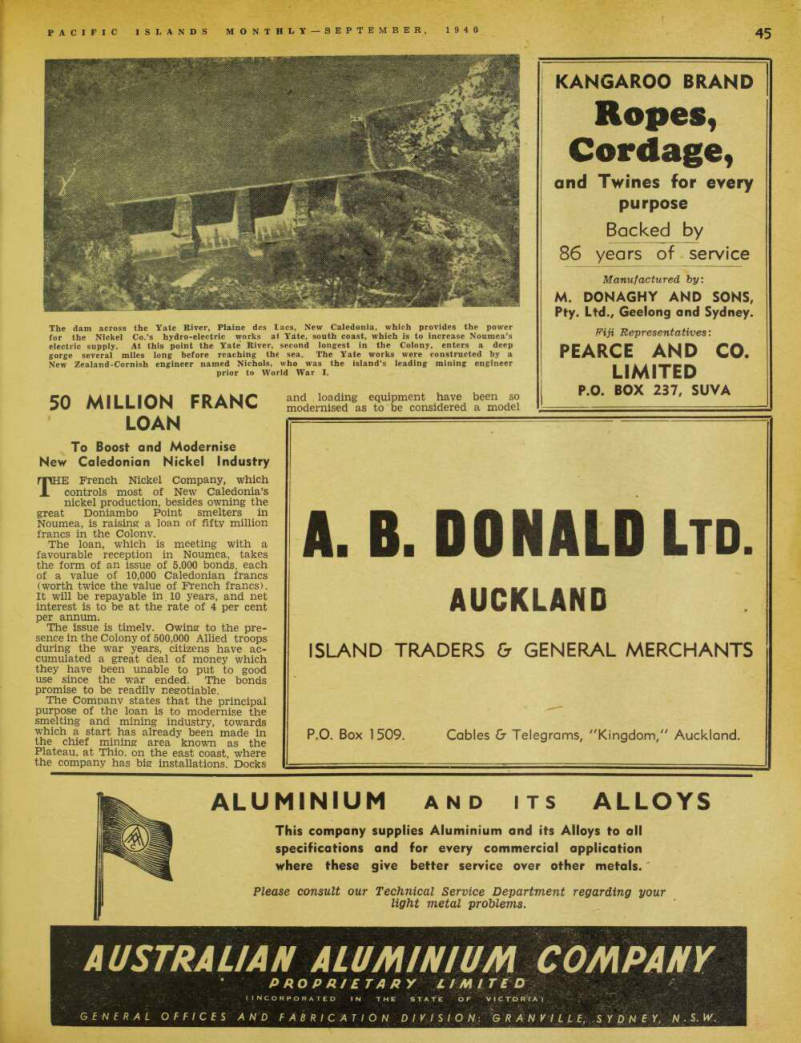
The company proposes not only to modernise its Caledonian mines and smelters but is to provide Noumea with a better and cheaper electric light and power service by bringing current across the Plaine des Lacs to Noumea from the hydro-electric works at Yate.
IT is of interest that the American Government has spent many millions
of dollars in Cuba to produce nickel oxide (not pure nickel, as the French company now does), by a new process which is not yet perfected. The Caledon ian company proposes studying this pro cess with a view to its adoption.
This process may allow of the economical exploitation of ores with as low as two per cent, nickel content, against the pre sent minimum of 3.40 per cent.
The news is most significant for New Caledonia’s future, since the reserves of two per cent, ores in the Colony are enormous.
Another proposal is the installation of electrolytic smelting to replace the pre sent method, for which big stocks of New castle (Australian) coal are required. As well as the present 74 per cent, nickel matte, carbonate or oxide of nickel could be produced by this new process.