Now Running
pp. 15-16 · Read in the full issue
Two Trans-Pacific Air Services
BCP Cannot Get Agreement With America
THHERE were interesting developments in Trans-Pacific air services during the month.
Pan American Airways service (Los Angeles-Honolulu-Fiji- Auckland) which was discontinued in July, when the American Aero nautical Board grounded all Constellations for investigation, as the result of an accident in USA, was resumed on August 30, when a plane departed from Los Angeles for Honolulu. The service will be on a weekly schedule, and will be carried on, for the present, by Douglas Clippers.
British fortnightly Trans-Pacific air service was inaugurated on September 1 5, when the Skymaster "Warana" left Melbourne for Van couver, via Fiji, Hawaii and San Francisco. § A conference representing the Air Departments of Britain, Australia, New Zealand and Fiji met in Wellington, NZ, in August, and discussed various matters relating to control of ground services, aero dromes, weather services, etc., in South Pacific.
September 10, the air mail rates between Australia and United States were reduced from 4/- to 2/6 per half-ounce.
Some features of these Trans-Pacific Air developments are discussed in our principal article on page 7.
The Bcp Service
THERE was extraordinary delay in launching the BCP Line (British Commonwealth Pacific Airlines Ltd).
The inaugural flight was expected months ago, when the British, Austra lian and New Zealand Government dele gates, at their conference in Wellington, NZ, in March, 1946, decided to form the Company and carry on the service.
Cause of the delay, of course, was the failure of the British delegates to reach agreement with the United States Gov ernment concerning reciprocal landing rights in the Pacific. The Americans would not grant landing and passenger carrying facilities in Hawaii and San Francisco unless the Australians and New Zealanders granted similar rights to American interests.
It appears that Britain and New Zealand left these delicate negotiations to Australia; and Australian views apparently were presented by Dr Evatt and Mr Drakeford, than whom few less suitable persons for the job can be imag ined. The result was a foregone conclu sion.
The BCP planes can only land and re fuel in Hawaii and San Francisco, but they cannot trade. Their United States bound passengers, even if they are Americans, must be carried on to Van couver, and returned to ’Frisco by another service at BCP expense! An American, travelling by BCP planes to Australia, must join the plane at Van couver, even if he lives in ’Frisco.
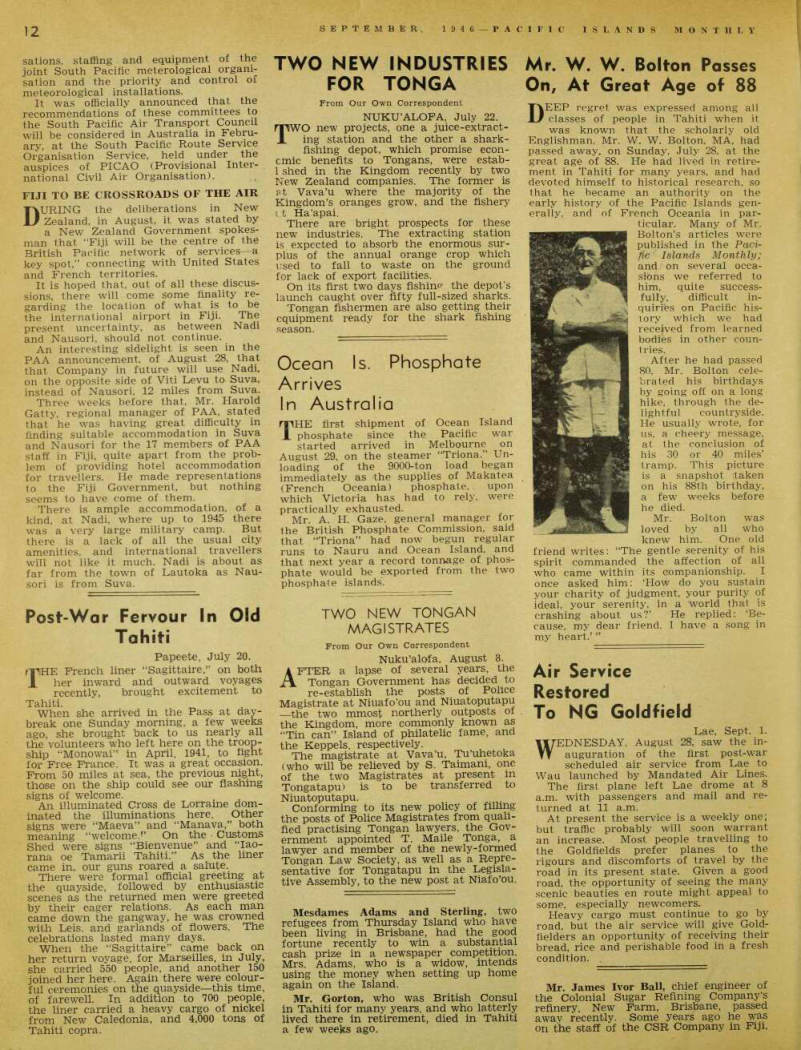
As BCP will not be able to obtain planes for another year, at least, the new service (fortnightly, for the present) will be carried on by the Skymasters of Australian National Airways. Under ANA operation, the planes will leave Melbourne at 4 pm, Sydney at 8 pm; arrive in Suva in early morning; spend a full day in Fiji; fly on to Hawaii via Canton Island; spend a day and a night in Honolulu; fly on to San Francisco, arriving there in early morning; and fly on to Vancouver in daylight.
The actual flying-time will be 42 hours; the elapsed time from Australia to Canada will be 4 days; and the fare
will be the astonishingly high figure of £214, single.
The return trip will occupy about the same time. The first plane, the Sky master “Warana,” which left on Sep tember 15, is expected back in Australia on September 25.
Paa Service
THE reappearance of the Pan Ameri can Airways weekly service at the beginning of September was wel comed in Fiji and New Caledonia, where the several facilities it provides were sadly missed in July and August.
The PAA Douglas Clippers fly Los Angeles-Honolulu-Canton Is.-Nadi (Fiji)- Noumea-Auckland, and return the same way. Their fares are equal to the rates fixed by the British Governments for the Australia-Vancouver trip, £214 Austra lian. These rates presumably were forced upon PAA by the British Com monwealth Governments, because PAA. a year ago, was confident it could run to a much cheaper schedule.
Experts Confer In Nz
THE appearance of a group of experts in New Zealand in August, to confer regarding flying conditions in the
Pacific, was confusing to many people— especially those misguided gentlemen who thought that the development of air transport is a matter for private enterprise. They could not understand where the experts came into the Pacific Air picture.
The Socialist Governments of Britain, Australia and New Zealand, in an effort to keep Pacific air transport under Gov ernmental control, sent delegates to a conference in Wellington, NZ, in March, 1946, They set up what they call the South Pacific Air Transport Council; and, to advise the Council in technical matters, two committees were formed, one a Committee of Air Navigation and Ground Organisation; and the other a Committee on Meteorology. It was decided that these two committees should meet jointly in Wellington on August 15. The members of the commit tees thus called together were: AUSTRALIA —A. Hepburn (leader), D.
Ross, E. C. Betts, S. G. Williamson, D. G.
Anderson, D. J. Anderson, W. A. Dyer and H. Easwan (secretary).
BRITAIN Wing-Commander L. L.
Johnson and E. Evans (Air Ministry Meteorologist).
FIJI —Flight-Lieut. R. Dyer (Meteoro logist) and R. C. Farquhar (Fiji Post and Telegraphs).
NEW ZEALAND—Names not pub lished, but they included Wing-Comman der Bray, RNZAF Commander in Fiji.
The British officials, three Australians and a New Zealand official assembled in Auckland on August 11, and flew in a special craft to Fiji, where in the ensu ing two days they made a survey of the conditions in which they were interested —and especailly the rival claims of Nadi and Nausori airports.
The meetings of the two committees commenced in Wellington on August 15, and dealt with numerous matters relat ing to air services within the South Paci fic area, such as communication facili ties, radio navigation aids, aerodrome requirements, search and rescue organi-
An ANA Skymaster In Flight
sations, staffing and equipment of the joint South Pacific meterological organi sation and the priority and control of meteorological installations.
It was officially announced that the recommendations of these committees to the South Pacific Air Transport Council will be considered in Australia in Febru ary, at the South Pacific Route Service Organisation Service, held under the auspices of PICAO (Provisional Inter national Civil Air Organisation).
FIJI TO BE CROSSROADS OF THE AIR DURING the deliberations in New Zealand, in August, it was stated by a New Zealand Government spokes man that “Fiji will be the centre of the British Pacific network of services—a key spot,” connecting with United States and French territories.
It is hoped that, out of all these discus sions, there will come some finality re garding the location of what is to be the international airport in Fiji. The present uncertainty, as between Nadi and Nausori, should not continue.
An interesting sidelight is seen in the PAA announcement, of August 28, that that Company in future will use Nadi, on the opposite side of Viti Levu to Suva, instead of Nausori, 12 miles from Suva.
Three weeks before that, Mr. Harold Gatty, regional manager of PAA, stated that he was having great difficulty in finding suitable accommodation in Suva and Nausori for the 17 members of PAA staff in Fiji, quite apart from the prob lem of providing hotel accommodation for travellers. He made representations to the Fiji Government, but nothing seems to have come of them.
There is ample accommodation, of a kind, at Nadi, where up to 1945 there was a very large military camp. But there is a lack of all the usual city amenities, and international travellers will not like it much. Nadi is about as far from the town of Lautoka as Nau sori is from Suva.