McDonald
p. 72 · Read in the full issue
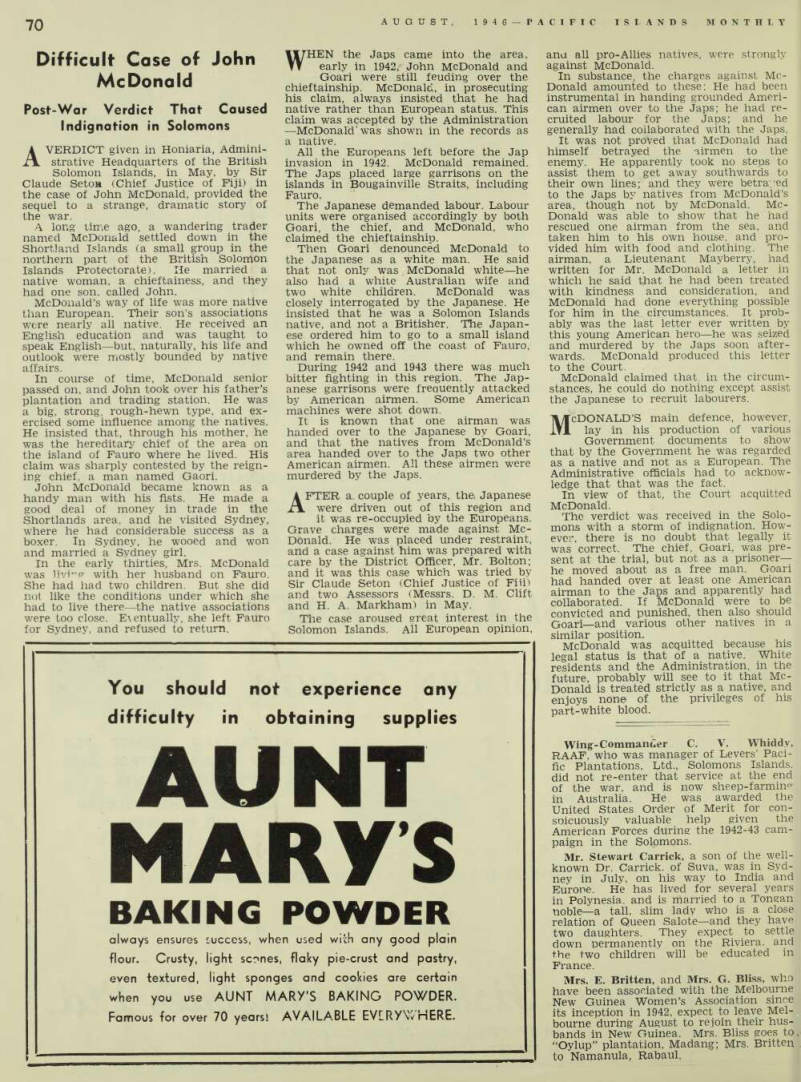
Difficult Case of John McDonald Post-War Verdict That Caused Indignation in Solomons
A VERDICT given in Honiaria, Admini strative Headquarters of the British Solomon Islands, in May, by Sir Claude Setoa (Chief Justice of Fiji) in the case of John McDonald, provided the sequel to a strange, dramatic story of the war.
A long time ago, a wandering trader named McDonald settled down in the Short!and Islands (a small group in the northern part of the British Solomon Islands Protectorate). He married a native woman, a chieftainess, and they had one son, called John.
McDonald’s way of life was more native than European. Their son’s associations were nearly all native. He received an English education and was taught to speak English—but, naturally, his life and outlook were mostly bounded by native affairs.
In course of time, McDonald senior passed on, and John took over his father’s plantation and trading station. He was a big, strong, rough-hewn type, and ex ercised some influence among the natives.
He insisted that, through his mother, he was the hereditary chief of the area on the island of Fauro where he lived. His claim was sharply contested by the reign ing chief, a man named Gaori.
John McDonald became known as a handy man with his fists. He made a good deal of money in trade in the Shortlands area, and he visited Sydney, where he had considerable success as a boxer. In Sydney, he wooed and won and married a Sydney girl.
In the early thirties, Mrs. McDonald was livi^p - with her husband on Fauro.
She had had two children. But she did not like the conditions under which she had to live there—the native associations were too close. E\entually, she left Fauro for Sydney, and refused to return.
WHEN the Japs came into the area, early in 1942, John McDonald and Goari were still feuding over the chieftainship. McDonald, in prosecuting his claim, always insisted that he had native rather than European status. This claim was accepted by the Administration —McDonald'was shown in the records as a native.
All the Europeans left before the Jap invasion in 1942. McDonald remained.
The Japs placed large garrisons on the islands in Bougainville Straits, including Fauro.
The Japanese demanded labour. Labour units were organised accordingly by both Goari, the chief, and McDonald, who claimed the chieftainship.
Then Goari denounced McDonald to the Japanese as a white man. He said that not only was McDonald white—he also had a white Australian wife and two white children. McDonald was closely interrogated by the Japanese. He insisted that he was a Solomon Islands native, and not a Britisher. The Japan ese ordered him to go to a small island which he owned off the coast of Fauro, and remain there.
During 1942 and 1943 there was much bitter fighting in this region. The Jap anese garrisons were frequently attacked by American airmen. Some American machines were shot down.
It is known that one airman was handed over to the Japanese by Goari, and that the natives from McDonald’s area handed over to the Japs two other American airmen. All these airmen were murdered by the Japs.
AFTER a. couple of years, the< Japanese were driven out of this region and it was re-occupied by the Europeans.
Grave charges were made against Mc- Donald. He was placed under restraint, and a case against him was prepared with care by the District Officer, Mr. Bolton; and it was this case which was tried by Sir Claude Seton (Chief Justice of Fin) and two Assessors (Messrs. D. M. Clift and H. A. Markham) in May.
The case aroused great interest in the Solomon Islands. All European opinion,
ana all pro-Allies natives, were strongly against McDonald.
In substance, the charges against Mc- Donald amounted to these: He had been instrumental in handing grounded Ameri can airmen over to the Japs; he had re cruited labour for the Japs; and he generally had collaborated with the Japs.
It was not proved that McDonald had himself betrayed the airmen to the enemy. He apparently took no steps to assist them to get away southwards to their own lines; and they were betrayed to the Japs by natives from McDonald’s area, though not by McDonald. Mc- Donald was able to show that he had rescued one airman from the sea, and taken him to his own house, and pro vided him with food and clothing. The airman, a Lieutenant Mayberry, had written for Mr. McDonald a letter in which he said that he had been treated with kindness and consideration, and McDonald had done everything possible for him in the circumstances. It prob ably was the last letter ever written by this young American hero—he was seized and murdered by the Japs soon after wards. McDonald produced this letter to the Court.
McDonald claimed that, in the circum stances, he could do nothing except assist the Japanese to recruit labourers.
MCDONALD’S main defence, however, lay in his production of various Government documents to show that by the Government he was regarded as a native and not as a European. The Administrative officials had to acknow ledge that that was the fact.
In view of that, the Court acquitted McDonald.
The verdict was received in the Solo mons with a storm of indignation. How ever. there is no doubt that legally it was correct. The chief, Goari, was pre sent at the trial, but not as a prisoner— he moved about as a free man. Goari had handed over at least one American airman to the Japs and apparently had collaborated. If McDonald were to be convicted and punished, then also should Goari—and various other natives in a similar position.
McDonald was acquitted because his legal status is that of a native. White residents and the Administration, in the future, probably will see to it that Mc- Donald is treated strictly as a native, and enjoys none of the privileges of his
part-white blood.
Wing-Commander C. V. Whiddy, RAAF, who was manager of Levers’ Paci fic Plantations, Ltd., Solomons Islands, did not re-enter that service at the end of the war, and is now sheep-farming in Australia. He was awarded the United States Order of Merit for con soicuously valuable help given the American Forces during the 1942-43 cam paign in the Solomons.
Mr. Stewart Carrick, a son of the well known Dr. Carrick. of Suva, was in Syd ney in July, on his way to India and Eurone. He has lived for several years in Polynesia, and is married to a Tongan noble —a tall, slim lady who is a close relation of Queen Salote —and they have two daughters. They expect to settle down permanently on the Riviera, and the two children will be educated in France.
Mrs. E. Britten, and Mrs. G. Bliss, who have been associated with the Melbourne New Guinea Women’s Association since its inception in 1942, expect to leave Mel bourne during August to rejoin their hus bands in New Guinea. Mrs. Bliss goes to “Oylup” plantation, Madang; Mrs. Britten to Namanula, Rabaul,