Compared
pp. 29-30 · Read in the full issue
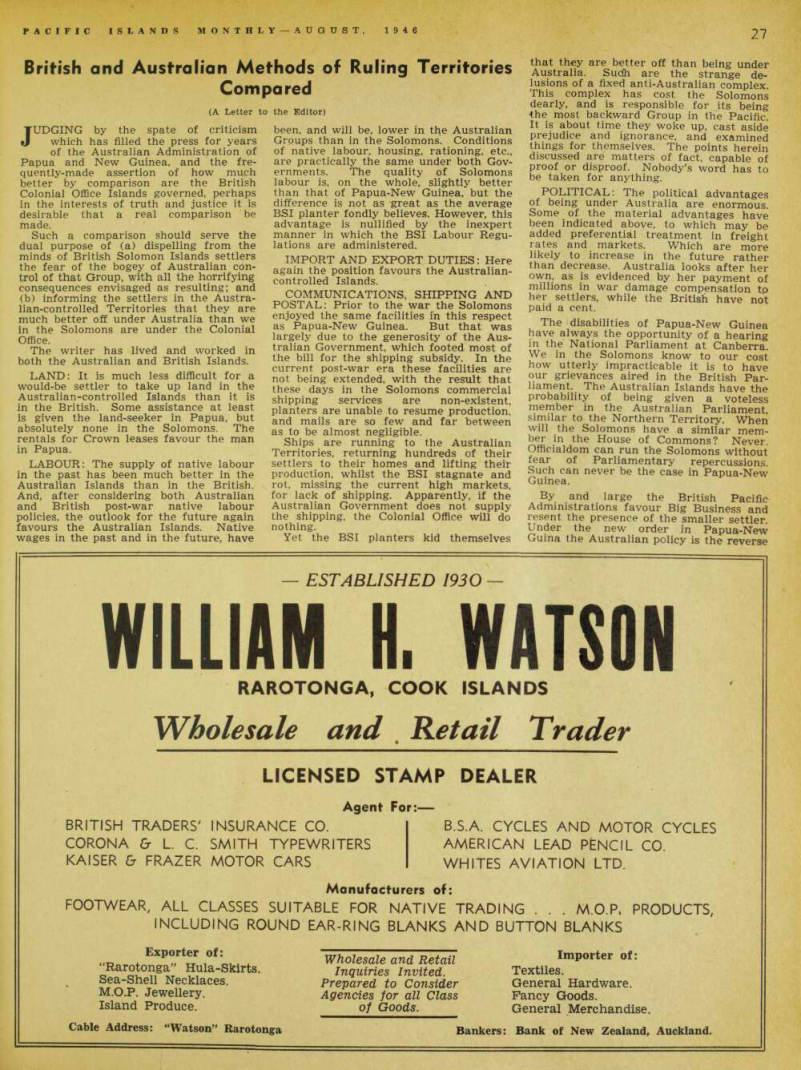

British and Australian Methods of Ruling Territories Compared
(A Letter to the Editor)
JUDGING by the spate of criticism which has filled the press for years of the Australian Administration of Papua and New Guinea, and the fre quently-made assertion of how much better by comparison are the British Colonial Office Islands governed, perhaps in the interests of truth and justice it is desirable that a real comparison be made.
Such a comparison should serve the dual purpose of (a) dispelling from the minds of British Solomon Islands settlers the fear of the bogey of Australian con trol of that Group, with all the horrifying consequences envisaged as resulting; and (b) informing the settlers in the Austra lian-controlled Territories that they are much better off under Australia than we in the Solomons are under the Colonial Office.
The writer has lived and worked in both the Australian and British Islands.
LAND: It is much less difficult for a would-be settler to take up land in the Australian-controlled Islands than it is in the British. Some assistance at least is given the land-seeker in Papua, but absolutely none in the Solomons. The rentals for Crown leases favour the man in Papua.
LABOUR: The supply of native labour in the past has been much better in the Australian Islands than in the British.
And, after considering both Australian and British post-war native labour policies, the outlook for the future again favours the Australian Islands. Native wages in the past and in the future, have
been, and will be, lower in the Australian Groups than in the Solomons. Conditions of native labour, housing, rationing, etc., are practically the same under both Gov ernments. The quality of Solomons labour is, on the whole, slightly better than that of Papua-New Guinea, but the difference is not as great as the average BSI planter fondly believes. However, this advantage is nullified by the inexpert manner in which the BSI Labour Regu lations are administered.
Import And Export Duties: Here
again the position favours the Australian controlled Islands.
Communications, Shipping And
POSTAL: Prior to the war the Solomons enjoyed the same facilities in this respect as Papua-New Guinea. But that was largely due to the generosity of the Aus tralian Government, which footed most of the bill for the shipping subsidy. In the current post-war era these facilities are not being extended, with the result that these days in the Solomons commercial shipping services are non-existent, planters are unable to resume production, and mails are so few and far between as to be almost negligible.
Ships are running to the Australian Territories, returning hundreds of their settlers to their homes and lifting their production, whilst the BSI stagnate and rot, missing the current high markets, for lack of shipping. Apparently, if the Australian Government does not supply the shipping, the Colonial Office will do nothing.
Yet the BSI planters kid themselves
that they are better off than being under Australia. Sudh are the strange de lusions of a fixed anti-Australian complex.
This complex has cost the Solomons dearly, and is responsible for its being the most backward Group in the Pacific.
It is about time they woke up, cast aside prejudice and ignorance, and examined things for themselves. The points herein discussed are matters of fact, capable of proof or disproof. Nobody’s word has to be taken for anything.
POLITICAL: The political advantages of being under Australia are enormous.
Some of the material advantages have been indicated above, to which may be added preferential treatment in freight rates and markets. Which are more likely to increase in the future rather than decrease. Australia looks after her own, as is evidenced by her payment of millions in war damage compensation to her settlers, while the British have not paid a cent.
The disabilities of Papua-New Guinea have always the opportunity of a hearing in the National Parliament at Canberra.
We in the Solomons know to our cost how utterly impracticable it is to have our grievances aired in the British Par liament. The Australian Islands have the probability of being given a voteless member in the Australian Parliament, similar to the Northern Territory. When will the Solomons have a similar mem ber in the House of Commons? Never Officialdom can run the Solomons without fear of Parliamentary repercussions Such can never be the case in Papua-New Guinea.
By and large the British Pacific Administrations favour Big Business and resent the presence of the smaller settler.
Under the new order in Papua-New Guina the Australian policy is the reverse
of this. So what do the BSI settlers hope to gain by continued support of the present set-up? Their loyal support of Colonial Office Administration has only earned them to date the scarcely veiled contempt of the officialdom they have pandered to. What on earth do they expect to get out of it all? I ask this in * *