"Voice Of New Guinea"
p. 14 · Read in the full issue
Australia Announces Radio Coverage of Her Territories
rE General Manager of the ABC (Lt.- Col. C. J. A. Moses) announces plans for six transmitters that, it is hoped, will eventually cover the whole of Papua and the Territory of New Guinea.
These are for one medium-wave and one short-wave transmitter each at Port Moresby, Kokopo (near Rabaul), and Finschhafen.
The first of these stations to come into operation under ABC auspices is 6PA, Port Moresby, which on July 1 reverted from military to ABC control under the supervision of Mr. Basil W. Kirke, form erly the Commission’s manager in NSW, and before that, manager in Western Australis Earlier, Mr. Kirke had experience of colonial administration and agricultural administration in Fiji, the Solomons, Malaya and Papua, and he organised soldier settlement in Northern NSW. His brother, Mr. Clem Kirke, was a well known resident of Wau, but he now has gone to Malaya.
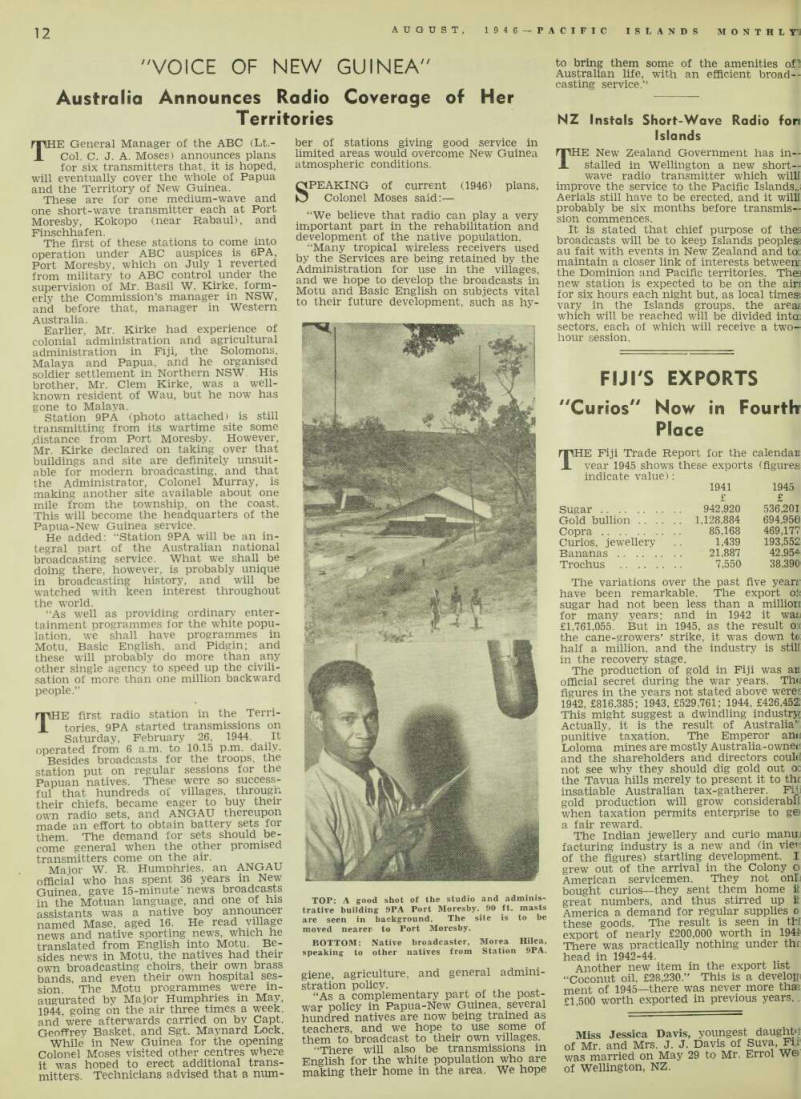
Station 9PA (photo attached) is still transmitting from its wartime site some .distance from Port Moresby. However, Mr. Kirke declared on taking over that buildings and site are definitely unsuit able for modern broadcasting, and that the Administrator, Colonel Murray, is making another site available about one mile from the township, on the coast.
This will become the headquarters of the Papua-New Guinea service.
He added: “Station 9PA will be an in tegral uart of the Australian national broadcasting service. What we shall be doing there, however, is probably unique in broadcasting history, and will be watched with keen interest throughout the world.
“As well as providing ordinary enter tainment urogrammes for the white popu lation, we shall have programmes in Motu, Basic English, and Pidgin; and these will probably do more than any other single agency to speed up the civili sation of more than one million backward people.” rE first radio station in the Terri tories, 9PA started transmissions on Saturday, February 26, 1944. It operated from 6 a.m. to 10.15 p.m. daily.
Besides broadcasts for the troops, the station put on regular sessions for the Papuan natives. These were so success ful that hundreds of villages, through their chiefs, became eager to buy their own radio sets, and ANGAU thereupon made an effort to obtain battery sets for them. The demand for sets should be come general when the other promised transmitters come on the air.
Maior W. R. Humphries, an ANGAU official who has spent 36 years in New Guinea, gave 15-minute news broadcasts in the Motuan language, and one of his assistants was a native boy announcer named Mase. aged 16. He read village news and native sporting news, which he translated from English into Motu. Be sides news in Motu, the natives had their own broadcasting choirs, their own brass bands, and even their own hospital ses sion The Motu programmes were in augurated bv Major Humphries in May, 1944, going on the air three times a week, and were afterwards carried on by Capt.
Geoffrey Basket, and Sgt. Maynard Lock.
While in New Guinea for the opening Colonel Moses visited other centres where it was honed to erect additional trans mitters. Technicians advised that a num
ber of stations giving good service in limited areas would overcome New Guinea atmospheric conditions.
SPEAKING of current (1946) plans, Colonel Moses said:— “We believe that radio can play a very important part in the rehabilitation and development of the native population.
“Many tropical wireless receivers used by the Services are being retained by the Administration for use in the villages, and we hope to develop the broadcasts in Motu and Basic English on subjects vital to their future development, such as hy-
giene, agriculture, and general admini stration policy.
“As a complementary part of the post war policy in Papua-New Guinea, several hundred natives are now being trained as teachers, and we hope to use some of them to broadcast to their own villages.
“There will also be transmissions in English for the white population who are making their home in the area. We hope
to bring them some of the amenities of?
Australian life, with an efficient broad casting service.”
TOP: A good shot of the studio and adminis trative building 9PA Port Moresby. 90 ft. masts are seen in background. The site is to be moved nearer to Port Moresby.
BOTTOM: Native broadcaster, Morea Hilea, speaking to other natives from Station 9PA.