Notable Hero
pp. 12-71 · Read in the full issue
Of Pacific War
How Captain Page, Son of late Harold Page, Met His Death at
Singapore
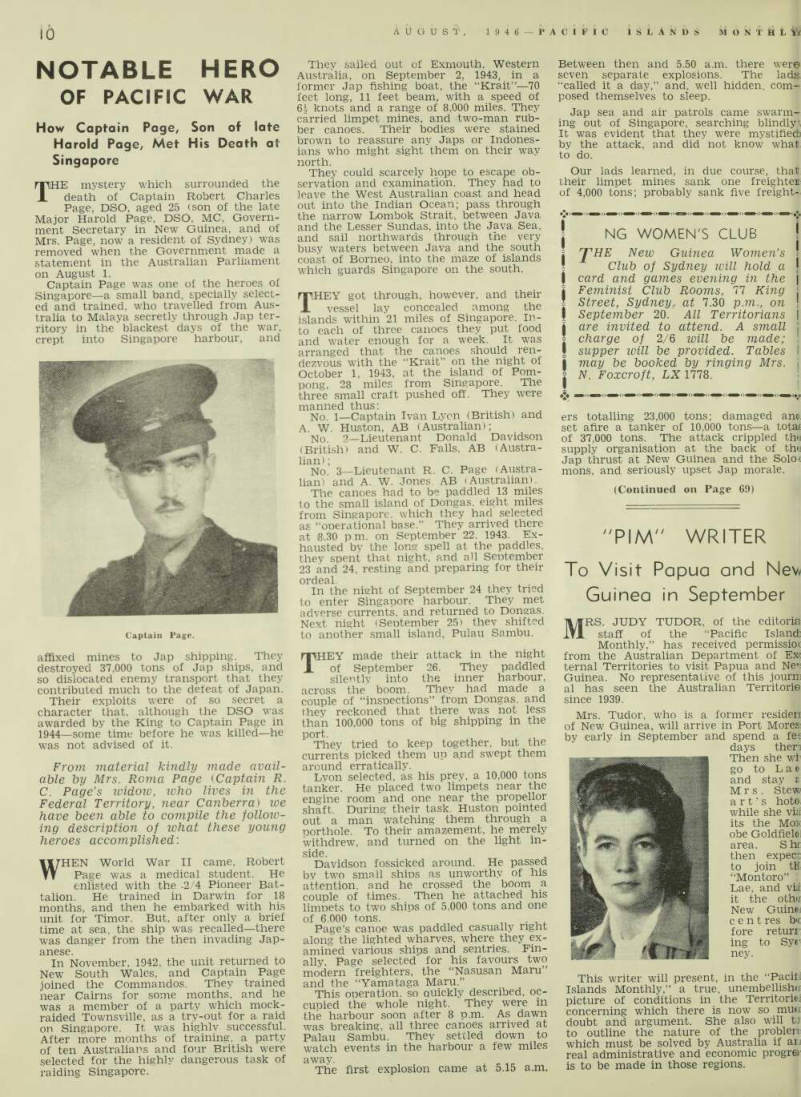
THE mystery which surrounded the death of Captain Robert Charles Page, DSO, aged 25 (son of the late Major Harold Page, DSO. MC, Govern ment Secretary in New Guinea, and of Mrs. Page, now a resident of Sydney) was removed when the Government made a statement in the Australian Parliament on August 1.
Captain Page was one of the heroes of Singapore—a small band, specially select ed and trained, who travelled from Aus tralia to Malaya secretly through Jap ter ritory in the blackest days of the war, crept into Singapore harbour, and
affixed mines to Jap shipping. They destroyed 37,000 tons of Jap ships, and so dislocated enemy transport that they contributed much to the defeat of Japan.
Their exploits were of so secret a character that, although the DSO was awarded by the King to Captain Page in 1944 —some time before he was killed—he was not advised of it.
From material kindly made avail able by Mrs. Roma Page (Captain R.
C. Page’s widow, who lives in the Federal Territory, near Canberra) we have been able to compile the follow
ing description of what these young
heroes accomplished :
WHEN World War II came, Robert Page was a medical student. He enlisted with the -2/4 Pioneer Bat talion. He trained in Darwin for 18 months, and then he embarked with his unit for Timor. But, after only a brief time at sea. the ship was recalled—there was danger from the then invading Jap anese.
In November, 1942, the unit returned to New South Wales, and Captain Page joined the Commandos. They trained near Cairns for some months, and he was a member of a party which mock raided Townsville, as a try-out for a raid on Singapore. It was highly successful.
After more months of training, a party of ten Australians and four British were selected for the highly dangerous task of raiding Singapore.
They sailed out of Exrnouth, Western Australia, on September 2, 1943, in a former Jap fishing boat, the “Krait”—7o feet long, 11 feet beam, with a speed of 6i knots and a range of 8,000 miles. They carried limpet mines, and two-man rub ber canoes. Their bodies were stained brown to reassure any Japs or Indones ians who might sight them on their way north.
They could scarcely hope to escape ob servation and examination. They had to leave the West Australian coast and head out into the Indian Ocean; pass through the narrow Lombok Strait, between Java and the Lesser Sundas, into the Java Sea, and sail northwards through the very busy waters between Java and the south coast of Borneo, into the maze of islands which guards Singapore on the south.
THEY got through, however, and their vessel lay concealed among the islands within 21 miles of Singapore. In to each of three canoes they put food and water enough for a week. It was arranged that the canoes should ren dezvous with the “Krait” on the night of October 1, 1943, at the island of Pom pong, 28 miles from Singapore. The three small craft pushed off. They were manned thus: No. I—Captain Ivan Lyon (British) and A. W. Huston, AB (Australian); No 2—Lieutenant Donald Davidson (British) and W. C. Falls, AB (Austra lian) ; No. 3—Lieutenant R. C. Page (Austra lian) and A. W. Jones. AB (Australian).
The canoes had to be paddled 13 miles to the small island of Dongas, eight miles from Singapore, which they had selected as “onerational base.” They arrived there at 8.30 pm. on September 22. 1943. Ex hausted by the long spell at the paddles, they spent that night, and all Sentember 23 and 24, resting and preparing for their ordeal.
In the night of September 24 they tried to enter Singapore harbour. They met adverse currents, and returned to Dongas.
Next night (Sentember 25) thev shifted to another small island, Pulau Sambu.
THEY made their attack in the night of September 26. They paddled silently into the inner harbour, across the boom. They had made a couple of “insnections” from Dongas, and they reckoned that there was not less than 100,000 tons of big shipping in the P °They tried to keep together, but the currents picked them up and swept them around erratically.
Lyon selected, as his prey, a 10,000 tons tanker. He nlaced two limpets near the engine room and one near the propellor shaft. During their task. Huston pointed out a man watching them through a northole. To their amazement, he merely withdrew, and turned on the light in side. , Davidson fossicked around. He passed bv two small shins as unworthy of his attention, and he crossed the boom a couple of times. Then he attached his limnets to two shins of 5.000 tons and one of 6.000 tons. , . , Page’s canoe was paddled casually right along the lighted wharves, where they ex amined various shins and sentries. Fin ally, Page selected for his favours two modern freighters, the “Nasusan Maru” and the “Yamataga Maru.”
This operation, so auickly described, oc cupied the whole night. They were in the harbour soon after 8 p.m. As dawn was breaking, all three canoes arrived at Palau Sambu. They settled down to watch events in the harbour a few miles away. , . .
The first explosion came at 5.15 a.m.
Between then and 5.50 a.m. there were seven separate explosions. The ladsJ “called it a day,” and, well hidden, com posed themselves to sleep.
Jap sea and air patrols came swarm ing out of Singapore, searching blindly\ It was evident that they were mystified) by the attack, and did not know what, to do.
Our lads learned, in due course, that, their limpet mines sank one freighter of 4,000 tons; probably sank five freights
ers totalling 23,000 tons; damaged anoj set afire a tanker of 10,000 tons—a totae of 37,000 tons. The attack crippled thu supply organisation at the back of tha Jap thrust at New Guinea and the Soloc mons, and seriously upset Jap morale.
(Continued on Page 69)
Captain Page.
The six men slept all that day (27th); and that night they set out to keep their rendezvous with the “Krait.” on October 1, at Pompong, some 26 miles from Palau Sambu. The “Krait,” with eight very anxious men in her, had been cruising off the coast of Borneo.
The canoes at first could not find the “Krait,” and there was confusion and trouble. However, there is this entry in the “Krait’s” log on October 3; “Picked up remainder of personnel and returned down Strait. Well, we are on our way home. Thank God!”
Although the whole Jap navy and air force were seeking something into which they could plant a sting, the old Jap fish ing boat plugged steadily southwards, and reached Exmouth again on October 19.
It had been one of the most successful exploits of the war; but, for obvious reasons, it also was the most secret.
IT was decided to repeat the attack, if possible. Six of the previous party— Lyons, Davidson, Page, Falls and Huston, with Able Seaman F. R. Marsh (who had remained aboard the “Krait” in the first raid) left Western Australia on September 11, 1944, in a British sub marine. They successfully negotiated Lombok Strait and the party landed on the small island of Karapas on Septem ber 23, and made a stores depot. They captured a native junk, disguised them selves as native fishemen, and set out towards Singapore.
This time, fortune was against them.
A Malay natrol, under Jap orders, ap proached them, evidently suspicious. In an attempt to save themselves, they
opened fire on the Malay vessel, and sank it and its crew.
They knew that this would raise a general alarm against them, so they act ed quickly. They destroyed their equip ment, especially their secret weapons, and turned southwards in an effort to escape.
But it was no use—they were overtaken by a swarm of Jap planes and small craft.
They fought, and two were killed, includ ing Lieut.-Colonel Lyon (he was promot ed in 1944). The other four were taken prisoners, and were beheaded by the Japs, with much ceremony, on July 7, 1945, only a month before the Jap surrender.
The Japanese were so impressed with the bravery of Captain Page that, after they had beheaded him, a special order of-the-day was issued extolling his gal lantry and exhorting Japanese troops to emulate his courage.
Tribute to Lote
Major Harold Page
THE following tribute to Captain Page’s father, Major H. H. Page, was paid by Mr. A. Norton, of Victoria, who served under him in New Guinea as a District Officer.
“His ability and his tact were of the highest order. We went to the same war,
on the same ship, among 2,000 men of the 25th and 26th Battalions, AIF. He was an officer, I a corporal, but I remem ber how he came and congratulated me on some feat of athletics. I served un der him in New Guinea for 16 years and I always admired his work and the way he could handle men. He won the DSO and MC in France, He deserved even higher honours for what he did in New Guinea.”
The Director of Education in Fiji, Mr.
A. H. Phillips, is to go on leave in early August, prior to retirement. He has been stationed in Fiji since 1920, when he was transferred from the Seychelles to become headmaster, Queen Victoria School. In 1936 Mr. Phillips was appointed temporary principal at Natabua Training School, and two years later was made Assistant Direc tor of Education. In August, 1944, he was appointed Director.
Recent promotions in the Fiji Govern ment Service have included those of Mr.
H, Edmunds, who has been appointed Assistant Accountant, Post and Telegraphs Department. Mr. R. B. Roberts, who has been appointed Executive Engineer, Public Works Department, and Inspectors J. A.
Moore and H. S. Sell, who have been ap pointed Assistant Superintendents of Police.