Radio And Paper Bombers
pp. 40-41 · Read in the full issue
The Story of FELO, Told by "Kosso"
full story of FELO—the Pacific war’s most mysterious mystery Unit—is now told for the first time.
It is a fascinating story, in itself.
But, as well . it ties off many loose ends which have puzzled those who spent the war years in the South west Pacific, but outside the official circle.
We know now why those New Guinea natives were treated to a ; goodwill visit to Australia in the darkest days of 1943. At the time dismissed as a further piece of Gov ernment foolishness, it is now re vealed in another light.
And the functions of such men as Keogh, O’Dea, Vial and many more— who were known to be doing a job, but “in smoke”—are now made clear.
Much has been heard about the NGVR, ANGAU, the AIB and other South-west Pacific Units—practically nothing about FELO. We are in debted to “Kassa” (who wishes to re main anonymous, but who also served in the Unit) for recording their story, which is a worthy one.
THE Far Eastern Liaison Office (FELO) was set up under the authority of the Commander-in-Chief, AMF, in June, 1942. It was an all-Service unit; and its Director, Commander J. C. R.
Proud, RANVR, made Melbourne his headquarters. It was owing to his ini tiative and imagination that the Unit was formed. Its purpose was to carry out propaganda work among the peoples
of the Japanese-occupied territories and against the Japanese troops themselves.
To reach the people in New Guinea and in the NEI three methods were used —radio, leaflets dropped from aircraft, and native agents. Malaya and Borneo could be reached in the initial stages only by radio and by use of the press in neutral countries.
To carry out propaganda work in New Guinea it was essential to have men who knew, and were at home with, the native people and the country. F/Lieut. Leigh Vial and Lieut. G. A. V. Stanley, RANVR, were the two New Guinea men first selected.
Vial took charge of the distribution of leaflets to the natives—indeed, he often wrote them; and, apart from his nightly task of running round in a truck to the various squadrons with his bundles of leaflets, and briefing the crews after their Intelligence Officers had finished with them, he went on raid after raid himself, being imbued with the deter mination to see that, as far as was humanly possible, the leaflets were dropped in the right spot.
From his own observations he pains takingly worked out scales for the dropping rates and the drifts of leaflets, in a kind of chart of height by weight of leaflet by speed of aircraft by velocity of wind.
All squadrons of the American and Australian Air Forces in Port Moresby were visited and lectures were given. At first some of the crews were a little slow to realise the value of “paper” bombs, when they were carrying high explosive missiles, which they could see burst after they dropped them. But the first few
definite cases of Allied airmen who were rescued by natives because they had re ceived leaflet instructions from the “Government” to do so convinced them utterly.
Because experience taught that crews often had as much as they could do in getting their craft ready for their own jobs, FELO developed the system of Liaison NCOs, who attended the crew briefings. After the briefing they would select from their stock, the leaflets which were most suitable for the job in hand, and would then visit each aircraft tak ing part in the raid, and personally stack the leaflets in the position most handy for the waist-gunner or whoever would be throwing them out.
The signal for “leaflets away” was given by the pilot who had already been briefed by the FELO NGO. On many occasions these FELO men accompanied the crews on the raids, and two of them followed Leigh Vial, and lost their lives whilst on this self-imposed duty.
Lieut. Stanley—or g.a.v., as he is known to most New Guinea people —developed the “native agent” scheme. At the time of the Buna-Gona show he selected natives who had been brought from Rabaul by the Japanese and then rescued by our Forces. With these men, who could tell their fellow countrymen at first-hand what Japanese occupation meant, plus selected Papuan natives, he organised a “Circus” which he brought to Australia.
Here the natives saw with their own eyes what Australia was doing to fight the Japanese. They met a number of New Guinea European men and women,
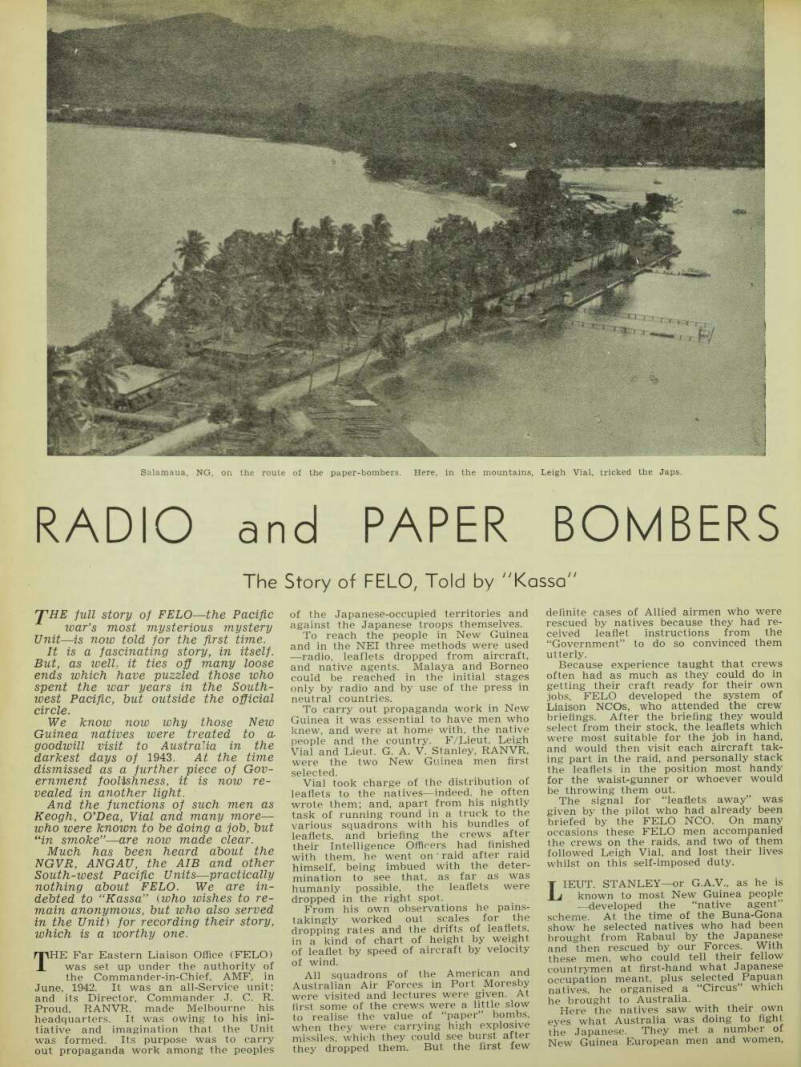
Salamaua, NG, on the route of the paper-bombers. Here, in the mountains, Leigh Vial, tricked the Japs.
working in munition and food factories, and the sight of European women whom they knew, labouring at machines, more than any other factor, brought home to them the determination which lay be hind the brave words which their “Government” in New Guinea had spoken.
Wherever the natives went they had their photographs taken with some weapon or machine as a background in order that when they returned to New Guinea and travelled about —often be hind the enemy lines —and told their fellow countrymen what they had seen, they could produce proof in the form of photographs. “Seeing is believing” is a very true saying, especially in a native country.
Some of these natives made recordings at the ABC studios —recordings which were processed and made into grama phone records. These, together with a portable gramaphone, were given to the natives who made them, and they carried them into the bush on their return. They were used as verbal notes, so that the speakers should not forget the places they had visited and the main things that they had seen.
Some of these trained agents were allotted to Allied Intelligence Bureau and some worked with American Forces; others remained with FELO field parties.
IT was owing to FELO insistence that new New Guinea coins were minted —new in the sense of freshly minted.
A FELO native from Buka went into Cape Gloucester with the pre-invasion American reconnaissance party, and there he met a Luluai whom he had known before the war.
The Luluai asked him if he were still a police-boy, because the Japanese had told the village that the “Government” had gone and that there were no more police-boys. The Luluai had doubted this because he had had leaflets (which he produced, although the penalty for being found in possession of one was decapitation), but he would be glad of news. He then asked the police-boy if he were being paid; and when the agent produced some newly minted New Guinea shillings the Luluai began to cry with joy.
“True,” he said, “the ‘Goverment’ must be in New Guinea if it is paying you in new shillings. The Japanese have told us that our silver money is no good and that we must change it for paper. Now I know that that is a lie and shall tell my people to hide their money.”
FELO commenced the broadcasting sessions for natives. These were given in Pidgin English at first from the AWA station in Moresby and, later on, from the powerful ABC short-wave.
The Brisbane studio was used, and Australian men and women from all parts of New Guinea gave their mes sages of hope and cheer and, in many instances, to natives who knew them personally. There were no divisions such as Government, Company, Mission, and so on; all were “Government”; all were working to one end—the overthrow of Japan.
Once a week, health talks were given by Dr. C. M. Deland, then with ANGAU and, besides doing good in the spreading of information, they helped to bolster up the position of the hundreds of medical orderlies throughout the Territory.
Sometimes broadcasts were directed to areas from which AIB parties had asked for special mention of native person alities or certain conditions. If a Luluai’s name was to be mentioned, it would be sure to be a common one, such as “Anis,” which would not give a clue to any one
particular area. It had this advantage, too; that every Anis (and there are hundreds apparently), who heard his name, took it that he was being men tioned by the Government; and was correspondingly pleased and proud.
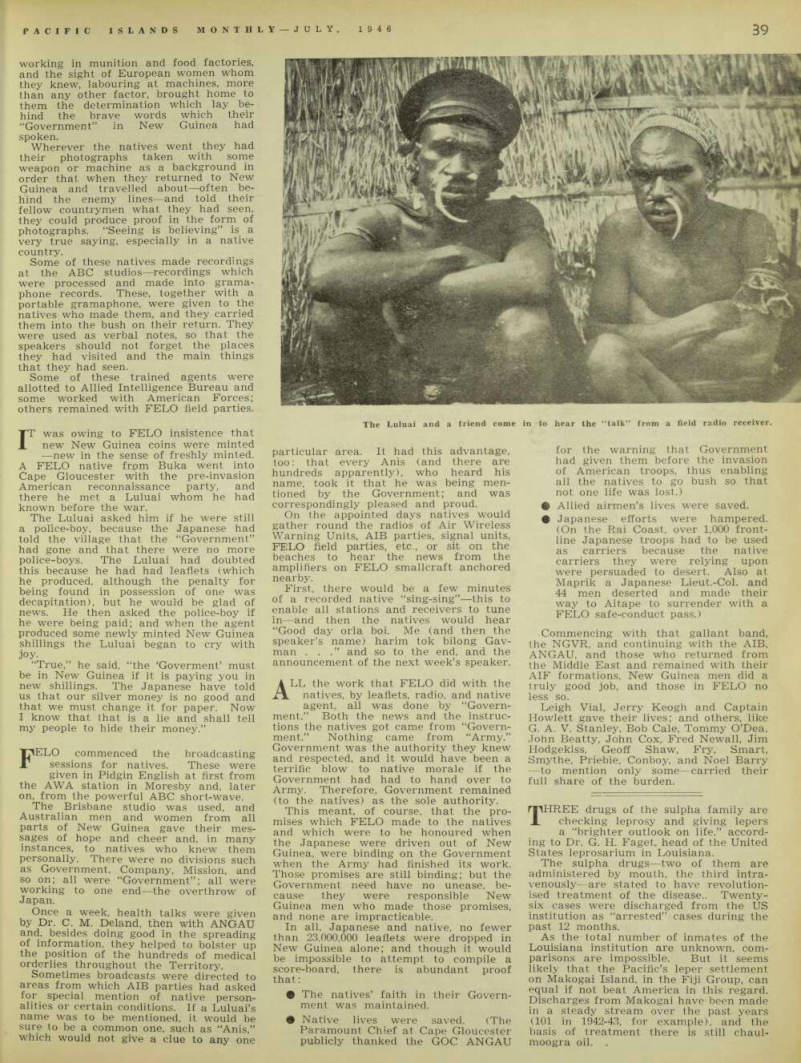
On the appointed days natives would gather round the radios of Air Wireless Warning Units, AIB parties, signal units, FELO field parties, etc., or sit on the beaches to hear the news from the amplifiers on FELO smallcraft anchored nearby.
First, there would be a few minutes of a recorded native “sing-sing”—this to enable all stations and receivers to tune in—and then the natives would hear “Good day orla boi. Me (and then the speaker’s name) harim tok bilong Gav man ...” and so to the end, and the announcement of the next week’s speaker.
ALL the work that FELO did with the natives, by leaflets, radio, and native agent, all was done by “Govern ment.” Both the news and the instruc tions the natives got came from “Govern ment.” Nothing came from “Army,”
Government was the authority they knew and respected, and it would have been a terrific blow to native morale if the Government had had to hand over to Army. Therefore, Government remained (to the natives) as the sole authority.
This meant, of course, that the pro mises which FELO made to the natives and which were to be honoured when the Japanese were driven out of New Guinea, were binding on the Government when the Army had finished its work.
Those promises are still binding; but the Government need have no unease, be cause they were responsible New Guinea men who made those promises, and none are impracticable.
In all, Japanese and native, no fewer than 23,000,000 leaflets were dropped in New Guinea alone; and though it would be impossible to attempt to compile a score-board, there is abundant proof that: 6 The natives’ faith in their Govern ment was maintained.
Native lives were saved. (The Paramount Chief at Cape Gloucester publicly thanked the GOC ANGAU
for the warning that Government had given them before the invasion of American troops, thus enabling all the natives to go bush so that not one life was lost.) Allied airmen’s lives were saved. • Japanese efforts were hampered. (On the Rai Coast, over 1,000 front line Japanese troops had to be used as carriers because the native carriers they were relying upon were persuaded to desert. Also at Maprik a Japanese Lieut.-Col. and 44 men deserted and made their way to Aitape to surrender with a FELO safe-conduct pass.) Commencing with that gallant band, the NGVR, and continuing with the AIB, ANGAU, and those who returned from the Middle East and remained with their AIF formations, New Guinea men did a truly good job, and those in FELO no less so.
Leigh Vial, Jerry Keogh and Captain Rowlett gave their lives; and others, like G. A. V. Stanley, Bob Cale, Tommy O’Dea, John Beatty, John Cox, Fred Newall, Jim Hodgekiss, Geoff Shaw, Fry, Smart, Smythe, Priebie, Conboy, and Noel Barry —to mention only some—carried their full share of the burden.
THREE drugs of the sulpha family are checking leprosy and giving lepers a “brighter outlook on life,” accord ing to Dr. G. H. Faget, head of the United States leprosarium in Louisiana.
The sulpha drugs—two of them are administered by mouth, the third intra venously—are stated to have revolution ised treatment of the disease.. Twenty six cases were discharged from the US institution as “arrested” cases during the past 12 months.
As the total number of inmates of the Louisiana institution are unknown, com parisons are impossible. But it seems likely that the Pacific’s leper settlement on Makogai Island, in the Fiji Group, can equal if not beat America in this regard.
Discharges from Makogai have been made in a steady stream over the past years (101 in 1942-43, for example), and the basis of treatment there is still chaul moogra oil. .
The Luluai and a friend come in to hear the “talk” from a field radio receiver.