Te Rangi Hiroa —Maori Knight
p. 38 · Read in the full issue
By Eric Ramsden
THE bestowal of a knighthood upon Peter Buck —Te Rangi Hiroa—will give as much satisfaction to the peoples of Polynesia as it has done to those of NZ, Maori and Pakeha alike. Sir Peter is as well-known in Papeete as he is in Honolulu; has as many friends in Samoa as he has in Fiji.
The honour is a well-deserved tribute, if a somewhat belated one, to a great Pacific figure, and a fitting culmination to an extraordinary career.
It appears that the reason why the knighthood had not been conferred upon him before this is because the NZ authori ties believed that he had either become a United States citizen, or was about to take that step. However, as Sir Peter himself says: “I was born a Maori and a BHtish subject, and I shall die as such!”
That he should ever have considered the possibility of becoming an American citizen is incomprehensible to his Maori neople. Nevertheless, if he had done so, it would have been understandable to anvone who has any knowledge of the nniaue nosition he has occupied for so long in Hawaii.
In New Zealand a cry has gone up from |he tribes: When is Te Rangi Hiroa com ing back to us? There are manv Maoris who believe that Sir Peter should never have left New Zealand; thev ignore the fact that. from his pinnacle of Maungaloa, in Hawaii, he has been able to survev the whole Polvnesian seene, and so enlighten the world on so much pertaining to the past.
With the exception of Dr. E. P. Ellison, who retired recently after valuable ser vice as a medical officer in the Cook Islands, Sir Peter is the only Maori who has been able to serve other branches of the Polynesian family in a really out standing capacity.
CERTAINLY, Sir Peter is needed also in New Zealand todav. where Maori leadership is at a low ebb. At one time he was one of a select band of Maori parliamentarians that included the late Sir James Carroll and Sir Maui Pomare. and Sir Apirana Ngata: and later for a short period he was a Cabinet Minister.
To-day it is not generally recognised what a struggle Buck and his contempor aries had to obtain their education or to gain a footing in the Pakeha world. Both he and Pomare were Taranaki born; they came from a district that had known the
horrors of war, and all the bitterness that had followed that conflict. The cleavage between the races was no mere passing phase—it existed for many years. Buck had the additional disadvantage of being born of mixed parentage, the son of a noble Maori mother and an Irish father.
Yet both Pomare and Buck became as popular in European circles as they were among the Maoris.
Pomare had to go to the United States to obtain his medical degree. From the humble Maori whare of his grandmother.
Buck passed into the village school of Urenui and, finally, to Te Aute College, the Alma Mater of many outstanding Maori lads of his generation.
However, there came a hiatus in his life during adolescence when the world of science might quite easily have lost his services. It was through the interest and encouragement of an Anglican clergyman that young Peter Buck found his way to Te Aute. Later, at the University of Otago, he carried all before him, and by 1904 he was a fully qualified medical man.
Yet, while he was imbibing European learning—and he amazed his examiners in Greek after what was only a preliminary study—he did not forget the ancient wis dom of his own people. The gaps in his
Maori education were so remedied that when later he stood upon a marae, he was able to reply to the old people in their own ceremonial language, toss simile for simile, swap metaphor for metaphor.
Then, again, though a graduate in medi cine, and employed as a medical officer among the Maori people, his real interest was plaiting and weaving. Strange inter ests for a chief! Such arts have always been regarded by the Maori as feminine.
However, it was his research into those subiects that eventually attracted scien tific attention, won him the offer of field work in the wider sphere of the Pacific for the British Museum. So-day there is no greater living authority in the world upon all Polynesian artifacts than Sir Peter Buck.
AS a man I do not think he has an enemy. Wherever he has gone he has collected a host of friends. Prince of reconteurs, his services as a lecturer have invariably been in demand to enliven the monotony of many a weary voyage across the Pacific.
He never forgot that he was a Maori, that in his veins was the blood of Poly nesian voyagers, men of infinite resource and capacity, seers, poets, warriors all.
It is typical of the man that, when re cently acknowledging the congratulations of New Zealand’s Native Minister, he should have replied: “I deeply appreciate your message on behalf of my Maori neople, for the honour came through my Maori heritage, which provided the key to an intimate understanding of our Poly nesian kinsmen.”
The secret of his popularity is due, per haps, to the fact that he never lost the common touch. The old Maori people held him in as much affection as do his con temporaries. No Maori was too humble for Buck to greet in the traditional “hongi” ceremonial. There are few groups which a New Zealander meets in Poly nesia where a Peter Buck story is not related.
As the time for his retirement from his post as Director of the Bishop Museum is now approaching, we can hope that he has begun to think seriously of his auto biography—he has made some prelimin ary notes for it, but its writing was in terrupted by the outbreak of war.
It will make a fascinating story: one that will interest Pacific readers as well as his own kindred in New Zealand. Those biographical references in his “Vikings of the Sunrise,” his first ‘popular” book, made delightful reading. Not many men with a scientific background can turn out such happy prose.
In Honolulu he has performed a valu able service for the country of his birth by acting as its unofficial ambassador, ably assisted by Lady Buck. Scores of fellow countrymen have called upon him at his office, or sampled the hospitality of the Buck home.
To Sir Peter and Lady Buck now will go the good wishes and congratulations of many friends scattered right round the Pacific Basin.
CRICKET —civilian cricket —is again be ing played on the original cricket oval in Rabaul, New Guinea, al though so many of the men who played there enthusiastically in past years are missing from our ranks.
The first match since the fall of the town in January, 1942, was played on June 13 against an Army team. Those playing for the civilian side were: F.
Boisen, “Snow” Rhodes, E. S. Bourke, C.
Bates, K. Minogue, H. Murray, W.
Conners, R. Fraser, J. E. L. Clark, N. M.
Elliott, and R. Browne.
First innings scores were: Army, 95; Civilians, 61. —J.E.L.C.
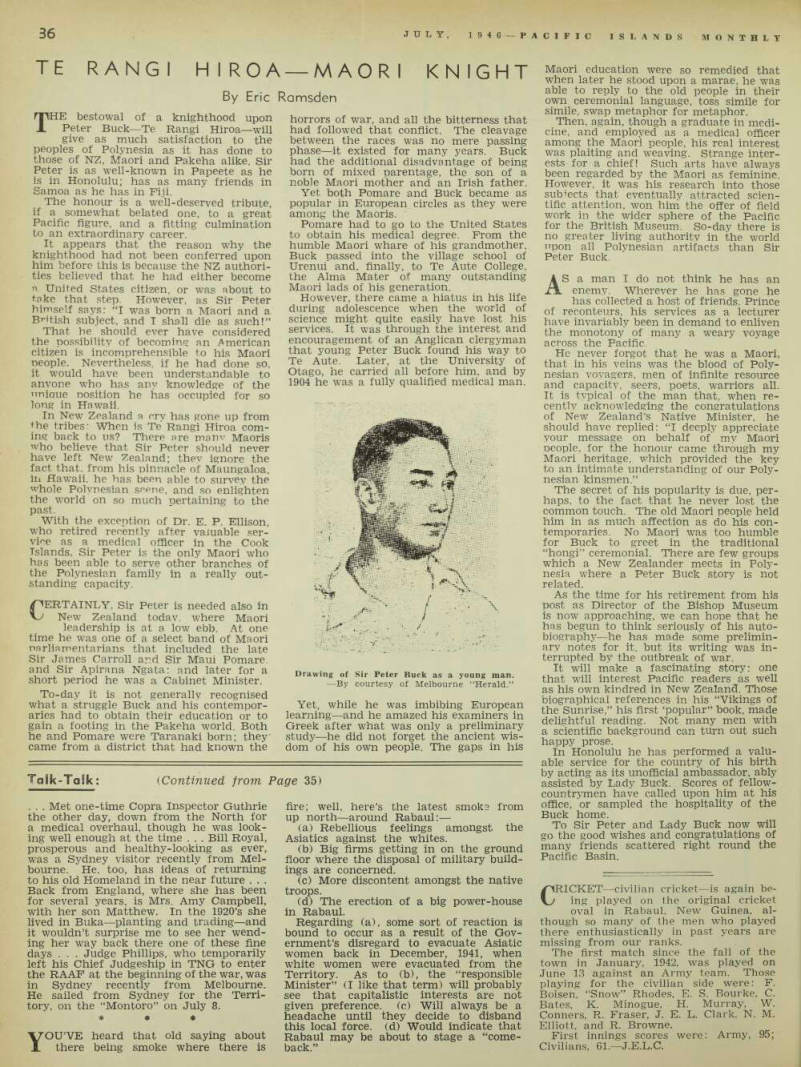
Drawing of Sir Peter Buck as a young man. —By courtesy of Melbourne “Herald.”