Government
p. 12 · Read in the full issue
New Guinea-Papua Now All Civil
Military Rule in Eastern New Britain and New Ireland Ended on June 24
IT was officially announced on June 24 that, with the transfer that day of administrative control of the Rabaul and Kokopo Sub-District of New Britain from the Australian Military Forces to the Provisional Administration of the Territory of Papua-New Guinea, the restoration of civil administration to the whole
of the Territories of Papua and New Guinea was now complete, Military control operated throughout both Territories from February 11, 1942, when civil administration was suspended as a result of the Japanese invasion, The Provisional Administration resumed control of the Territory of Papua and the
portion of the Territory of New Guinea south of the Markham River on October 30, 1945. That control was extended to the remainder of the mainland of New Guinea on February 28, 1946.
The island Districts of Manus and Kieta (Bougainville) were taken over dur ing May, followed earlier in June by the western part of the District of New Britain.
THE Australian Minister for External Territories said the effect of years of war could not be overcome in a few months, but already considerable progress had been made by the Provisional Ad ministration, which was faced at the out set with a situation which included the disruption of the European and native economies, and widespread destruction of towns, villages and plantations.
A comprehensive programme was be ing followed for the rehabilitation and development of the Territories, having re gard to the moral and material welfare of the native inhabitants, and the strategic importance of the area to Australia, The Administration had been authorised to acquire equipment and installations from the Services to assist in the work of reconstruction; and missionaries, plant ers, miners and others were being per mitted to return in increasing numbers.
Formal Ceremonies as Australian
Army Departs From Rabaul
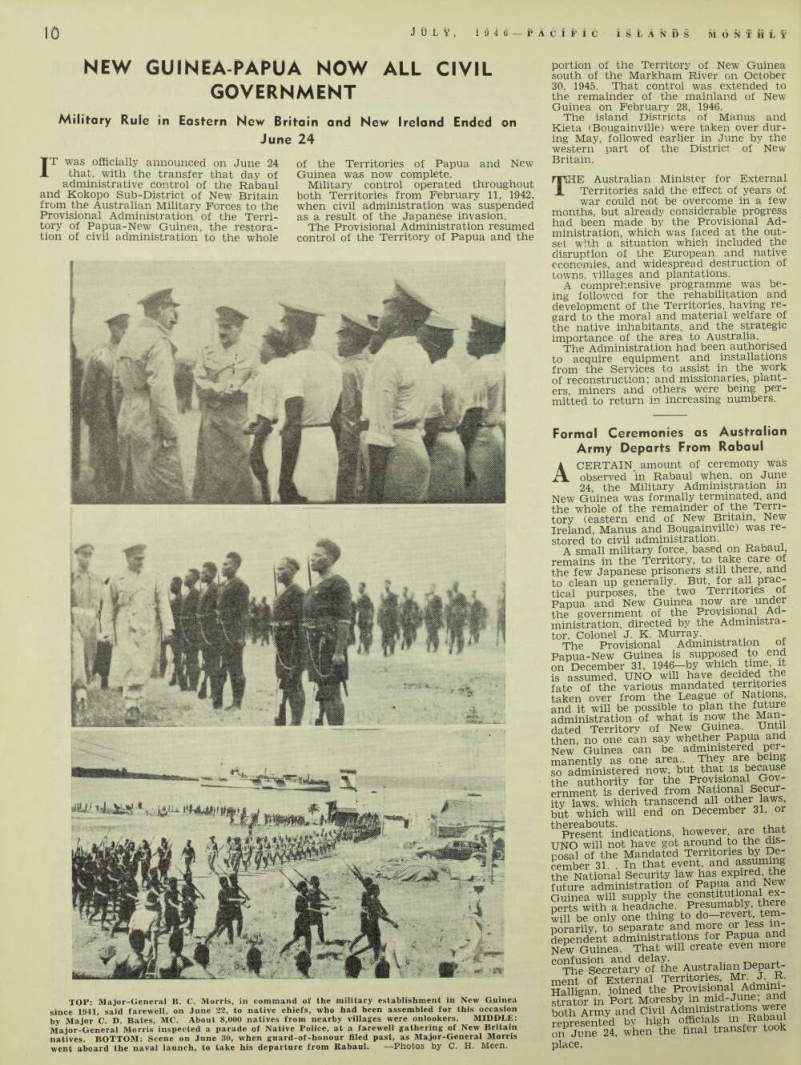
A CERTAIN amount of ceremony was observed in Rabaul when, on June 24, the Military Administration in New Guinea was formally terminated, and the whole of the remainder of the Terri tory (eastern end of New Britain, New Ireland, Manus and Bougainville) was re stored to civil administration.
A small military force, based on Rabaul, remains in the Territory, to take care of the few Japanese prisoners still there, and to clean up generally. But, for all prac tical purposes, the two Territories of Papua and New Guinea now are under the government of the Provisional Ad ministration, directed by the Administra tor, Colonel J. K. Murray.
The Provisional Administration of Papua-New Guinea is supposed to end on December 31, 1946—by which time it is assumed, UNO will have decided the fate of the various mandated territories taken over from the League of Nations, and it will be possible to plan the future administration of what is now the Man dated Territory of New Guinea. Until then, no one can say whether Papua and New Guinea can be administered P. er “ manently as one area.. They are being so administered now, but that is because the authority for the Provisional Gov ernment is derived from National Secur ity laws, which transcend all other laws, but which will end on December 31, or thereabouts. , ,v, O .
Present indications, however are that UNO will not have got around to the dis posal of the Mandated Territories byJ3e cember 31. . In that event and assmnmg the National Security law has expired the future administration of Papua and New Guinea will supply the constitutional ex perts with a headache. Presumably, there will be only one thing to do—revert, tem porarily, to separate and more or less in dependent administrations for Papua and New Guinea. That will create even more confusion and delay.
The Secretary of the Australian Depart ment of External Territories, Mr. J. R.
Halliaan ioined the Provisional Admini strator in Port Moresby in mid-June; and both Army and Civil Administrations were ronresented bv high officials in Rabaul or P June 24. when the final transfer took place.
TOF: Major-General B. C. Morris, in command of the military establishment in New Guinea since 1941, said farewell, on June 22, to native chiefs, who had been assembled for this occasion by Major C. D. Bates, MC. About 8,000 natives from nearby villages were onlookers. MIDDLE: Major-General Morris inspected a parade of Native Police, at a farewell gathering of New Britain natives. BOTTOM: Scene on June 30, when guard-of-honour filed past, as Major-General Morris went aboard the naval launch, to take his departure from Rabaul. — Photos by C. H. Meen.