Carolines:
pp. 40-41 · Read in the full issue
The
Stone-Money and And Now the Yanks!
IN the past 60 years, the Caroline Islands have been governed by three foreign powers first the Germans, then the Japs, and now the Americans.
Before that time, these beautiful islands had been annexed by Spain (in 1686) and later visited by all the scum of the Paci fic adventurous gentlemen who suc ceeded pretty well in debasing the attractive Caroline Islanders and present ing them with ready-made European diseases.
Little is known of the Caroline Islander of to-day, who has survived these various invasions—the Japs kept their Mandated Islands a close preserve for Japs be tween the wars, and issued no reports to the League of Nations after 1935; and the Americans have been too short a time in the Group for very much to have been recorded of the people themselves.
Christian missions were established under the German regime and were per mitted to continue their activities after the Group became (with the Marianas and Marshalls) a Jap Mandate. But after 1935 the whole territory was closed to missionaries, as well as other Euro peans, and mission schools and mission teaching were gradually swallowed up by Japanese Government schools and Japan ese culture.
According to pre-war figures issued by the Japs, 50,000 natives (in the whole Mandate) still owned their own land, but at the same time 68.000 Japanese infested the three groups, and also tilled the land, producing sugar, copra, coffee. In the Carolines, there were 35,436 natives and 25,248 Japs.
WHAT the Americans plan for the Carolines we do not know yet. If the Japanese are permitted to re main, and the native people become Americanised, we may in time see them as a larger and more beautiful Hawaii— a super-duper, South Seas tourist resort for tired Yankees and visitors from Down-Under. It may, on the other hand, be administered purely as a strategic base and on behalf of the natives, after the pattern of Eastern Samoa (American) which has cut no swathe in the world of tourism and probably never will.
But whatever is in store for the Caro lines, the old days and ways of pre- World War I are gone; the customs and culture of the natives almost forgotten or unused.
Charles Reed, now of Western Samoa, once knew the Carolines well; and here he describes them as they were prior to 1917 when he last visited them: IN an archaeological sense, there are no more interesting places in the Pacific than the Caroline Islands except, perhaps, Easter Island. F. W. Christian described the Group as “an enchanted region of archaeology.”
The islands stretch in a vast chain, east to west, across nearly 2,000 miles of ocean, just north of the equator, lying like a barrier between New Guinea and Japan. There are some 550 of them, rang ing from tiny coral islets, to large moun tainous masses, with a volcanic origin.
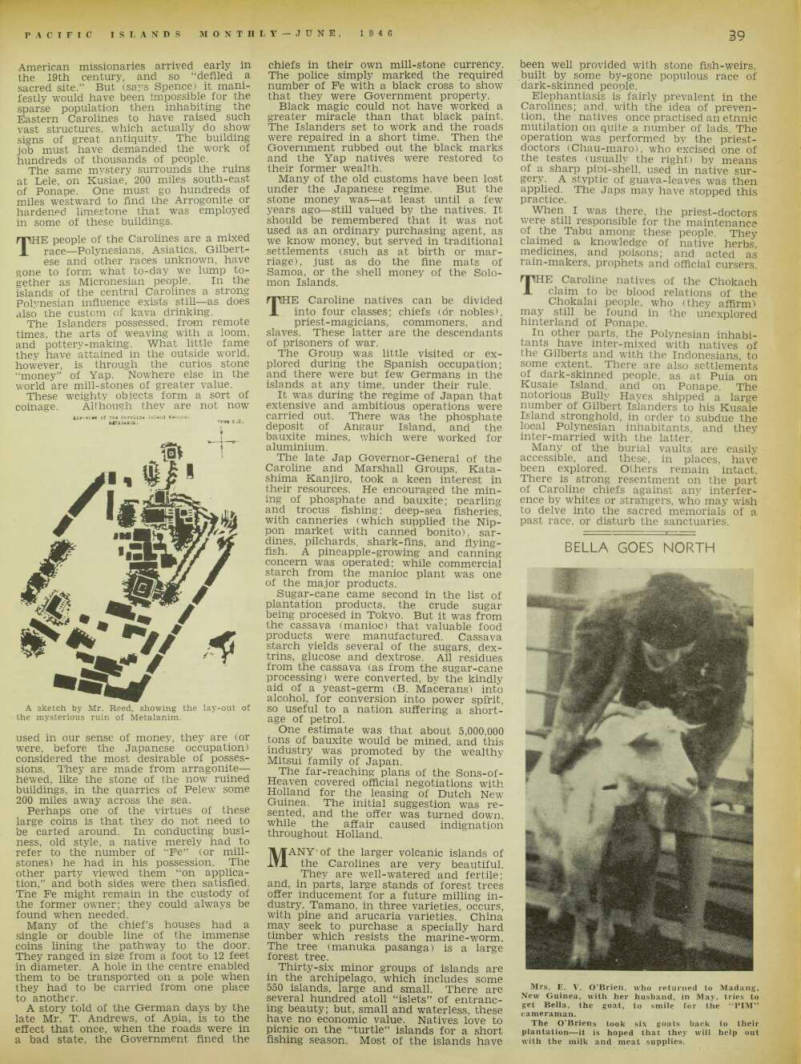
The ruins which, prior to Jap occupa tion, excited the interest of so many Euro pean scientists, lie chiefly in the east of the chain—on the Island of Ponape, and on Kusiae. What Lewis Spence, in his book “The Problem of Lemuria,” calls “the most important and perplexing of these sites” is the deserted city of Meta lanim, the remains of which cover 11 square miles, on the south-east shore of Ponape.
The island of Ponape is littered with large basaltic blocks, which must have been transported over considerable dis tances; and, from similar blocks, have been built the massive walls of Meta lanim Harbour, and the embankments of the winding canals—some of them from 30 to 100 feet wide—which have given to Metalanim the name, “Venice of the Pacific.”
It appears that, to found the city, arti ficial islands were first constructed on the coral reefs; these canals were left between the islands to permit boats to come alongside with the basaltic blocks; and then the buildings were erected on the artificial islands. This plan probably was based on defence considerations.
Metalanim was enclosed on one side by the high land of Ponape; and on the sea side by three extensive breakwaters of basalt,—the whole occupying an almost rectangular area. At the north-west corner a sea-gate gave entrance to ves sels and rafts, and this was guarded by a large breakwater of basaltic blocks.
“fItHE waterfront to the east.” says X Spence, “is faced with a terrace built of massive blocks, about 7 ft. in width, above which frowns the vast
retaining wall of the enclosure of Nan Tanach, ‘the place of Lofty Walls,’ the remains of the great gateway of which are still 30 feet high. Inside, a colossal staircase leads to a courtyard littered with fragments of fallen pillars, which encircle a second terraced enclosure, with a projecting frieze or cornice.
“The dimensions of the outer enclo sure are about 185 ft. by 115 ft. and the walls are about 15 ft. thick. Within the inner enclosure lies, the great central vault, or treasure chamber, of a legendary dynasty, known to local tradition as the ‘Chan-te-leur,’ or ‘Kings of the Sun’
Nan Tanach appears to have been the hub of the island city. It was —as described above—situated in a corner of the breakwater, in the north-east section of the area; but it was the nucleus from which the system of canals radiated.
Examinations: of the ruins presented the archaeologists with some headaches.
How were the building operations carried out? None could answer, with confi dence. One suggested that teams of men had dragged the huge blocks up inclined planes of tree trunks, which were lubri cated with coconut oil.
Excavations of the tombs found on the site revealed ceremonial axes made of shell, and beads made from shell that had been ground down. Basal tic crystals placed on end in a certain way, in the central courtyard of Nan Tanach, suggested that there had been places for the traditional Polynesian kava ceremony.
“Judging from four skulls found on the site, Christian and Kubary believed Meta lanim to have been founded by a negroid race. But conjectures based on so limited a collection of crania cannot be regarded as satisfactory ... It seems the most simple solution of the problem is to ascribe the building of Metalanim to a people of Polynesian stock. But there are features in the building of the city which render this view extremely difficult of acceptance.”
Dr. Hambruch. of Hamburg, after ex amining Metalanim, in 1908-10, before the Japanese invasion, argued that the build ings were not more than 250 years old, and that their erection ended when the
Sketches by Mr. Charles Reed, of Apia, Western Samoa.
American missionaries arrived early in the 19th century, and so “defiled a sacred site.” But (says Spence) it mani festly would have been impossible for the sparse population then inhabiting the Eastern Carolines to have raised such vast structures, which actually do show signs of great antiquity. The building job must have demanded the work of hundreds of thousands of people.
The same mvstery surrounds the ruins at Lele, on Xusiae, 200 miles south-east of Ponape. One must go hundreds of miles westward to find the Arrogonite or hardened limestone that was employed in some of these buildings.
THE people of the Carolines are a mixed race —Polynesians, Asiatics, Gilbert ese and other races unknown, have gone to form what to-day we lump to gether as Micronesian people. In the islands of the central Carolines a strong Polynesian influence exists still—as does also the custom of kava drinking.
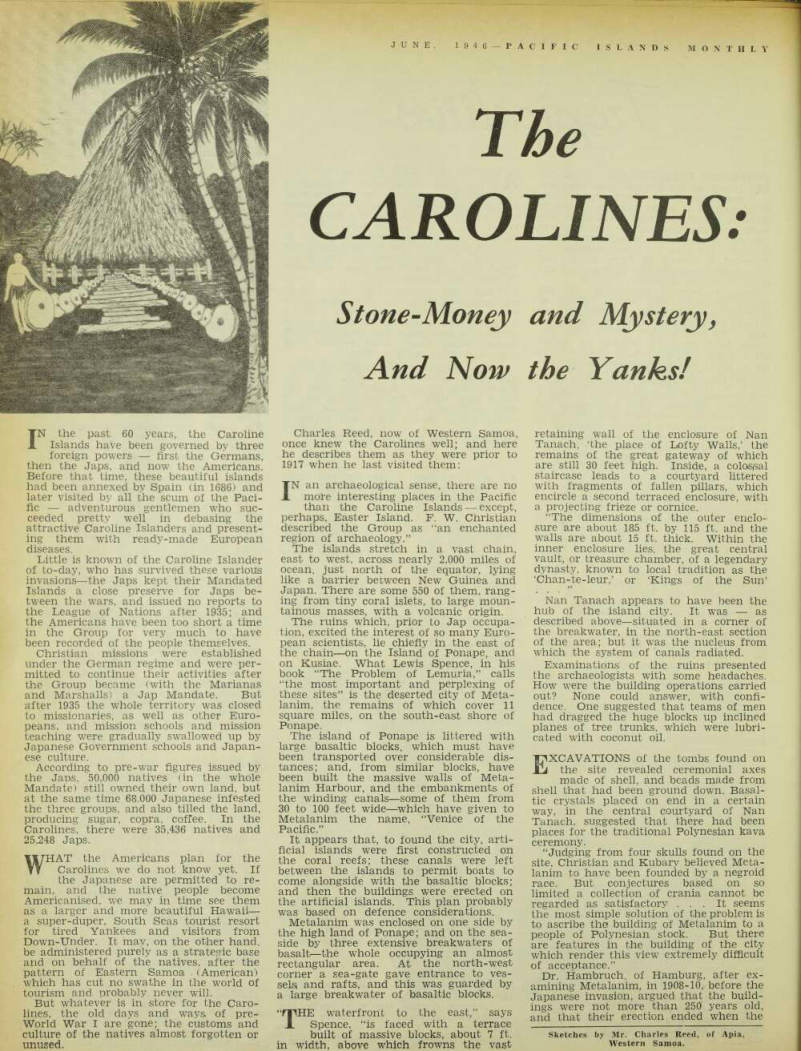
The Islanders possessed, from remote times, the arts of weaving with a loom, and potterv-making. What little fame they have attained in the outside world, however, is through the curios stone “money” of Yap. Nowhere else in the world are mill-stones of greater value.
These weighty obiects form a sort of coinage. Although they are not now
used in our sense of money, they are (or were, before the Japanese occupation) considered the most desirable of posses sions. They are made from arragonite— hewed, like the stone of the now ruined buildings, in the quarries of Pelew some 200 miles away across the sea.
Perhaps one of the virtues of these large coins is that they do not need to be carted around. In conducting busi ness, old style, a native merely had to refer to the number of “Fe” (or mill stones) he had in his possession. The other party viewed them “on applica tion,” and both sides were then satisfied.
The Fe might remain in the custody of the former owner; they could always be found when needed.
Many of the chief’s houses had a single or double line of the immense coins lining the pathway to the door.
They ranged in size from a foot to 12 feet in diameter. A hole in the centre enabled them to be transported on a pole when they had to be carried from one place to another.
A story told of the German days by the late Mr. T. Andrews, of Apia, is to the effect that once, when the roads were in a bad state, the Government fined the
chiefs in their own mill-stone currency.
The police simply marked the required number of Fe with a black cross to show that they were Government property.
Black magic could not have worked a greater miracle than that black paint.
The Islanders set to work and the roads were repaired in a short time. Then the Government rubbed out the black marks and the Yap natives were restored to their former wealth.
Many of the old customs have been lost under the Japanese regime. But the stone money was—at least until a few years ago—still valued by the natives. It should be remembered that it was not used as an ordinary purchasing agent, as we know money, but served in traditional settlements (such as at birth or mar riage), just as do the fine mats of Samoa, or the shell money of the Solo mon Islands. rE Caroline natives can be divided into four classes; chiefs (dr nobles), priest-magicians, commoners, and slaves. These latter are the descendants of prisoners of war.
The Group was little visited or ex plored during the Spanish occupation; and there were but few Germans in the islands at any time, under their rule.
It was during the regime of Japan that extensive and ambitious operations were carried out. There was the phosphate deposit of Angaur Island, and the bauxite mines, which were worked for aluminium.
The late Jap Governor-General of the Caroline and Marshall Groups. Kata shima Kanjiro, took a keen interest in their resources. He encouraged the min ing of phosphate and bauxite; nearling and trocus fishing; deep-sea fisheries, with canneries (which supplied the Nip pon market with canned bonito), sar dines, pilchards, shark-fins, and flying fish. A pineapple-growing and canning concern was operated; while commercial starch from the manioc plant was one of the major products.
Sugar-cane came second in the list of plantation products, the crude sugar being procesed in Tokvo. But it was from the cassava (manioc) that valuable food products were manufactured. Cassava starch yields several of the sugars, dex trins, glucose and dextrose. All residues from the cassava (as from the sugar-cane processing) were converted, bv the kindly aid of a yeast-germ (B. Macerans) into alcohol, for conversion into power spirit, so useful to a nation suffering a short age of petrol.
One estimate was that about 5,000,000 tons of bauxite would be mined, and this industry was promoted by the wealthy Mitsui family of Japan.
The far-reaching plans of the Sons-of- Heaven covered official negotiations with Holland for the leasing of Dutch New Guinea. The initial suggestion was re sented, and the offer was turned down, while the affair caused indignation throughout Holland.
MANY- of the larger volcanic islands of the Carolines are very beautiful.
They are well-watered and fertile; and, in parts, large stands of forest trees offer inducement for a future milling in dustry. Tamano, in three varieties, occurs, with pine and arucaria varieties. China may seek to purchase a specially hard timber which resists the marine-worm.
The tree (manuka pasanga) is a large forest tree.
Thirty-six minor groups of islands are in the archipelago, which includes some 550 islands, large and small. There are several hundred atoll “islets” of entranc ing beauty; but, small and waterless, these have no economic value. Natives love to picnic on the “turtle” islands for a short fishing season. Most of the islands have
been well provided with stone fish-weirs, built by some by-gone populous race of dark-skinned people.
Elephantiasis is fairly prevalent in the Carolines; and, with the idea of preven tion, the natives once practised an etnnic mutilation on quite a number of lads. The operation was performed bv the priest doctors (Chau-maro). who excised one of the testes (usually the right) by means of a sharp pini-shell, used in native sur gery. A styptic of guava-leaves was then applied. The Japs mav have stopped this practice.
When I was there, the priest-doctors were still responsible for the maintenance of the Tabu among these people. They claimed a knowledge of native herbs, medicines, and poisons; and acted as ram-makers, prophets and official cursers.
THE Caroline natives of the Chokach claim to be blood relations of the Chokalai people, who (they affirm) may still be found in the unexplored hinterland of Ponape.
In other parts, the Polynesian inhabi tants have inter-mixed with natives of the Gilberts and with the Indonesians, to some extent. There are also settlements of dark-skinned people, as at Puia on Kusaie Island, and on Ponape. The notorious Bully Haves shipped a large number of Gilbert Islanders to his Kusaie Island stronghold, in order to subdue the local Polynesian inhabitants, and they inter-married with the latter.
Many of the burial vaults are easily accessible, and these, in places, have been explored. Others remain intact.
There is strong resentment on the part of Caroline chiefs against any interfer ence by whites or strangers, who may wish to delve into the sacred memorials of a past race, or disturb the sanctuaries.
A sketch by Mr. Reed, showing the lay-out of the mysterious ruin of Metalanim.