Action!
p. 37 · Read in the full issue
Pacific
Oddments of the Past
TREADING through old newspaper files is a hobby of Mr. J. D.
Davison, of Norfolk Island, who re
cently spent some months in Sydney.
Through his research in the Mitchell Library, Sydney , he has been able to unearth many forgotten bits and
pieces of Pacific history, some of
which we print here.
IF we are to believe the London “Weekly Despatch” of November 22, 1835, a marked shilling had a pro found effect on early events in the Pacific.
Young James Cook was a native of Yorkshire and as a lad was apprenticed to a merchant of that county. Money had been missed from the till and to detect the culprit a marked shilling was placed there, and later, missed.
James was taxed with having taken it. He admitted as much, saying that because it had had a peculiar appear ance, he had wished to keep it, and had put another shilling-piece in its place.
One can imagine with what dark looks of suspicion his master counted the money, the while young Cook stood by and glowered his displeasure. The money was found to be correct, and the whole incident was brushed aside. But Cook did not forget.
He was annoyed at being suspected, bided his time, and, when opportunity presented itself, ran away to sea, and became a cabin-boy on a collier.
He spent years in the North Sea trade, then joined the Navy, and, after 12 years —most of them spent surveying the St.
Lawrence River and the coast of New foundland —he was sent to the Pacific with a Royal Society expedition to observe the transit of the planet Venus.
Upon such small incidents hangs his tory. Had it not been for that hurt to his boyish pride, Cook might have become a merchant and the progress of modern navigation and Pacific discovery retarded for many years. ♦ ♦ ♦ IN a recent Sydney daily, it was stated that an officer on a visiting British warship was a direct descendant of Cook. This was later denied. In the “Sun” of September 20, 1911, a similar case was reported, and this also proved untrue.
Frank Wild, a member of an Aus tralian expedition to Antarctica, was stated to be descended from the great navigator. A few days later, however, a correspondent pointed out that, although Captain Cook had six children, only one reached maturity—James Cook ll—but that there is no record of his marriage or parenthood. This Cook, too, followed the sea, but was drowned while on his way to join HMS Sloop, “Spitfire,” to which he had been appointed Com mander.
IT is interesting to trace, from old news paper clippings, the history of Cook’s famous ship “Endeavour.” On March 23, 1768, the Admiralty at Deptford, Eng land, reported that two “Cats” (appar ently an old term for a certain type of craft) called “Valentine” and “Earl of Pembroke” were coming in for survey, and that it was proposed to purchase one of these to be refitted for Cook’s first Pacific venture.
Five days later it was reported from the same source that “Earl of Pembroke” had been selected.
She was “sheathed, filled and fitted” for her voyage to the great, mysterious south; and she was rechristened “En deavour Bark.”
Cook cruised the South Seas in her for three years and, when he returned to England in 1771, the “Endeavour” was sent to the Falklands as a Navy store ship. In 1775 she was sold and returned to the collier trade, and in 1789 was pur chased by the French and named again, this time, “La Liberte.” Fitted out as a whaler, she was chased into the American port of Newport by a British frigate and, in attempting to leave, she was disabled.
Sne was subsequently condemned, dis mantled and her hulk sold. In 1813 even the hulk was lost—broken up in a gale.
A piece of her timber, it is recorded, was salvaged and presented to that fire eater, James Fenimore Cooper, by an admirer. Cooper was one of the fore most writers of his time, but, although he wrote many novels, only “Last of the Mohicans” is remembered well to-day.
Born a “gentleman,” Cooper took up writing on a challenge, and by it suc ceeded in raising the ire, not only of his countrymen, but also of the English. He spent much time in France, and his years in America were mostly employed in sueing various newspapers for libel. ♦ » * AN old copy of the Sydney “Daily Telegraph” tells how, in the early days, two Maoris were sent to Nor folk Island.
It appears that when HMS “Doedalus was off the New Zealand coast, Sydney bound, she was approached by a number of Maori canoes, two of the occupants of
which were induced to go aboard. In spite of the protests of the two Maoris, “Doedalus” then set sail for Sydney.
Gross was then Governor of New South Wales, and believing that the natives would be able to instruct the convicts of Norfolk how to cultivate the flax that grew naturally there, and make of it an article of commerce, he sent the two across to the island. Norfolk’s Governor, King (after whom the island’s largest township. Kingston, is now named), treated the Maoris well, but away from their native land they were lonely, dis satisfied and of no use as flax producers, or anything else. At last, they were placed on board the ship “Brittania” and returned to New Zealand. • ♦ • FEW people remember —unless they have read the inscription on the concrete block that now marks the Sl te —that the first Government House in Australia was at the corner of Bridge and Phillip Streets, Sydney. The old house was pulled down and the site boarded up for 27 years, and the fact that it was Government property passed from even official minds. It was remem bered in Governor McGowen’s time, and the present concrete block was placed there.
Perhaps “Bounty” Bligh was the last Governor to live in the old house?
FROM an evacuee resident of Mel bourne.—To-day’s thought: Do you think I would have any hope of Mr.
Ward granting me, say, £5O, of the £llB,OOO they are going to use for build ing a model village, so that I could build myself an “igloo” on the banks of the Yarra somewhere, and so save the re maining threads of my sanity in having a permanent place to lay my head for the few remaining months of my “sentence” in this frozen hole? No! Well—even if I have red hair I still think I could use iodine and stain my skin to a good imi tation of a Milne Bay type. After that, I ought to be “set.”
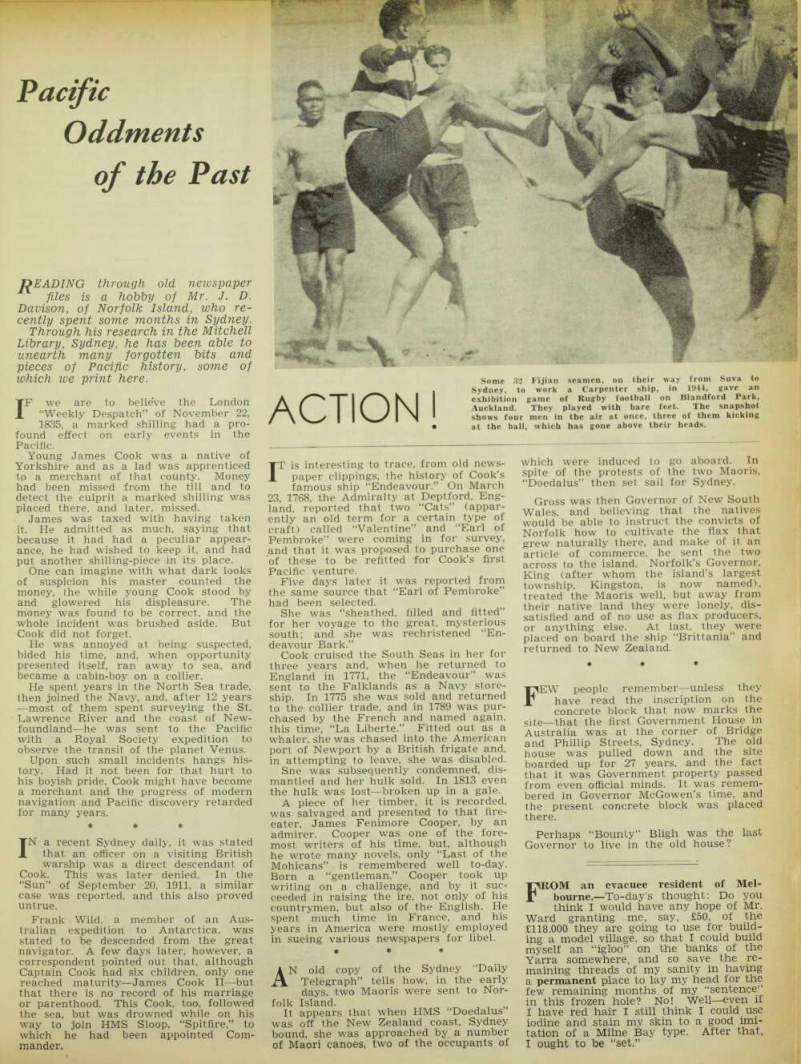
Action!
Some 32 Fijian seamen, on their way from Suva to Sydney, to work a Carpenter ship, in 1944, gave an exhibition game of Rugby football on Blandford Park, Auckland. They played with bare feet. The snapshot shows four men in the air at once, three of them kicking at the ball, which has gone above their heads.