Magazine Section
p. 35 · Read in the full issue
Territories Talk-Talk
By "Tolala"
rUS writes a recent returnee to Port Moresby: “My first and remaining impression of Moresby was the ap palling damage and condition of the town. Vandalism by the Services—one in particular—is the prime factor and cause of the town’s desolate appearance ... I never imagined that our country men would write such a black page in its history.”
A sorry tale, no doubt, but we white people are inclined to be the most tolerant in the world, and will dismiss the rane of Moresby with a shrug of the shoulders. The native population, how ever, will not have such short memories, or such great tolerance for the perpetra tors of this vandalism . . . And now, we’re trying to square off! * * * TALKING of Moresby: Another corres pondent touches on the present food situation there. No fruit or green vegetables available; fresh meat at a premium; and natives charging 15 - to 20/- each for fowls. Did anyone men tion the word “exploitation?”
H 5 *l» AN efficient Administrative Service must consist of satisfied personnel; and men and women existing on
short commons in the tropics do not make for that needful satisfied state of mind which breeds efficiency—unless, of course, the curriculum of ASPA (which, as you know is the Australian School of Pacific Administration) includes inocula tion against such human frailties. * * * THE recent pilgrimage of Finschhaven, made by the RSL officials from Aus tralia, at the request of the Ameri can Legion, to commemorate Decoration Day, gives some idea of what may hap pen in the years to come if some 10,000 US graves remain in NG. Pilgrimages by sorrowing relatives from across the Paci fic may be expected to become a regular institution when travel restrictions are lifted. Nor will visitations be made only to the graves, but also to the scenes of battles which have become so widely known: Buna, Gona, Milne Bay, to men tion a few.
Properly organised, the tourist trade of New Guinea could be made a wonderful money-spinner. It’s worthy of considera tion and organisation. * * * THE Territories have been top-ranking controversial topics over the air of late, and such subjects as native policy, indenture system and strategical value of the Territories have been well to the fore over the ABC net-work.
Colonel Kerr, principal of a school of instruction for budding Territorial
officials, and pioneer Metho dist missionary John Burton were lined up against Editor Robson and one-time Papuan RM, Alex Rentoul, in Forum on the Air programme one evening, when new theories were pitted against old prac tices. Another session was edited by journalist Norman Bartlett, when two old Terri torians—Gordon Thomas and Ward Oakley expressed opinions on developmental policies and strategical values.
Future sessions of this team (with Anthropologist Camilla Wedgewood added) are billed for June 17 and 24. * ♦ * HEARD over the teacups and/or mugs of beer; Matron Mosey, one-time of Namanula “House Sick,” meeting old-time Islands friends in Sydney before de parting for Ceylon on the “Highland Princess.” She was a POW in Hong Kong, and hopes to be back here next October . . . Perc. Hufton has sailed for PM, where he joins the PWD. Mrs. Perc is already up there . . . Re cently arrived from England is Mrs. Eve Walker, well known in Brisbane’s Terri torial circles during the war when she was in the WRENS.
She is making a “flying” visit as press officer for the BOAC . ' . Pacific Territories Association holds its annual general meeting—the fourth, by the way on June 18.
Place; Federal Hall, Phillip Street, Sydney. Time: 8 p.m. ’Tis the last meeting to be
held in Australia, which seems to indicate an exodus of Islanders to their old homes . . . Another annual meeting in the offing is that of the NG Women’s Club set down for July 12, at 7.30 p.m., at the Feminist Club. Election of office-bearers will be the main item of interest; most of the old officers are retiring after having done a very fine job of work. ♦ ♦ ♦ SEEN at the Best Places recently were Willy Dupain and his charming wife both old Islands identities who have successfully defied Old Father Time.
Willy was BP’s first manager at Rabaul during World War I, when the Dupain home there was well known for its hos pitality. * * * ARMY veterinary officers from NG re port alarming threats to Island live stock, and mention an “unidentified pig disease’’ working havoc amongst native herds,.
Another pest which they do not men tion, but which the Nips brought with them from NEI, was the monkey, long a prohibited import into NG (dating from the old German days), because of the damage they do to the coconut palms They will need watching! ♦ ♦ ♦ BIG Business in the transport line seems to be giving the Territories the go-by. At any rate, firms ap pear to be apathetic about developmental work where previously they collected good money.
Chairman Powell, of Guinea Airways, seemed a bit pessimistic at the recent Adelaide annual meeting. Operations in NG would depend on whether the road from coast to goldfields functioned, over which freights were being transported now. Army contracts finished up in April last, and now Guinea Airways was dependent on its airline operations, so he said. Although traffic had increased, suc cess of operations depended on a Govern ment subsidy for carrying mails, and this had not as yet been tee’d-up. * * * SO much for Big Business in aerial transport. A somewhat similar view was expressed by chairman James Burns at the annual BP meeting, when he stressed the high costs of building new ships to replace the six motor ships which had been lost. The Co., said James Burns, might be forced to con centrate its business in Australia. This seems to indicate the Co. doesn’t mind whether Territorians will be able to play draughts on the old chequer-board funnels or not.
IN Ripley’s “Believe it — or not” serial, in a recent issue of Sydney “Sunday Sun,” there is a drawing of a black man, wearing one of the famous “Upa” hats, sometimes seen on the heads of northern Bougainville youths who are being prepared for initiation rites. Mr.
Ripley, however, calls it “the death hat,” and says of it:— “The young men of Bougainville are obliged to wear these basket-shaped hats until marriage. Any girl who looks at their hat is put to death,”
As Mr. Ripley says, himself; Believe it —or not!
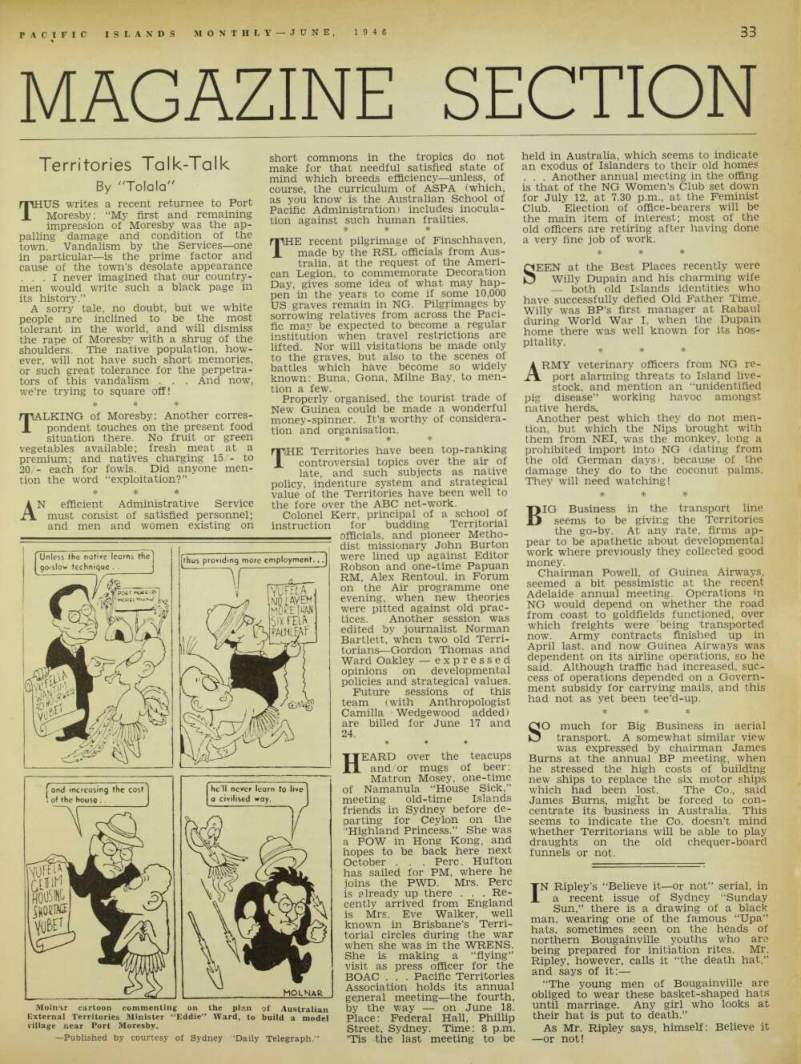
Molnar cartoon commenting on the plan of Australian External Territories Minister “Eddie” Ward, to build a model village near Port Moresby.
Published by courtesy of Sydney ‘Daily Telegraph.”