Divide The “Pandemonium”!
pp. 23-25 · Read in the full issue
Frank Discussion of New Hebrides by Experienced Australian Administrator
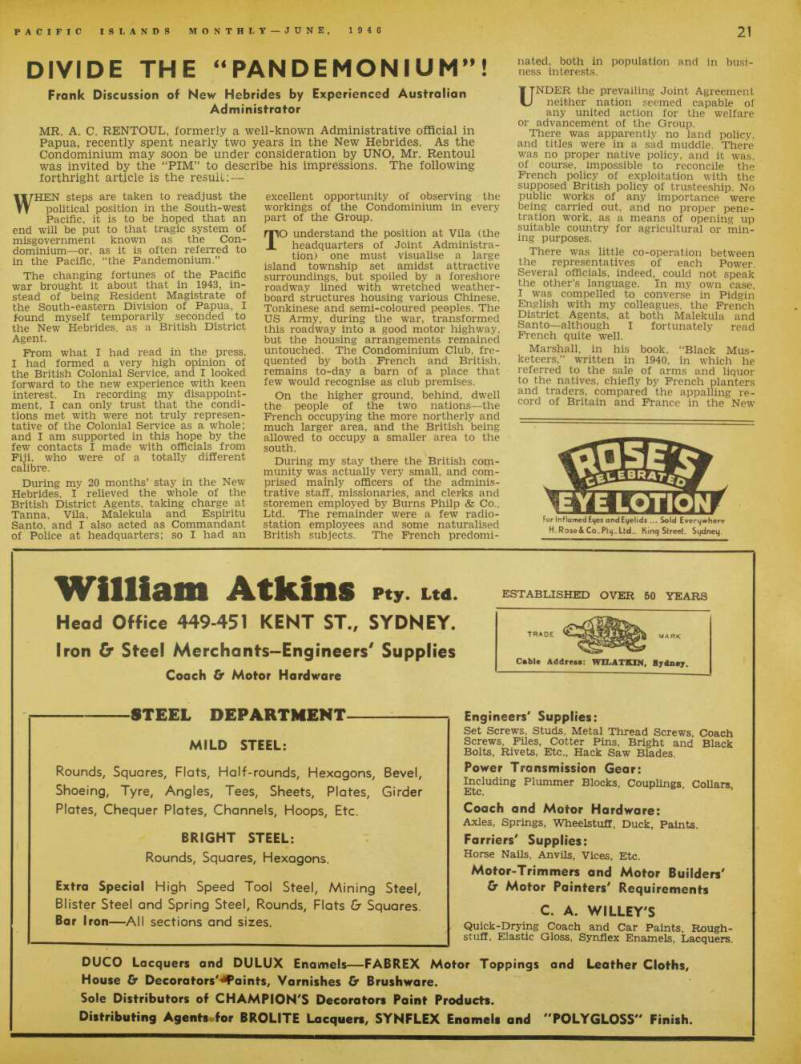
MR. A. C. RENTOUL, formerly a well-known Administrative official in Papua, recently spent nearly' two years in the New Hebrides, As the Condominium may soon be under consideration by UNO, Mr. Rentoul was invited by the “PIM” to describe his impressions. The following forthright article is the result:—
WHEN steps are taken to readjust the political position in the South-west Pacific, it is to be hoped that an end will be put to that tragic system of misgovernment known as the Con dominium—or, as it is often referred to in the Pacific, “the Pandemonium.”
The changing fortunes of the Pacific war brought it about that in 1943, in stead of being Resident Magistrate of the South-eastern Division of Papua, I found myself temporarily seconded to the New Hebrides, as a British District Agent.
Prom what I had read in the press, I had formed a very high opinion of the British Colonial Service, and I looked forward to the new experience with keen interest. In recording my disappoint ment, I can only trust that the condi tions met with were not truly represen tative of the Colonial Service as a whole; and I am supported in this hope by the few contacts I made with officials from Fiji, who were of a totally different calibre.
During my 20 months’ stay in the New Hebrides, I relieved the whole of the British District Agents, taking charge at Tanna, Vila, Malekula and Espiritu Santo, and I also acted as Commandant of Police at headquarters; so I had an
excellent opportunity of observing the workings of the Condominium in every part of the Group.
TO understand the position at Vila (the headquarters of Joint Administra tion) one must visualise a large island township set amidst attractive surroundings, but spoiled by a foreshore roadway lined with wretched weather board structures housing various Chinese, Tonkinese and semi-coloured peoples. The US Army, during the war, transformed this roadway into a good motor highway, but the housing arrangements remained untouched. The Condominium Club, fre quented by both French and British, remains to-day a barn of a place that few would recognise as club premises.
On the higher ground, behind, dwell the people of the two nations —the French occupying the more northerly and much larger area, and the British being allowed to occupy a smaller area to the south.
During my stay there the British com munity was actually very small, and com prised mainly officers of the adminis trative staff, missionaries, and clerks and storemen employed by Burns Philp & Co..
Ltd. The remainder were a few radio station employees and some naturalised British subjects. The French predomi
nated, both in population and in busi ness interests.
UNDER the prevailing Joint Agreement neither nation seemed capable of any united action for the welfare or advancement of the Group.
There was apparently no land policy, and titles were in a sad muddle. There was no proper native policy, and it was. of course, impossible to reconcile the French policy of exploitation with the supposed British policy of trusteeship. No public works of any importance were being carried out, and no proper pene tration work, as a means of opening up suitable country for agricultural or min ing purposes.
There was little co-operation between the representatives of each Power.
Several officials, indeed, could not speak the other’s language. In my own case, I was compelled to converse in Pidgin English with my colleagues, the French District Agents, at both Malekula and
Santo—although I fortunately read
French quite well.
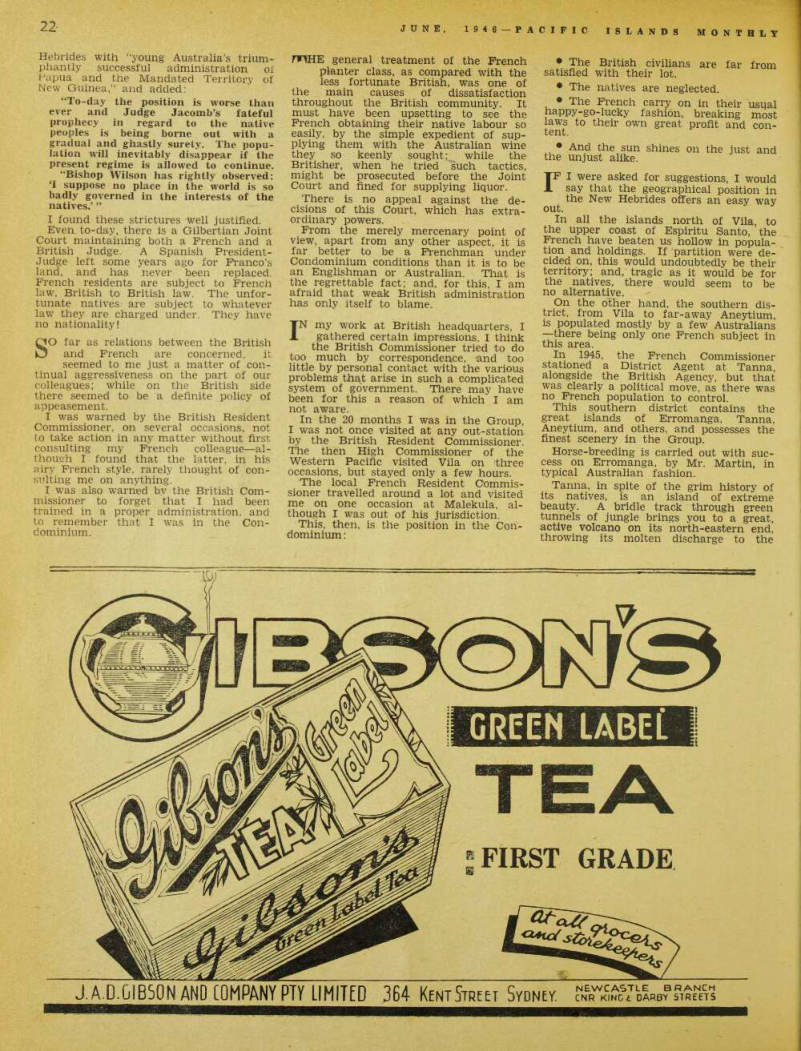
Marshall, in his book, “Black Mus keteers,” written in 1940, in which he referred to the sale of arms and liquor to the natives, chiefly by French planters and traders, compared the appalling re cord of Britain and France in the New
SSf Australia’s trium-
nn . °f
x and tnc Mandated Territory of New Guinea,” and added: “To-day the position is worse than ever and Judge Jacomb’s fateful prophecy in regard to the native peoples is being borne out with a gradual and ghastly surety. The population will inevitably disappear if the present regime is allowed to continue.
"Bishop Wilson has rightly observed: ‘I suppose no place in the world is so badly governed in the interests of the natives.
I found these strictures well justified.
Even, to-day, there is a Gilbertian Joint Court maintaining both a French and a British Judge. A Spanish President- Judge left some years ago for Franco's land, and has never been replaced.
French residents are subject to French law, British to British law. The unfortunate natives are subject to whatever law they are charged under. They have no nationality!
SO far as relations between the Rritish lar , gelations between the British and Fiench are concerned. it seemed to me just a matter of contmual aggressiveness on the part of our colleagues: while on the British side there seemed to be a definite policy of appeasement.
I was warned by the British Resident Commissioner, on several occasions, not to take action in any matter without first c° nsu ltirig my French colleague—althoueJi I found that the latter, in his airy French style, rarely thought of consuiting me on anything I was also warned by the British Commissionei to forget that I had been trained in a proper administration, and lomTnTum er 1 in the Con comimum.
mHE general treatment of the French planter class, as compared with the less fortunate British nnp nf the main causes B of lSh diSatisfaction throughout the British community. It must have been upsetting to see the French obtaining their native labour so easily, by the simple expedient of supplying them with the Australian wine they so keenly sought; while the Britisher, when he tried such tactics, might be prosecuted before the Joint Court and fined for supplying liquor.
There is no appeal against the decisions of this Court, which has extraordinary powers.
From the merely mercenary point of view, apart from any other aspect, it is far better to be a Frenchman under Condominium conditions than it is to be an Englishman or Australian. That is the regrettable fact; and, for this, I am afraid that weak British administration has only itself to blame.
TN my work at British headquarters, I * Sphered certain impressions. I think the British Commissioner tried to do too much by correspondence, and too nttle by personal contact with the various problems that arise in such a complicated system of government. There may have been for this a reason of which I am not aware. i n the 20 months I was in the Group i was not once visited at any out-station by the British Resident Commissioner.
The then High Commissioner of the Western Pacific visited Vila on three occasions, but stayed only a few hours.
The local French Resident Commissioner travelled around a lot and visited me on one occasion at Malekula, although I was out of his Jurisdiction, „ then, is the position in the Condominium:
• The British civilians are far from satisfied with their lot. ** The natives are neglected. • Tile French carry on in their usual happy-go-lucky fashion, breaking most laws to their o wn great profit and con tent. • And the sun shines on the in«t onH the unjust alike 3 and TF I were asked for suggestions I would 1 say that the geographical position in the New Hebrides offers an easy way out - In all the islands north of Vila, to the upper coast of Espiritu Santo, the French have beaten us hollow in popula tion and holdings. If partition were de cided on, this would undoubtedly be their territory; and, tragic as it would be for natives, there would seem to be no alternative.
On the other hand, the southern dis trict, from Vila to far-away Aneytium, is Populated mostly by a few Australians Q being onl y one French subject in th i s ar f a - , 1945, the French Commissioner stationed a District Agent at Tanna, alongside the British Agency, but that was clea rly a political move, as there was no Fr ench population to control, This southern district contains the S reat islands of Erromanga, Tanna, Aneytium, and others, and possesses the finest scenery in the Group.
Horse-breeding is carried out with suc cess on Erromanga, by Mr. Martin, in typical Australian fashion, Tanna in spite of the srim historv of
its natiVes S an of lxtreme
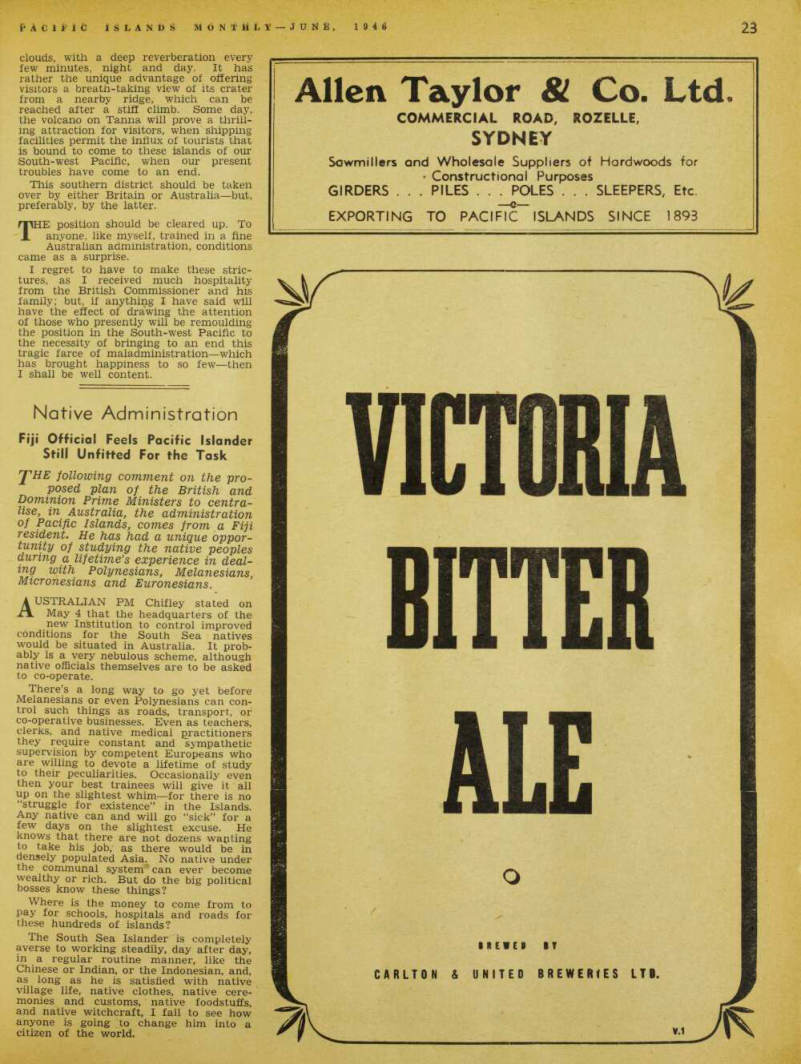
beauty. A bridle track through green tunnels of Jungle brings you to a Slat active volcano on toSortS-eastern g end! throwing its molten discharge to the
clouds, with a deep reverberation every few minutes, night and day. It has rather the unique advantage of offering visitors a breath-taking view of its crater from a nearby ridge, which can be reached after a stiff climb. Some day, the volcano on Tanna will prove a thrill ing attraction for visitors, when shipping facilities permit the influx of tourists that is bound to come to these islands of our South-west Pacific, when our present troubles have come to an end.
This southern district should be taken over by either Britain or Australia —but, preferably, by the latter. rE position should be cleared up. To anyone, like myself, trained in a fine Australian administration, conditions came as a surprise.
I regret to have to make these stric tures, as I received much hospitality from the British Commissioner and his family; but, if anything I have said will have the effect of drawing the attention of those who presently will be remoulding the position in the South-west Pacific to the necessity of bringing to an end this tragic farce of maladministration—which has brought happiness to so few—then I shall be well content.