Lae Today:
pp. 16-17 · Read in the full issue
New Hostel At Lae
Progress of Rehabilitation in New Guinea
Accommodation on a considerable scale is now available in Lae.
Mrs. Flo Stewart, well-known for many years to all Territorians as the owner and manager of the Bulolo Hotel at Wau, and owner of the Lae Hotel (both totally destroyed in the Jap in vasion) has taken over the large assembly of buildings at Lae which lately com prised the AAMWS camp. The camp had been lavishly equipped by the Australian Goyernment; and, when Mrs. Stewart arrived in Lae, some months ago, she was given every assistance by War Disposals and Administration officials in taking over the buildings and equipment, as a private hotel.
Mrs. Stewart paid a hurried visit to Sydney in May, and she reports that she now has available “any number” of well furnished single rooms, and about 50 bathrooms and showers. The establish ment has electric light and water throughout, with hot water to the bath rooms and numerous laundries. There are two tennis courts; abundant kitchen facilities; and various amenities. Miss Ela Gofton has gone to Lae to assist her mother in the management.
Mrs, Stewart still holds the liquor licence for Lae Hotel, and—when build ing facilities are available —she will use the abundant material of the camp for the erection of a large modern hotel there. In the meantime, she hopes that she may have the licence transferred to the late AAMWS establishment.
An increasing amount of traffic is now passing through Lae, towards the Mark ham Valley and the Morobe goldfields, and the new hostlery is very much appreciated.
THERE are now 300 Europeans with their headquarters in or near Lae, reports a correspondent. There is still much confusion—but it is all being straightened out, gradually.
Native workers are still very hard to get. One of the things which has irri tated many people is that they have to take recruits some miles for a medical examination, although there is a hospital adjacent to the District Office, where the boys are signed on.
People who have not seen Lae since Pearl Harbour would not recognise it now. The old township is just a ruin in the midst of desolation. The new town is taking shape on the other side of the Buso River—post office, hotel, and so forth.
The Army did finally succeed, despite erosion, in establishing large docks —one of them a floating dock —at the water side, and two or three big ships can be accommodated there. Indications are that the new stores of Burns, Philp & Co. and W. R. Carpenter & Co. will be located near these docks.
THE port of Salamaua —18 miles south of- Lae—has been cleaned up and entirely abandoned. The Adminis tration officials who were there have gone on to the Morobe centres, where preparations for the resumption of the goldmining industry are proceeding steadily.
There will not be much goldmining
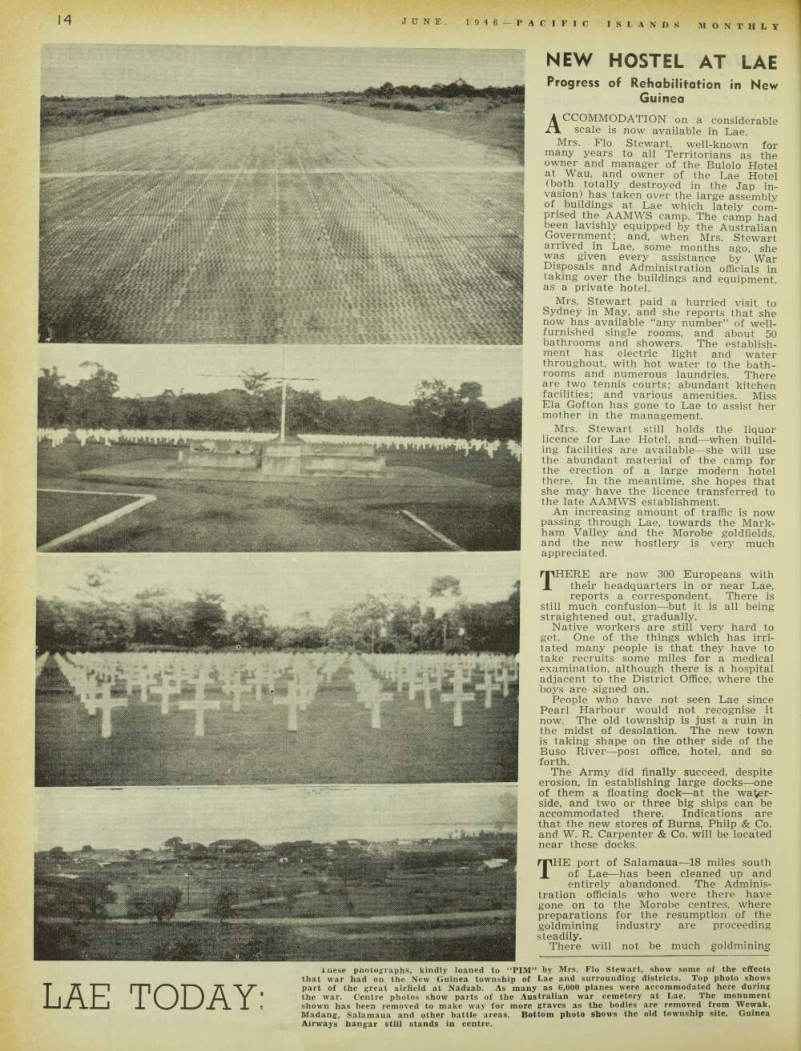
These photographs, kindly loaned to “PIM” by Mrs. Flo Stewart, show some of the effects that war had on the New Guinea township of Lae and surrounding districts. Top photo shows part of the great airfield at Nadzab. As many as 6,000 planes were accommodated here during the war. Centre photos show parts of the Australian war cemetery at Lae. The monument shown has been removed to make way for more graves as the bodies are removed from Wewak, Madang, Salamaua and other battle areas. Bottom photo shows the old township site. Guinea Airways hangar still stands in centre.
Lae Today:
before 1947, however, owing to lack of shipping and transport, and the difficulty of getting machinery to replace that destroyed when the Bulolo company’s hydro-electric stations were “scorched earthed.”
The new road via the Markham and Snake Valleys to the Bulolo is being used more and more, and apparently much of the freighting from Lae will be via the motor trucks and the road.
The intentions of the air freighting services are not clear. Mandated Air ways (Carpenters) have commenced a couple of services, and have been running planes to the North Coast and Aitape— a godsend to those awaiting mails and urgent supplies.
A GOOD many people who have re turned to New Guinea are just sitting down on their battered pro perties, and waiting for something to turn up—they cannot guess at the Terri tory’s economic future.
They are confused by the lack of labour, and by officialdom’s obvious determination to check all private enter prise by means of the Production Control Board. Most of them seem inclined to mark time until next September, when —they hope—a general election in Aus tralia may bring into office a Govern ment more sympathetic towards the Europeans of the Pacific Territories.