Australia's Betrayal of the Indonesian Dutch
pp. 9-10 · Read in the full issue
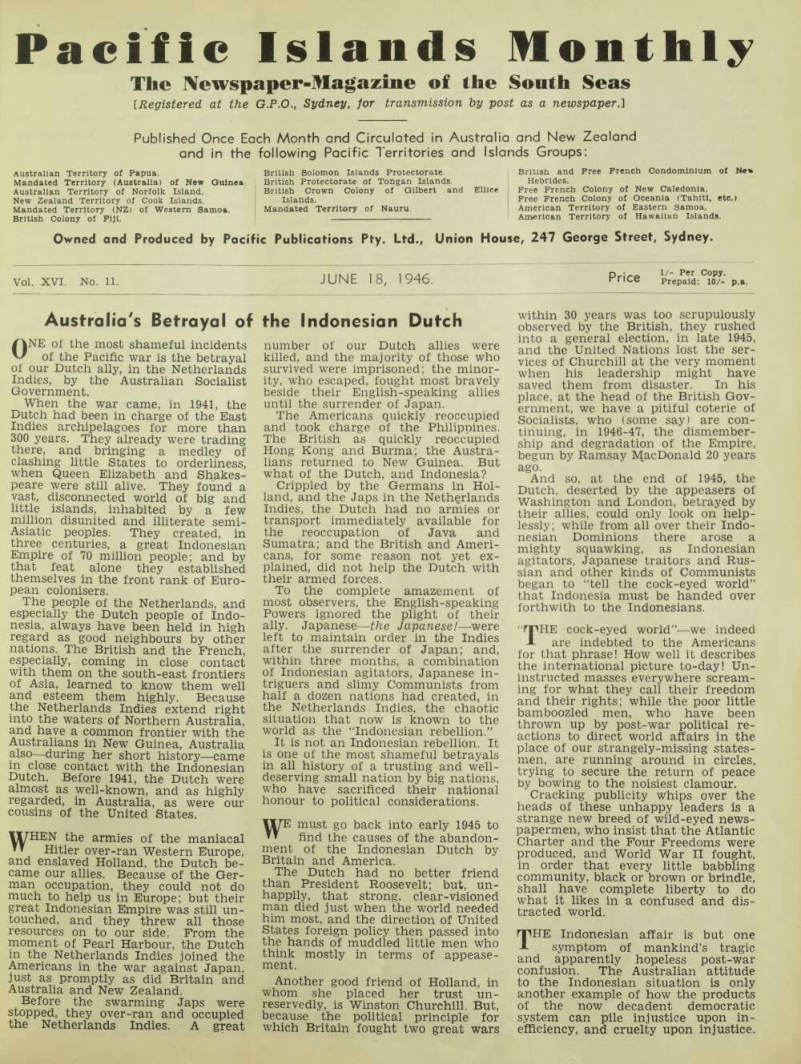
ONE of the most shameful incidents of the Pacific war is the betrayal of our Dutch ally, in the Netherlands Indies, by the Australian Socialist Government.
When the war came, in 1941, the Dutch had been in charge of the East Indies archipelagoes for more than 300 years. They already were trading there, and bringing a medley of clashing little States to orderliness, when Queen Elizabeth and Shakes peare were still alive. They found a vast, disconnected world of big and little islands, inhabited by a few million disunited and illiterate semi- Asiatic peoples. They created, in three centuries, a great Indonesian Empire of 70 million people; and by that feat alone they established themselves in the front rank of Euro pean colonisers.
The people of the Netherlands, and especially the Dutch people of Indo nesia, always have been held in high regard as good neighbours by other nations. The British and the French, especially, coming in close contact with them on the south-east frontiers of Asia, learned to know them well and esteem them highly. Because the Netherlands Indies extend right into the waters of Northern Australia, and have a common frontier with the Australians in New Guinea, Australia also—during her short history—came in close contact with the Indonesian Dutch. Before 1941, the Dutch were almost as well-known, and as highly regarded, in Australia, as were our cousins of the United States.
VIfHEN the armies of the maniacal " Hitler over-ran Western Europe, and enslaved Holland, the Dutch be came our allies. Because of the Ger man occupation, they could not do much to help us in Europe; but their great Indonesian Empire was still un touched, and they threw all those resources on to our side. From the moment of Pearl Harbour, the Dutch in the Netherlands Indies joined the Americans in the war against Japan, just as promptly as did Britain and Australia and New Zealand.
Before the swarming Japs were stopped, they over-ran and occupied the Netherlands Indies. A great
number of our Dutch allies were killed, and the majority of those who survived were imprisoned; the minor ity, who escaped, fought most bravely beside their English-speaking allies until the surrender of Japan.
The Americans quickly reoccupied and took charge of the Philippines.
The British as quickly reoccupied Hong Kong and Burma; the Austra lians returned to New Guinea. But what of the Dutch, and Indonesia?
Crippled by the Germans in Hol land, and the Japs in the Netherlands Indies, the Dutch had no armies or transport immediately available for the reoccupation of Java and Sumatra; and the British and Ameri cans, for some reason not yet ex plained, did not help the Dutch with their armed forces.
To the complete amazement of most observers, the English-speaking Powers ignored the plight of their ally. Japanese —the Japanese!- —were left to maintain order in the Indies after the surrender of Japan; and, within three months, a combination of Indonesian agitators, Japanese in triguers and slimy Communists from half a dozen nations had created, in the Netherlands Indies, the chaotic situation that now is known to the world as the “Indonesian rebellion.”
It is not an Indonesian rebellion. It is one of the most shameful betrayals in all history of a trusting and well deserving small nation by big nations, who have sacrificed their national honour to political considerations.
VlfE must go back into early 1945 to find the causes of the abandon ment of the Indonesian Dutch by Britain and America.
The Dutch had no better friend than President Roosevelt; but, un happily, that strong, clear-visioned man died just when the world needed him most, and the direction of United States foreign policy then passed into the hands of muddled little men who think mostly in terms of appease ment.
Another good friend of Holland, in whom she placed her trust un reservedly, is Winston Churchill. But, because the political principle for which Britain fought two great wars
within 30 years was too scrupulously observed by the British, they rushed into a general election, in late 1945, and the United Nations lost the ser vices of Churchill at the very moment when his leadership might have saved them from disaster. In his place, at the head of the British Gov ernment, we have a pitiful coterie of Socialists, who (some say) are con tinuing, in 1946-47, the dismember ship and degradation of the Empire, begun by Ramsay MacDonald 20 years ago.
And so, at the end of 1945, the Dutch, deserted by the appeasers of Washington and London, betrayed by their allies, could only look on help lessly; while from all over their Indo nesian Dominions there arose a mighty squawking, as Indonesian agitators, Japanese traitors and Rus sian and other kinds of Communists began to “tell the cock-eyed world” that Indonesia must be handed over forthwith to the Indonesians.
THE cock-eyed world”—we indeed are indebted to the Americans for that phrase! How well it describes the international picture to-day! Un instructed masses everywhere scream ing for what they call their freedom and their rights; while the poor little bamboozled men, who have been thrown up by post-war political re actions to direct world affairs in the place of our strangely-missing states men, are running around in circles, trying to secure the return of peace by bowing to the noisiest clamour.
Cracking publicity whips over the heads of these unhappy leaders is a strange new breed of wild-eyed news papermen, who insist that the Atlantic Charter and the Four Freedoms were produced, and World War II fought, in order that every little babbling community, black or brown or brindle, shall have complete liberty to do what it likes in a confused and dis tracted world.
THE Indonesian affair is but one symptom of mankind’s tragic and apparently hopeless post-war confusion. The Australian attitude to the Indonesian situation is only another example of how the products of the now decadent democratic system can pile injustice upon in efficiency, and cruelty upon injustice.
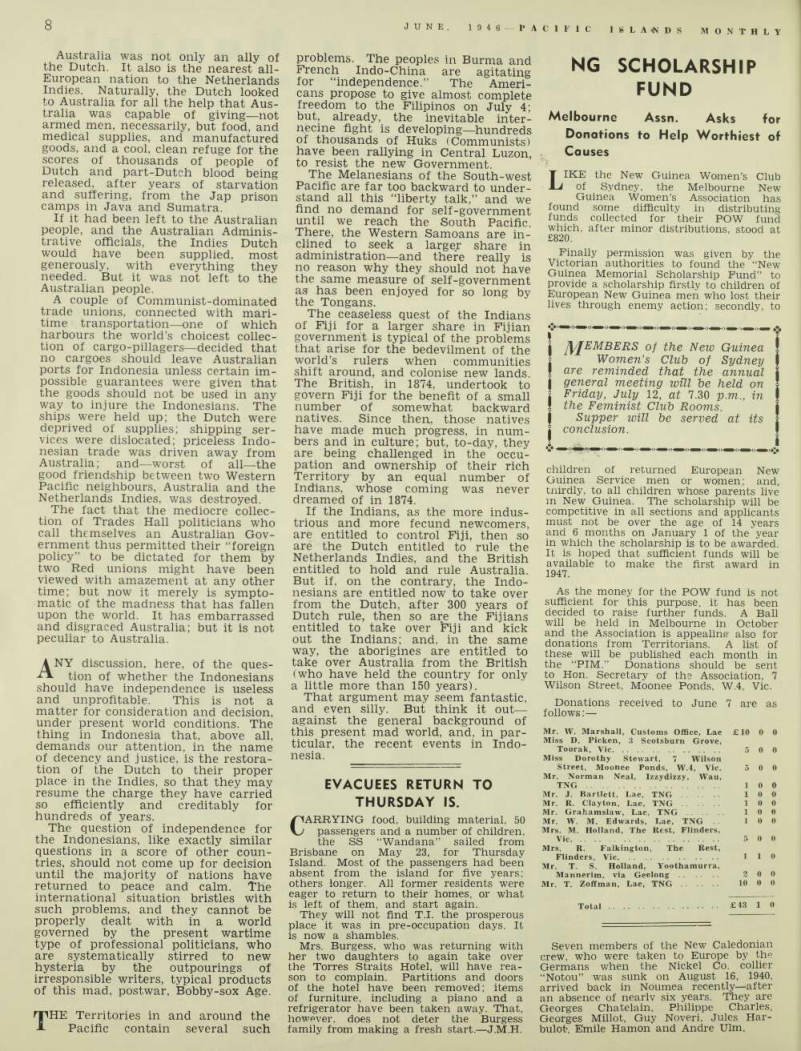
Australia was not only an ally of the Dutch. It also is the nearest all- European nation to the Netherlands Indies. Naturally, the Dutch looked to Australia for all the help that Aus tralia was capable of giving—not armed men, necessarily, but food, and medical supplies, and manufactured goods, and a cool, clean refuge for the scores of thousands of people of Dutch and part-Dutch blood being released, after years of starvation and suffering, from the Jap prison camps in Java and Sumatra.
If it had been left to the Australian people, and the Australian Adminis trative officials, the Indies Dutch would have been supplied, most generously, with everything they needed. But it was not left to the Australian people.
A couple of Communist-dominated trade unions, connected with mari time transportation—one of which harbours the world’s choicest collec tion of cargo-pillagers—decided that no cargoes should leave Australian ports for Indonesia unless certain im possible guarantees were given that the goods should not be used in any way to injure the Indonesians. The ships were held up; the Dutch were deprived of supplies; shipping ser vices were dislocated; priceless Indo nesian trade was driven away from Australia; and—worst of all—the good friendship between two Western Pacific neighbours, Australia and the Netherlands Indies, was destroyed.
The fact that the mediocre collec tion of Trades Hall politicians who call themselves an Australian Gov ernment thus permitted their “foreign policy” to be dictated for them by two Red unions might have been viewed with amazement at any other time; but now it merely is sympto matic of the madness that has fallen upon the world. It has embarrassed and disgraced Australia; but it is not peculiar to Australia.
ANY discussion, here, of the ques tion of whether the Indonesians should have independence is useless and unprofitable. This is not a matter for consideration and decision, under present world conditions. The thing in Indonesia that, above all, demands our attention, in the name of decency and justice, is the restora tion of the Dutch to their proper place in the Indies, so that they may resume the charge they have carried so efficiently and creditably for hundreds of years.
The question of independence for the Indonesians, like exactly similar questions in a score of other coun tries, should not come up for decision until the majority of nations have returned to peace and calm. The international situation bristles with such problems, and they cannot be properly dealt with in a world governed by the present wartime type of professional politicians, who are systematically stirred to new hysteria by the outpourings of irresponsible writers, typical products of this mad, postwar, Bobby-sox Age.
THE Territories in and around the Pacific contain several such
problems. The peoples in Burma and French Indo-China are agitating for “independence.” The Ameri cans propose to give almost complete freedom to the Filipinos on July 4; but, already, the inevitable inter necine fight is developing—hundreds of thousands of Huks (Communists) have been rallying in Central Luzon, to resist the new Government.
The Melanesians of the South-west Pacific are far too backward to under stand all this “liberty talk,” and we find no demand for self-government until we reach the South Pacific.
There, the Western Samoans are in clined to seek a larger share in administration—and there really is no reason why they should not have the same measure of self-government as has been enjoyed for so long by the Tongans.
The ceaseless quest of the Indians of Fiji for a larger share in Fijian government is typical of the problems that arise for the bedevilment of the world’s rulers when communities shift around, and colonise new lands.
The British, in 1874, undertook to govern Fiji for the benefit of a small number of somewhat backward natives. Since then, those natives have made much progress, in num bers and in culture; but, to-day, they are being challenged in the occu pation and ownership of their rich Territory by an equal number of Indians, whose coming was never dreamed of in 1874.
If the Indians, as the more indus trious and more fecund newcomers, are entitled to control Fiji, then so are the Dutch entitled to rule the Netherlands Indies, and the British entitled to hold and rule Australia.
But if, on the contrary, the Indo nesians are entitled now to take over from the Dutch, after 300 years of Dutch rule, then so are the Fijians entitled to take over Fiji and kick out the Indians; and, in the same way, the aborigines are entitled to take over Australia from the British (who have held the country for only a little more than 150 years).
That argument may seem fantastic, and even silly. But think it out— against the general background of this present mad world, and, in par ticular, the recent events in Indo nesia.