Europeans
pp. 51-52 · Read in the full issue
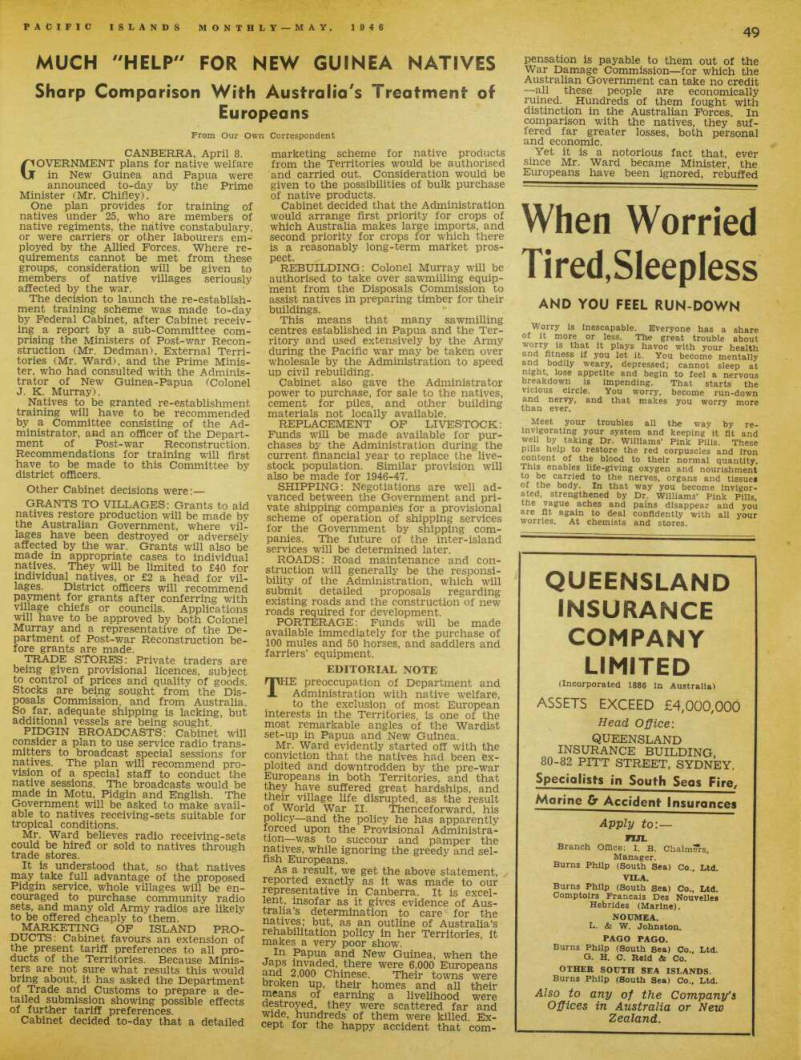
Much "Help" For New Guinea Natives
Sharp Comparison With Australia's Treatment of Europeans
From Our Own Correspondent
CANBERRA, April 8.
GOVERNMENT plans for native welfare in New Guinea and Papua were announced to-day by the Prime Minister (Mr. Chifley).
One plan provides for training of natives under 25, who are members of native regiments, the native constabulary, or were carriers or other labourers em ployed by the Allied Forces. Where re quirements cannot be met from these groups, consideration will be given to members of native villages seriously affected by the war.
The decision to launch the re-establish ment training scheme was made to-day by Federal Cabinet, after Cabinet receiv ing a report by a sub-Commlttee com prising the Ministers of Post-war Recon struction (Mr. Dedman), External Terri tories (Mr. Ward), and the Prime Minis ter, who had consulted with the Adminis trator of New Guinea-Papua (Colonel J. K. Murray).
Natives to be granted re-establishment training will have to be recommended by a Committee consisting of the Ad ministrator, and an officer of the Depart ment of Post-war Reconstruction.
Recommendations for training will first have to be made to this Committee by district officers.
Other Cabinet decisions were:— GRANTS TO VILLAGES: Grants to aid natives restore production will be made by the Australian Government, where vil lages have been destroyed or adversely affected by the war. Grants will also be made in appropriate cases to individual natives. They will be limited to £4O for individual natives, or £2 a head for vil lages. District officers will recommend payment for grants after conferring with village chiefs or councils. Applications will have to be approved by both Colonel Murray and a representative of the De partment of Post-war Reconstruction be fore grants are made.
TRADE STORES: Private traders are being given provisional licences, subject to control of prices and quality of goods.
Stocks are being sought from the Dis posals Commission, and from Australia.
So far, adequate shipping is lacking, but additional vessels are being sought.
PIDGIN BROADCASTS: Cabinet will consider a plan to use service radio trans mitters to broadcast special sessions for natives. The plan will recommend pro vision of a special staff to conduct the native sessions. The broadcasts would be made in Motu, Pidgin and English. The Government will be asked to make avail able to natives receiving-sets suitable for tropical conditions.
Mr. Ward believes radio receiving-sets could be hired or sold to natives through trade stores.
It is understood that, so that natives may take full advantage of the proposed Pidgin service, whole villages will be en couraged to purchase community radio sets, and many old Arm}' radios are likely to be offered cheaply to them.
Marketing Of Island Pro
DUCTS: Cabinet favours an extension of the present tariff preferences to all pro ducts of the Territories. Because Minis ters are not sure what results this would bring about, it has asked the Department of Trade and Customs to prepare a de tailed submission showing possible effects of further tariff preferences.
Cabinet decided to-day that a detailed
marketing scheme for native products from the Territories would be authorised and carried out. Consideration would be given to the possibilities of bulk purchase of native products.
Cabinet decided that the Administration would arrange first priority for crops of which Australia makes large imports, and second priority for crops for which there is a reasonably long-term market pros pect.
REBUILDING; Colonel Murray will be authorised to take over sawmilling equip ment from the Disposals Commission to assist natives in preparing timber for their buildings.
This means that many sawmilling centres established in Papua and the Ter ritory and used extensively by the Army during the Pacific war may be taken over wholesale by the Administration to speed up civil rebuilding.
Cabinet also gave the Administrator power to purchase, for sale to the natives, cement for piles, and other building materials not locally available.
Replacement Of Livestock:
Funds will be made available for pur chases by the Administration during the current financial year to replace the live stock population. Similar provision will also be made for 1946-47.
SHIPPING: Negotiations are well ad vanced between the Government and pri vate shipping companies for a provisional scheme of operation of shipping services for the Government by shipping com panies. The future of the inter-island services will be determined later.
ROADS: Road maintenance and con struction will generally be the responsi bility of the Administration, which will submit detailed proposals regarding existing roads and the construction of new roads required for development.
PORTERAGE: Funds will be made available immediately for the purchase of 100 mules and 50 horses, and saddlers and farriers’ equipment.
Editorial Note
rjIHE preoccupation of Department and X Administration with native welfare, to the exclusion of most European interests in the Territories, is one of the most remarkable angles of the Wardist set-up in Papua and New Guinea.
Mr. Ward evidently started off with the conviction that the natives had been ex ploited and downtrodden by the pre-war Europeans in both Territories, and that they have suffered great hardships, and their village life disrupted, as the result of World War 11. Thenceforward, his policy—and the policy he has apparently forced upon the Provisional Administra tion—was to succour and pamper the natives, while ignoring the greedy and sel fish Europeans.
As a result, we get the above statement, reported exactly as it was made to our representative in Canberra. It is excel lent, insofar as it gives evidence of Aus tralia’s determination to care for the natives; but, as an outline of Australia’s rehabilitation policy in her Territories, it makes a very poor show.
In Papua and New Guinea, when the Japs invaded, there were 6,000 Europeans and 2,000 Chinese. Their towns were broken up, their homes and all their means of earning a livelihood were destroyed, they were scattered far and wide, hundreds of them were killed Ex cept for the happy accident that com
pensation is payable to them out of the War Damage Commission—for which the Australian Government can take no credit —all these people are economically ruined. Hundreds of them fought with distinction in the Australian Forces. In comparison with the natives, they suf fered far greater losses, both personal and economic.
Yet it is a notorious fact that, ever since Mr. Ward became Minister, the Europeans have been ignored, rebuffed
and humiliated, while the External Terri tories Department has gone to really extraordinary lengths to assist the natives. The foregoing report from Can berra is a good example of it.
Permits have been issued to the mem bers of the New Guinea mission staff to return to the Rooke-Siassi Islands at an early date. Missionaries A. P. H. Freund, Con Eckermann and Keith Nagel will sail on the new mission schooner and take with them the necessary equipment to rehabilitate the mission. It is pleasing to note that the native teachers carried on the work during the Japanese occupa tion of the Islands.