When Cakobau Was Crowned
pp. 43-44 · Read in the full issue
WORKS on the early history of Fiji - contain many references to the so called “King” Cakobau, or Tui Viti; and the era of the Fijian monarch, a few years before the Fiji Group was ceded to Queen Victoria, forms the sub ject matter of many of the books which to-day are only too scarce, and rarely to be found outside a good reference lib rary. HoWever, it is the era itself that is generally dealt with, and the fact that there was an actual formal coronation ceremony for the king in those far-off days may not be generally known.
It was in 1867 that Cakobau was crowned at Bau—or, rather, crowned himself, for that somewhat despotic monarch placed the crown on his own noble brow, there being no Archbishop to officiate.
The tiny island of Bau might almost be said to be the cradle of Fijian his tory, and as the ancestral home of the king it was fitting that it, rather than the then centre of civilisation, Levuka, should be the scene of the coronation.
One of the few eye-witness accounts of the ceremony was written by Charles Churchill in an English magazine in 1870, and he describes the ceremony with a wealth of detail.
THE coronation took place on Bau in the Wesleyan church, which was specially furbished for the occasion.
There was a platform at one end, and at the back of this was draped a large piece of tapa cloth, the floor of the dais and a large part of the church being covered with many fine mats, the pro duct of Fiji. Rotuma and Tonga.
There were simple furnishings on the dais —a table and a large armchair, the
latter covered with the national flag of Bau—white, blue and red horizontally, with a sun rising out of the blue ground and a crown in the upper corner. On the table was the crown which had been prepared for the occasion, a Bible and a sword.
The ceremony was largely attended by both white residents and native chiefs, who had come from many parts to do homage to Cakobau. The white people sat on the left of the platform and
By R. C. Macpherson
representative chiefs on the opposite side, whilst the king-designate sat on the edge of the paltform.
THERE was a deep hush in the church as the resident Wesleyan mission ary, the Rev. F. Tait, rose and offered a prayer after the lengthy con stitution “granted by Ebenezer Cakobau with the consent of the chiefs and people in council assembled” was read.
A hymn, the reading of a lesson and a short sermon followed and then came the real part of the ceremony.
The aged chief, Ratu Marika Toroca, read the following address: “We, as re presentatives of the chiefs and people of this kingdom, now in the sight of Almiehty God, in the name of the people of this realm, and with their love and prayers, do lay at your feet this token of the sovereignty of this country. May God save your Majesty.”
AS Ratu Marika finished, Roko Tui Namata advanced to the king, bear ing before him the crown. As he
laid it at the great chief’s feet, he said: “Sire, from the crown of my head to the soles of my feet, I affirm all that Ratu Marika has just said.”
Another chief followed with a short address, and he in turn was followed bv Roko Tui Dreketi, with the sword of State and emblem of justice, which was also laid at the king’s feet.
Next came the Bible, borne by Ratu
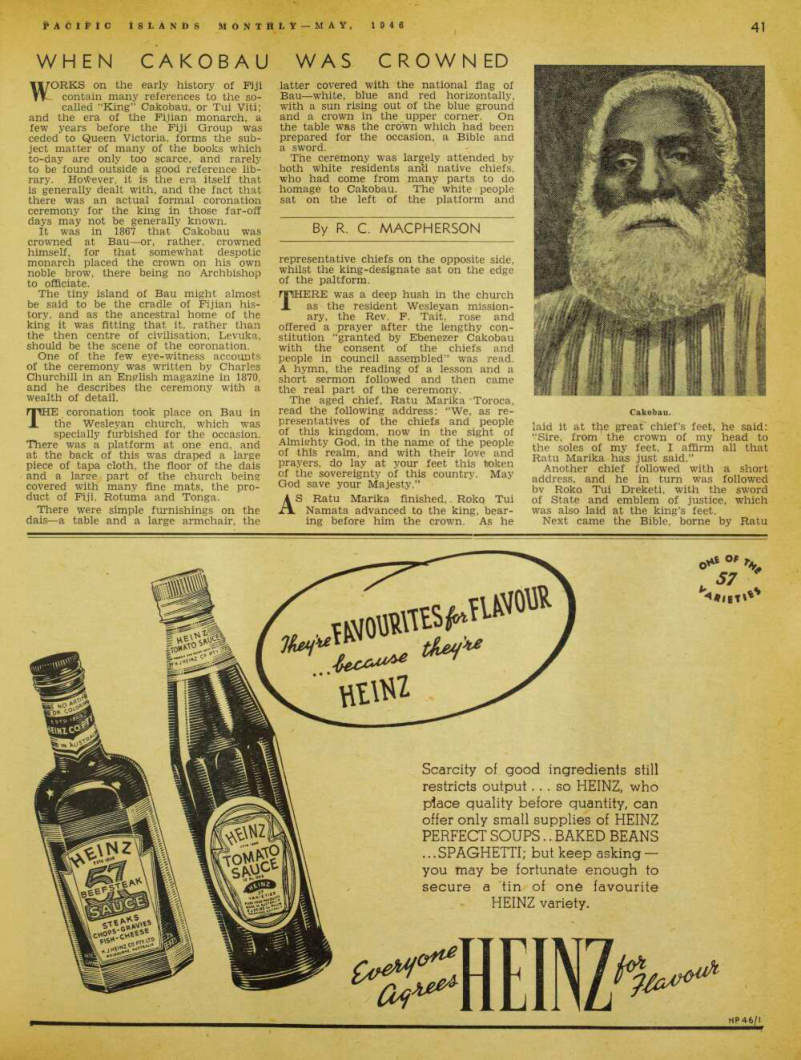
Cakobau.
Penjamini Yaku and Ratu Meli Rokona gata, who laid the Bible in the king’s hands. j m Cakobau’s address followed, and it is well worth quoting in full, for, like the addresses of the other chiefs, it had obviously been well prepared for the oc casion by an educated European—one is inclined to suspect, the missionary. The kir~ said:— “My chiefs, my people, my white friends —I say friends because the time was when I did not look upon you as such, but that time is past. I feel that I, this day, speak in the presence of Almighty God. I feel that through the instrumentality of His Almighty Provi dence, my country is rising out of the darkness into the light of civilisation.
I love my people, I love my country. My earnest wish and prayer is for the hap piness of my people and the prosperity and advancement of my country. May we become a great country and may we
so live that we may all become subjects of Christ’s blessed kingdom above.
“The constitution and laws read to you this day will be good for you and will materially aid in our advancement and prosperity. I thank our white friends who have so kindly aided in their pre paration.”
Then kneeling before the assembly, Cakobau said: “The sovereignty of this country conferred upon me with the love of my people, j.’ accept, and I solemnly and sincerely declare my determination in the presence of Almighty God and with His assistance, to maintain the con stitution of this country whole and in violate, and to govern in conformity thereto.”
STILL kneeling, the king took the crown in his hands and placed it on his head. Then rising with the sword in his right hand and the Bible in his left, he ascended the armchair doing service as a throne, and took his seat.
A salute of 21 guns followed and the national fla<~ was hoisted. During the five minutes it took to fire the salute no one spoke and no one moved, says the chronicler, but “all continued to look upon Cakobau the First as he sat there, the very image of a Christian king, well clothed, - still with the sword and Bible in his hands and the crown upon his head.” rE writer goes on to comment on the contrast between the Cakobau of that day and the Cakobau of 15 years previously, when he was “one of the most bloodthirsty of men, delighting only in cruelty and the grossest of can nibal ♦ crimes.”
Now he sat within 10 paces of his for mer cannibal ovens, respected and honoured by a goodly number of intel ligent English and American subjects, “which could not fail to strike the minds of those present as an instance of the power of Christianity and civilisation rarely paralleled in the history of the world.”
Immediately after the coronation cere mony, Mr. St. Julian, the Secretary of State, took an oath of fidelity to the king and the chiefs took the oath of allegi ance. A prayer by the missionary and three cheers closed the ceremony.
When the crowd left the buildings the Europeans and half-castes formed a line on one side of the path, and natives on the other, and as the king walked be tween them the Europeans formed in procession and followed him to his house.
Thus was Cakobau crowned king of Fiji, and thus he entered on the era that was to provide him with many cares of State—cares that were overcome only with the cession of the islands to the British Crown, seven years later.
CAKOBAU died in 1883, and rests to day in the little graveyard on the hillside of Bau. The simple monu ment over the crave overlooks the scene of his coronation.
Studying the account of the ceremony and the language in which the speeches of the king and chiefs were couched, one cannot but wonder if those who prepared them for the speakers, so lately removed from barbarism, did it in all seriousness and did not see the almost grotesque humour in the courtly language they put in the mouths of the Fijians—language more suited to Westminster Abbey than lately-converted Bau, with the blood of countless cannibal orgies scarce dry upon the killing stones within a few yards of the church.