Tropical Moon, Island Lagoon—But
pp. 41-42 · Read in the full issue
No Guitar
By Edwin Gold
HOLLYWOOD, aided and abetted by various gramophone companies, would have us believe that the South Sea Island hula girl always came complete with a wailing steel guitar, or a thrumming ukulele. But ’tis not so.
Although the Polynesian takes readily to these instruments, he must have initial instruction from a European.
On some of the outer Cook Islands, where Europeans are few, and money even scarcer, the natives still shape their own musical taste, do their own com posing, and manufacture out of local material the means of expression.
Most important instrument is, heaven help us, the drum!
There are at least six varieties of drum, all made of wood, and having a note like the lower tones of the xylo phone. They are of the simplest form — just hollowed logs of varying lengths, having a deep slot cut in them. The wood is smooth and highly polished with coco nut-oil; and the longer the log, the deeper the note.
In action, a sort of tune is played upon the smallest drums (“pate”), which are held in the hand, and there is, in all this primitive banging and clattering, a definite pattern of rhythm.
The mezzo (“pao”) and base drums supply any form of accompaniment, from march to waltz-time.
If a reader can imagine a brass band that lacks all its cornetists, but is complete in the “oom-pah” department, es saying to perform a programme regardless, and leaving the solo melody to the audience’s imagination, he will get some idea of the effect of the genuine South Sea native music on a
European.
LESS noisy and capable of rendering music compara tively pleasing to a white man’s ear (if the European
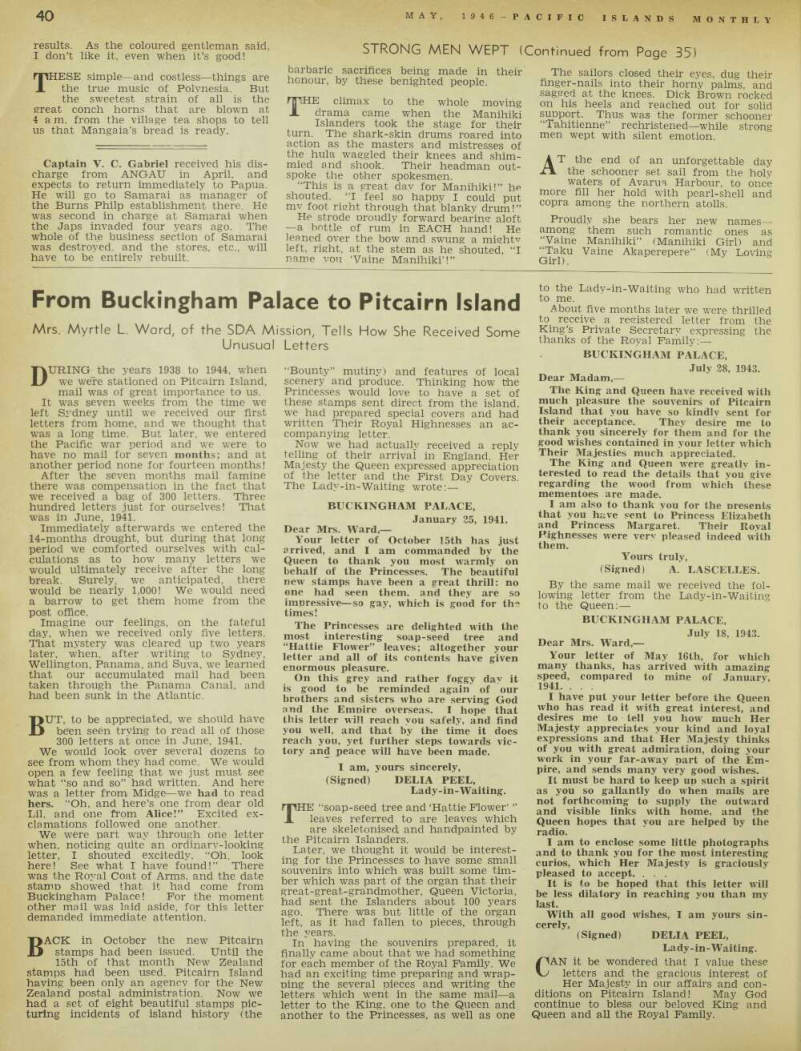
aforesaid is a great lover of the Jew’s harp) is the instrument our Polynesians at Mangaia Island call the “Ko’e.” This is simply a length of narrow bamboo, with a piece of wire stretched along it and tightened by a wooden bridge.
The player holds one end of the hol low bamboo tube clenched tightly be tween his teeth, and taps the stretched wire with a piece of hardwood the size of a pencil. As in the case of Jew’s harps, the cavity of the performer’s mouth and throat form the notes.
At first, only a jarring and jangling are heard (these form the “carrier-wave,” in wireless parlance, on which the melody floats). Soon, however, amid the jang lings can be heard a real tune —faint, but musical, and definitely a tune. Some local Europeans aver that it sounds like a Jew’s harp played in a bird cage fac tory, but that’s purely a matter of opinion. Personally, I can listen to a “ko’e” concert all day; but 10 minutes of the drums is much more than enough for any non-Polynesian ear!
The only other truly native musical instrument here is the lowly “ka’ara” — just three inches of palm leaf, held to the teeth (again, a la Jew’s harp!) and its central spine used as a “tongue,” to “twang”—with dubiously harmonious (Continued Next Page)
Mangaian Orchestra.
results. As the coloured gentleman said, I don’t like it, even when it’s good!
THESE simple—and costless —things are the true music of Polynesia. But the sweetest strain of all is the great conch horns that are blown at 4 am. from the village tea shops to tell us that Mangaia’s bread is ready.
Captain V. C, Gabriel received his dis charge from ANGAU in April, and expects to return immediately to Papua.
He will go to Samarai as manager of the Burns Philp establishment there. He was second in charge at Samarai when the Japs invaded four years ago. The whole of the business section of Samarai was destroyed, and the stores, etc., will have to be entirely rebuilt.