Mv "Lakatoi"
pp. 32-33 · Read in the full issue
How She Escaped the Fall of Rabaul
/pHE Burns Philp motor vessel “Lakatoi,”
X 340 tons, Captain James Farrar, ran regularly along the South Papuan coast from Daru, in the west, out to Misima Island, in the east, in the years before the war. Her home port was Samaraii.
Late in 1941, she was ordered to pro ceed from Port Moresby to Rabaul. She was kept for some time in Rabaul by the authorities there, being repeatedly sent around to the north coast, to Witu Islands, to bring copra to Rabaul. She brought 2,000 bags at a time.
When she Was again ordered away from Rabaul, to Witu, in January, 1942, Rabaul already was being air-raided, and
the crew protested strongly against re maining in the vicinity. However, she went away on her fourth trip, and was at Witu Is. when the Japs landed in Rabaul on January 23, 1942.
Henceforward, for the next six weeks, Captain Farrar and his “Lakatoi” dodged around the Witus, not knowing what to do. By day she was kept close hidden in the very good harbours in the Witus, mostly in Meto. It was in these waters that the German vessel “Wolff” remained hidden for so long in the last war.
A Jap plane came along one dav and flew past the “Lakatoi,” onlv about a mile away. It went on towards the western end of New Britain.
Later, the Jap returned and flew close
over the “Lakatoi.” Everyone on board rushed to the boats and left the ship— they expected she would be blown up any moment.
But the Jap pilot signed to them to return to the ship and .proceed east ward towards Rabaul. The captain de cided to follow instructions—and then to go straight across to the New Ireland shore, and try to creep through St.
George’s Channel and away southwards in the darkness.
However, they eluded the Japs and went into Talasea island—and, later on, they started off westwards towards Vitiaz Strait. They steamed along dur ing the nights and hid up among the islands in daytime.
They picked up a couple of boatloads of refugee soldiers at the western end of New Britain, and they eventually got through Dampier and Vitiaz Straits, and away south to Cairns.
They left Witu, finally, on March 20, 1942, and reached Cairns early in April.
“Lakatoi” was later taken over by the Americans, and was overloaded, and sank off the coast of New Caledonia in 1943.
There were many lively Incidents while the “Lakatoi” was on the north coast of New Britain. They had no teleradio — only a receiving set, from which they tried to pick up news of what was hap pening. They got a rumour that the Aus
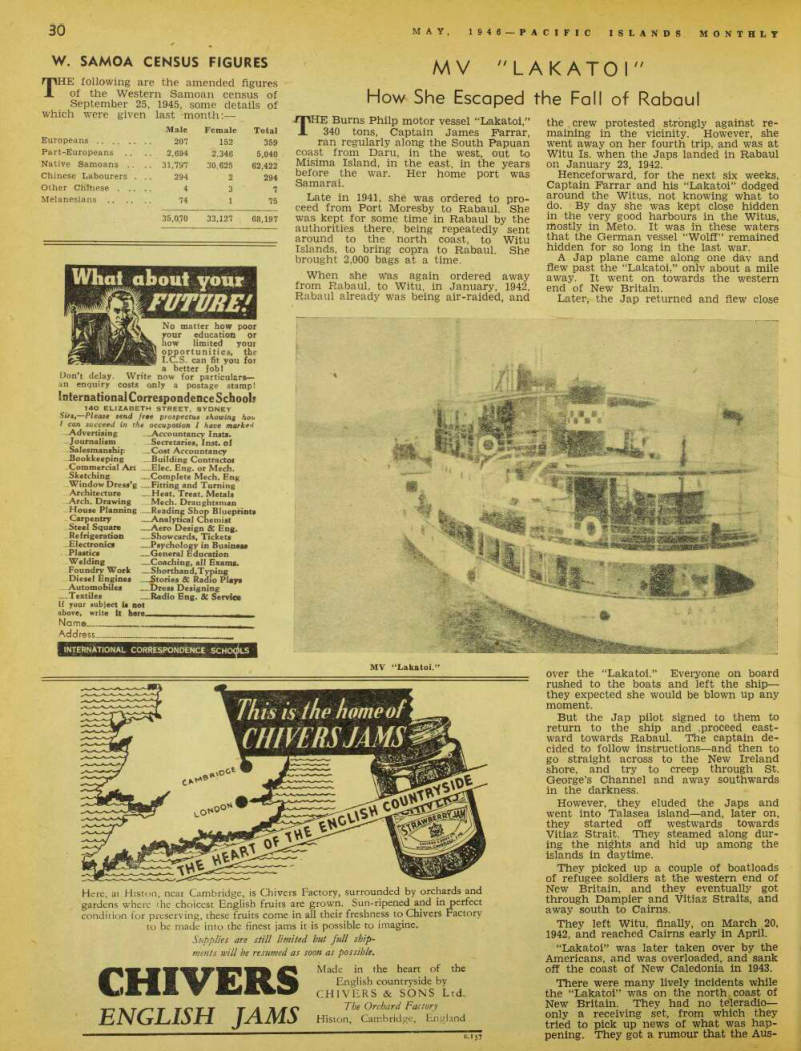
MV “Lakatoi.”
tralians had evacuated Rabaul, and they sent away Mr. Lumley, and another, in Mrs. Baker’s launch, to the north coast of New Britain to try and get news. Some one there—an Australian official—seized Mr. Lumley and the launch, and would not let them go—but they escaped even tually. Mr. Lumley appears to have been Captain Farrar’s right-hand man. Also aboard the “Lakatoi,” when she escaped were Mr. E. D. Robinson, a BP plantation inspector, and District Officer J. K.
McCarthy. Mr. Robinson afterwards joined the AIB, and won captain’s rank and the Military Cross.
Mrs. Jean Poole, widow of Rev. John Poole, formerly of the Methodist Mission, Rabaul, is taking the missionary sister’s course at George Brown College before returning to New Guinea. Her husband was one of the missionaries lost on the “Montevideo Maru.”