Nh High Chief Shot From Ambush
pp. 28-29 · Read in the full issue
Murder Starts Trouble Between Big Nambus and Amok Tribes
From a Special Correspondent
ON Christmas Eve, 1945, while sitting in his large native house, drinking kava with some of his friends, Maluan Vavau, the high chief of the Big Nambus tribe on north-west Malekula, New Hebrides, was fatally shot by some one hiding in the thick jungle a few yards from the assembled party.
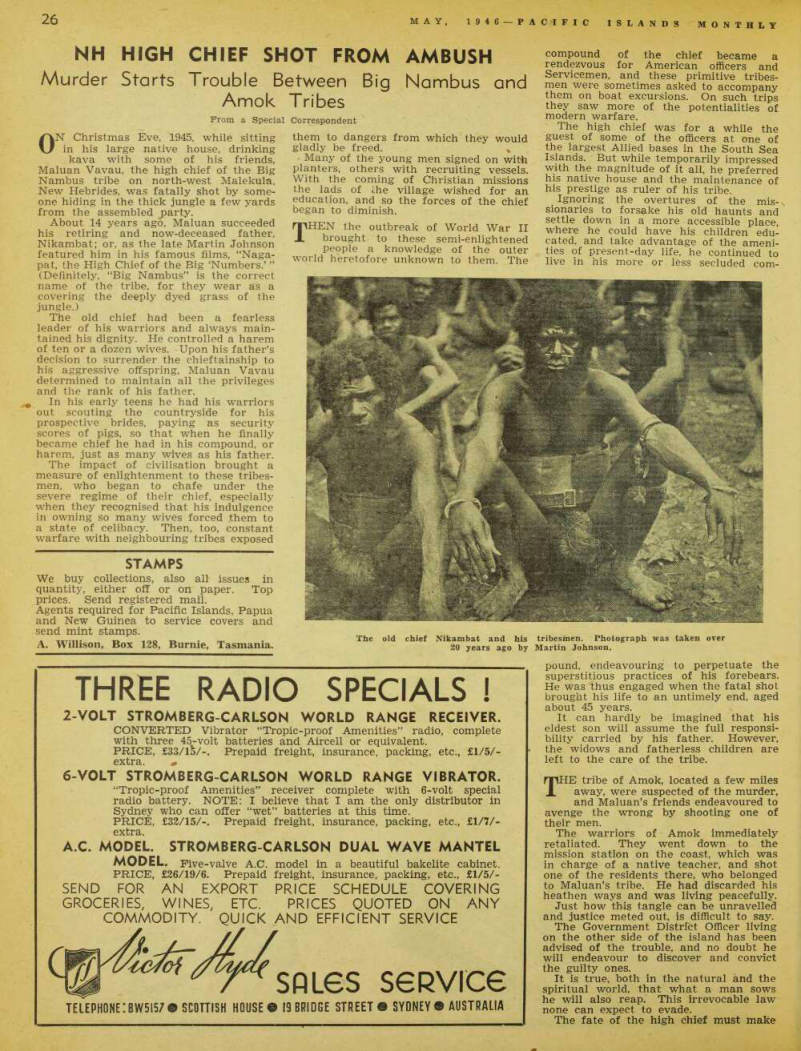
About 14 years ago, Maluan succeeded his retiring and now-deceased father, Nikambat; or, as the late Martin Johnson featured him in his famous films, “Naga pat, the High Chief of the Big ‘Numbers.’ ” (Definitely, “Big Nambus” is the correct name of the tribe, for they wear as a covering the deeply dyed grass of the jungle.) The old chief had been a fearless leader of his warriors and always main tained his dignity. He controlled a harem of ten or a dozen wives. Upon his father’s decision to surrender the chieftainship to his aggressive offspring, Maluan Vavau determined to maintain all the privileges and the rank of his father.
In his early teens he had his warriors out scouting the countryside for his prospective brides, paying as security scores of pigs, so that when he finally became chief he had in his compound, or harem, just as many wives as his father.
The impact of civilisation brought a measure of enlightenment to these tribes men, who began to chafe under the severe regime of their chief, especially when they recognised that his indulgence in owning so many wives forced them to a state of celibacy. Then, too, constant warfare with neighbouring tribes exposed
them to dangers from which they would gladly be freed. * Many of the young men signed on with planters, others with recruiting vessels.
With the coming of Christian missions the lads of the village wished for an education, and so the forces of the chief began to diminish. mREN the outbreak of World w«r it
I hrmio-ht • r^f r *1
A 1 -ei jJ i lghten f ed W orld P he?ltoforp k unknown °™ r world heretofore unknown to them. The
compound of the chief became a rendezvous for American officers and Servicemen, and these primitive tribes men were sometimes asked to accompany them on boat excursions. On such trips they saw more of the potentialities of modern warfare.
The high chief was for a while the guest of some of the officers at one of the largest Allied bases in the South Sea Islands. But while temporarily impressed with the magnitude of it all, he preferred his native house and the maintenance of his prestige as ruler of his tribe.
Ignoring the overtures of the mis sionaries to forsake his old haunts and settle down in a more accessible place, where he could have his children edu cated, and take advantage of the ameni ties of present-day life, he continued to live in his more or less secluded com-
pound, endeavouring to perpetuate the superstitious practices of his forebears.
He was thus engaged when the fatal shot brought his life to an untimely end, aged about 45 years.
It can hardly be imagined that his eldest son will assume the full responsi bility carried by his father. However, the widows and fatherless children are left to the care of the tribe.
THE tribe of Amok, located a few miles away, were suspected of the murder, and Maluan’s friends endeavoured to avenge the wrong by shooting one of their men.
The warriors of Amok immediately retaliated. They went down to the mission station on the coast, which was in charge of a native teacher, and shot one of the residents there, who belonged to Maluan’s tribe. He had discarded his heathen ways and was living peacefully.
Just how this tangle can be unravelled and justice meted out, is difficult to say.
The Government District Officer living on the other side of the island has been advised of the trouble, and no doubt he will endeavour to discover and convict the guilty ones.
It is true, both in the natural and the spiritual world, that what a man sows he will also reap. This irrevocable law none can expect to evade.
The fate of the high chief must make
The old chief Nikambat and his tribesmen. Photograph was taken over 20 years ago by Martin Johnson.
an impression, not only upon his people, but also upon the surrounding tribes of that part of the country. It may be that greater facilities will now be given the missionaries to extend their work; and probably they will have easier access to the young people, who are giv ing evidence of a desire to separate from the old ways and live in peaceful con ditions.