Lutheran Internees Who
pp. 57-58 · Read in the full issue
Wish to Return
TWO members of the Lutheran Mission at Finschhafen, New Guinea, who faced the civil internees inquiry at Tatura in February were missionary Gustav August Bergmann and Dr. Alfred Stuerzenhofecker.
Mr. Bergmann was described as hav-
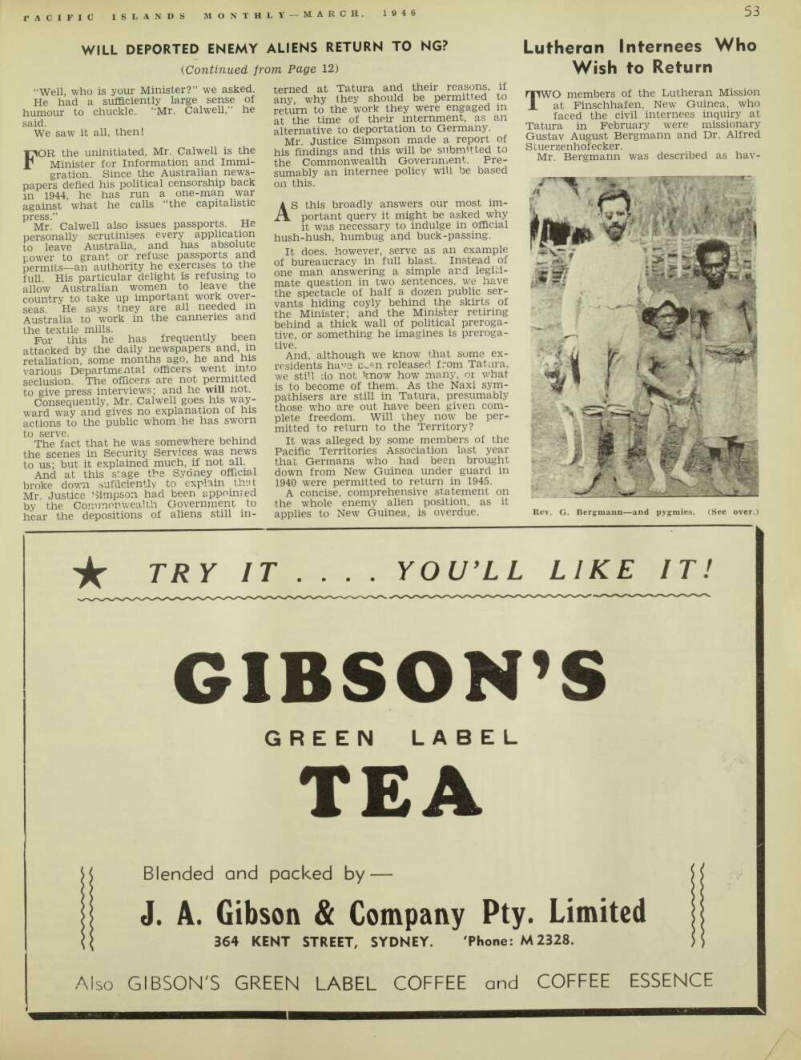
Rev. G. Bergmann—and pygmies. (See over.)
ing appeared with a “black eye-patch, a van Dyke beard and a military bearing.”
He refused to take an oath of affirmation as he said he had never taken an oath in his life, and would not do so except on an appropriate occasion. He did not regard tne Tatura inquiry as “sufficiently important” to warrant a change of policy.
He asked that he, his wife and their six children be returned to their mis sion station in New Guinea, and if this were not permitted, he wished to return to Germany. He admitted that he had applied for membership of the Nazi Party but that he had cancelled his application later because the attitude of the Nazis to the church “was wrong.”
Dr. Stuerzenhofecker, in his evidence, said that he was mission doctor at Finsch hafen. He said that he was not anti semitic, but that in pre-Nazi days 90 per cent, of the influential positions in the medical profession in Germany were held by Jews. He said that there were too many Jews in Germany, and that they held all the best positions.
Mr. Justice Simpson suggested that per haps they had had more brains than the Aryans.
OUR photograph shows the Rev. Gustav Bergmann (still in black eye-patch
and van Dyke beard) with a mem ber of one of the famous pygmy tribes in the Boana Mountains, inland from Finschhafen. Between them stands a dwarf of the same tribe.
The photograph was taken some years ago by the Rev. P. Deutscher, also of the Finschhafen mission.
The well-known missionary and anthro pologist, Fr. Kirschbaum discovered the pygmies and described them in a scienti fic magazine years ago; but in 1936, the late Lord Moyne, wno was “exploring” along the northern New Guinea coast in his yacht, claimed to have found them.
Lord Moyne was assassinated about two years ago in the Middle East, where he held a British Government post.
THE Lutheran Mission of New Guinea was generally directed from Brisbane but actually it was in two sections— the Neuendettelsau Mission Society, at Finschhafen, and the American Lutheran Church Missionary Society, with head quarters at Madang.
The former branch was German and its missionaries came from Germany, al though many of its older members had severed all ties with the Fatherland, and were concerned with only one country— New Guinea. Several of these men gave outstanding service to the Allied cause during the war.
A number who came to the mission from Germany during the ’3o’s, however, had—or were suspected of—Nazi sym pathies; and these caused a great deal of heartburning among other New Guinea residents in the early davs of the war.
The number of Lutheran missionaries (or the number of New Guinea Germans, for that matter) interned during the war has not been disclosed. It is significant, however, that although 63 members of the Finschhafen branch were listed in the Pacific Islands Year Book of 1939, only four members were listed in the 1942 and 1944 editions.
The American Lutheran mission list, on the other hand, has remained sub stantially the same throughout. A num ber of the members of the Madang mission were captured by the Japs and those who survived the ordeal were subsequently liberated by the Americans at Hollandia, where they had been imprisoned.