"Bulolo"
pp. 52-54 · Read in the full issue
The two lay members of the New Guinea Lutheran Mission staff, Messrs. V. Neu mann and A. Zacher, who served with distinction in the Australian Forces in New Guinea during the war, are in Aus tralia awaiting their discharge. They have received official permission to return to the plantation on Rooke Island. A new mission schooner is nearing comple tion in the Sydney shipbuilding yards.
A move is on foot to form a Noumea symphony orchestra of 35 musicians.
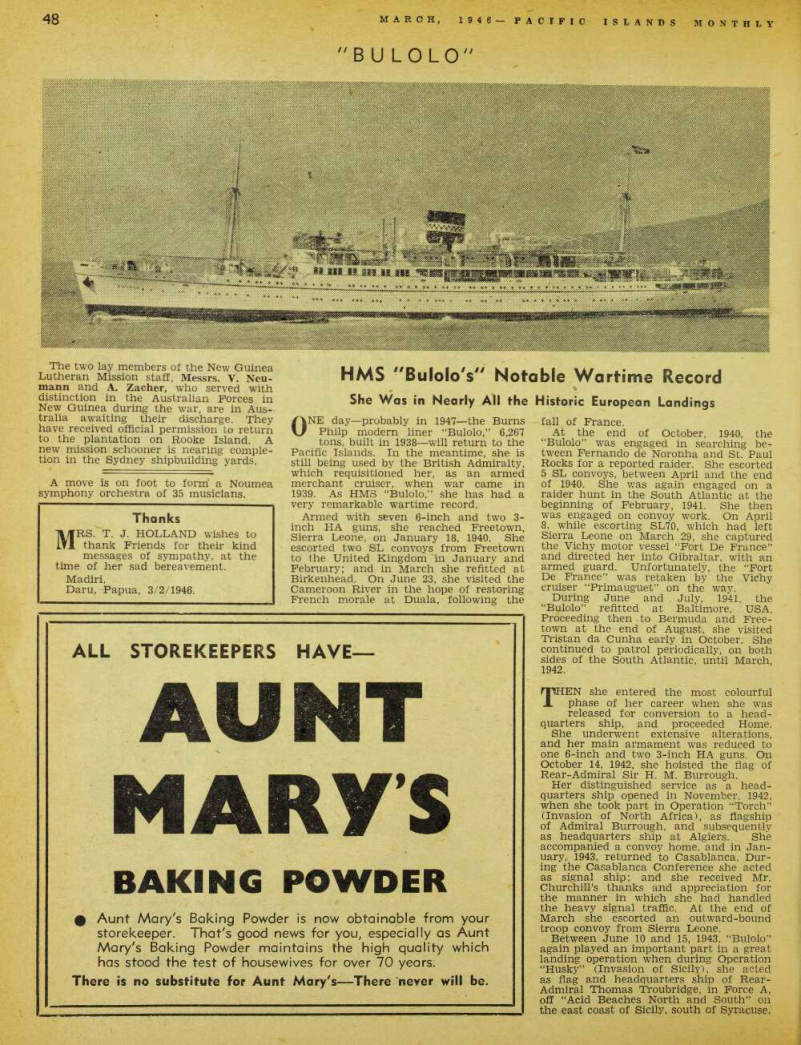
HMS "Bulolo's" Notable Wartime Record
, * She Was in Nearly All the Historic European Landings
ONE day—probably in 1947 —the Burns Philp modern liner “Bulolo,” 6,267 tons, built in 1938 —will return to the Pacific Islands. In the meantime, she is still being used by the British Admiralty, which requisitioned her, as an armed merchant cruiser, when war came in 1939. As HMS “Bulolo,” she has had a very remarkable wartime record.
Armed with seven 6-inch and two 3inch HA guns, she reached Freetown, Sierra Leone, on January 18, 1940. She escorted two SL convoys from Freetown to the United Kingdom In January and February; and in March she refitted at Birkenhead. On June 23, she visited the Cameroon River in the hope of restoring French morale at Duala, following the
fall of France.
At the end of October, 1940, the “Bulolo” was engaged in searching be tween Fernando de Noronha and St. Paul Rocks for a reported raider. She escorted 5 SL convoys, between April and the end of 1940. She was again engaged on a raider hunt in the South Atlantic at the beginning of February, 1941. She then was engaged on convoy work. On April 8, while escorting SL7O, which had left Sierra Leone on March 29, she captured the Vichy motor vessel “Fort De France” and directed her into Gibraltar, with an armed guard. Unfortunately, the “Fort De France” was retaken by the Vichy cruiser “Primauguet” on the way.
During June and July, 1941, the “Bulolo” refitted at Baltimore, USA.
Proceeding then to Bermuda and Free town at the end of August, she visited Tristan da Cunha early in October. She continued to patrol periodically, on both sides of the South Atlantic, until March, 1942.
THEN she entered the most colourful phase of her career when she was released for conversion to a head quarters ship, and proceeded Home.
She underwent extensive alterations, and her main armament was reduced to one 6-inch and two 3-inch HA guns. On October 14, 1942, she hoisted the flag of Rear-Admiral Sir H. M. Burrough.
Her distinguished service as a head quarters ship opened in November. 1942, when she took part in Operation “Torch” (Invasion of North Africa), as flagship of Admiral Burrough, and subsequently as headquarters ship at Algiers. She accompanied a convoy home, and in Jan uary, 1943, returned to Casablanca. Dur ing the Casablanca Conference she acted as signal ship; and she received Mr.
Churchill’s thanks and appreciation for the manner in which she had handled the heavy signal traffic. At the end of March she escorted an outward-bound troop convoy from Sierra Leone.
Between June 10 and 15, 1943, “Bulolo” again played an important part in a great landing operation when during Operation “Husky” (Invasion of Sicily), she acted as flag and headquarters ship of Rear- Admiral Thomas Troubridge, in Force A, off “Acid Beaches North and South” on the east coast of Sicily, south of Syracuse.
She flew the flag of Rear-Admiral A. M.
Peters, Force M, Suez Canal Area, from August 16 till September 4. After visit ing Bombay she was at Aden on January 1, 1944.
ON January 22, 1944, she rehoisted the flag of Rear-Admiral Troubridge for Operation “Shingle” (the Anzio landing), and once again played a promi nent part in a historic operation.
“Bulolo” left the Mediterranean at the end of March, 1944, and went to England, where she was placed under the orders of Admiral Sir Bertram Ramsay for the invasion of France (Operation “Over lord”). On May 24 (Empire Day), she received the great honour of a visit from HM King George VI, who reviewed the assault craft from her bridge.
On April 28, she hoisted the flag of Commodore C. E. Douglas-Pennant; and on June 3 she received a welcome visit from two Prime Ministers, Mr. Winston Churchill and Field-Marshal Smuts.
Three days later, on June 6, “Bulolo” took a leading part in Operation “Nep tune” (Normandy landing), and was damaged by a 250 lb. phosphorous bomb, in an air attack off the beaches next day, sustaining some fatal casualties.
At the end of June, 1945, she was taken in hand and brought up to the new headquarters ship requirements. She completed her trials on April 30, 1945, a few days before the war in Europe came to its victorious end.