Reviewed
pp. 50-51 · Read in the full issue
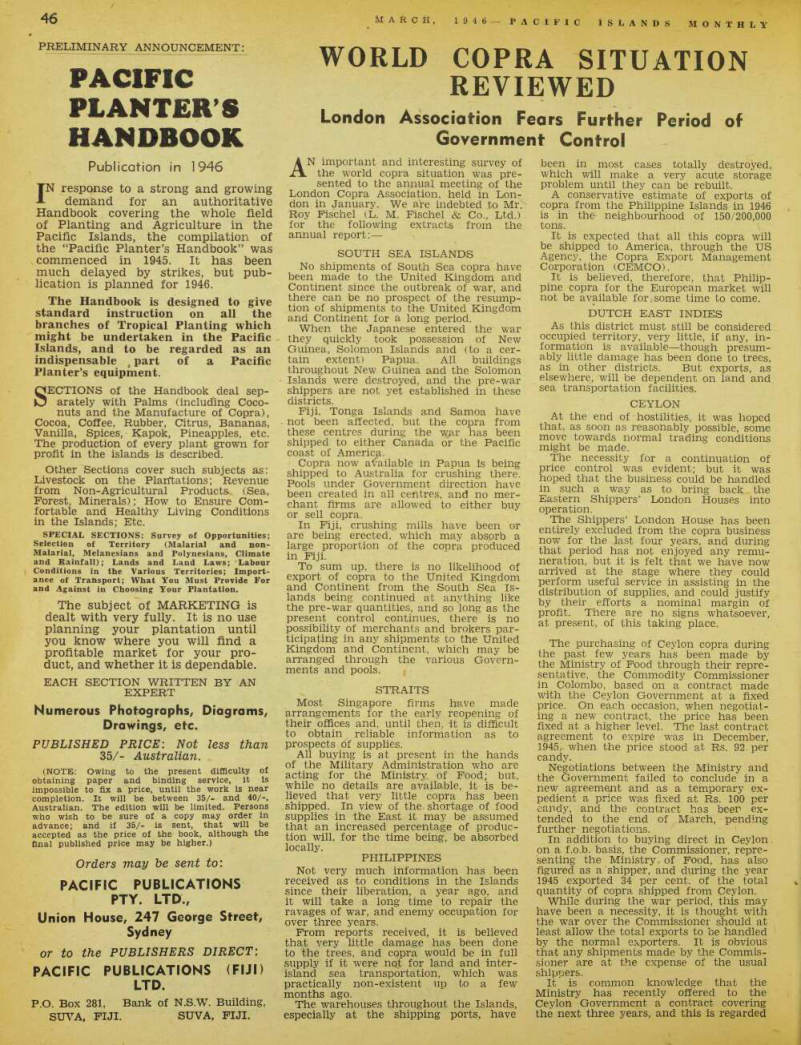
World Copra Situation
London Association Fears Further Period of Government Control
AN important and interesting survey of the world copra situation was pre sented to the annual meeting of the London Copra Association, held in Lon don in January. We are indebted to Mr.
Roy Fischel (L. M. Fischel & Co., Ltd.) for the following extracts from the annual report:—
South Sea Islands
No shipments of South Sea copra have been made to the United Kingdom and Continent since the outbreak of war, and there can be no prospect of the resump tion of shipments to the United Kingdom and Continent for a long period.
When the Japanese entered the war they quickly took possession of New Guinea, Solomon Islands and (to a cer tain extent) Papua. All buildings throughout New Guinea and the Solomon Islands were destroyed, and the pre-war shippers are not yet established in these districts.
Fiji, Tonga Islands and Samoa have not been affected, but the copra from these centres during the war has been shipped to either Canada or the Pacific coast of America.
Copra now available in Papua is being shipped to Australia for crushing there.
Pools under Government direction have been created in all centres, and no mer chant firms are allowed to either buy or sell copra.
In Fiji, crushing mills have been or are being erected, which may absorb a large proportion of the copra produced in Fiji.
To sum up, there is no likelihood of export of copra to the United Kingdom and Continent from the South Sea Is lands being continued at anything like the pre-war quantities, and so long as the present control continues, there is no possibility of merchants and brokers par ticipating in any shipments to the United Kingdom and Continent, which may be arranged through the various Govern ments and pools.
Straits
Most Singapore firms have made arrangements for the early reopening of their offices and, until then, it is difficult to obtain reliable information as to prospects of supplies.
All buying is at present in the hands of the Military Administration who are acting for the Ministry, of Food; but, while no details are available, it is be lieved that very little copra has been shipped. In view of the shortage of food supplies in the East it may be assumed that an increased percentage of produc tion will, for the time being, be absorbed locally.
Philippines
Not very much information has been received as to conditions in the Islands since their liberation, a year ago, and it will take a long time to repair the ravages of war, and enemy occupation for over three years.
From reports received, it is believed that very little damage has been done to the trees, and copra would be in full supply if it were not for land and inter island sea transportation, which was practically non-existent up to a few months ago.
The warehouses throughout the Islands, especially at the shipping ports, have
been in most cases totally destroyed, which will make a very acute storage problem until they can be rebuilt, A conservative estimate of exports of copra from the Philippine Islands in 1946 is in the neighbourhood of 150/200,000 tons.
It is expected that all this copra will be shipped to America, through the US Agency, the Copra Export Management Corporation (CEMCO).
It is believed, therefore, that Philip pine copra for the European market will not be available for, some time to come.
Dutch East Indies
As this district must still be considered occupied territory, very little, if any, in formation is available—though presum ably little damage has been done to trees, as in other districts. But exports, as elsewhere, will be dependent on land and sea transportation facilities.
Ceylon
At the end of hostilities, it was hoped that, as soon as reasonably possible, some move towards normal trading conditions might be made.
The necessity for a continuation of price control was evident; but it was hoped that the business could be handled in such a way as to bring back the Eastern Shippers’ London Houses into operation.
The Shippers’ London House has been entirely excluded from the copra business now for the last four years, and during that period has not enjoyed any remu neration, but it is felt that we have now arrived at the stage where they could perform useful service in assisting in the distribution of supplies, and could justify by their efforts a nominal margin of profit. There are no signs whatsoever, at present, of this taking place.
The purchasing of Ceylon copra during the past few years has been made by the Ministry of Food through their repre sentative, the Commodity Commissioner in Colombo, based on a contract made with the Ceylon Government at a fixed price. On each occasion, when negotiat ing a new contract, the price has been fixed at a higher level. The last contract agreement to expire was in December, 1945 r when the price stood at Rs. 92 per candy.
Negotiations between the Ministry and the Government failed to conclude in a new agreement and as a temporary ex pedient a price was fixed at Rs. 100 per candy, and the contract has beer ex tended to the end of March, pending further negotiations.
In addition to buying direct in Ceylon on a f.o.b. basis, the Commissioner, repre senting the Ministry of Food, has also figured as a shipper, and during the year 1945 exported 34 per cent, of the total quantity of copra shipped from Ceylon.
While during the war period, this may have been a necessity, it is thought with the war over the Commissioner should at least allow the total exports to be handled by the normal exporters. It is obvious that any shipments made by the Commis sioner are at the expense of the usual shippers.
It is common knowledge that the Ministry has recently offered to the Ceylon Government a contract covering the next three years, and this is regarded
as a very significant move, which might act detrimentally to the future of the Shippers’ London House. It is an indi cation of the view held by the Ministry of Food of the present world situation of oils and fats.
If a further period of three years’ con trol is contemplated, to the exclusion of the Shippers’ London House, we fear that the continued inter-Governmental trad ing, without their assistance, might even tually result in their obliteration for an
extended period.
AS Ceylon has been the only copra producing centre of any consequence for some years, we regard the method of handling the present negotia tions as an indication of the attitude which the Ministry of Food will ultimately adopt with other copra-producing centres.
If the Shippers’ London Houses are ever again to play their part in the trade, as they should do, it is suggested that it is at this stage that representatives of the London copra trade should make the most strenuous efforts for the re-establishment of Shippers’ London Houses, which in the past have contributed a genuine and valu able effort towards the success of the trade.
In conclusion, though it is not ex pected that the trade will return to its pre-war channels in any great volume during 1946, it is hoped that the incoming Committee will continue to make every effort by direct action; and, through the British Federation, to get the copra trade back to conditions that Will be mutually satisfactory to its members.
Editorial Note—Why There Is
Copra Shortage
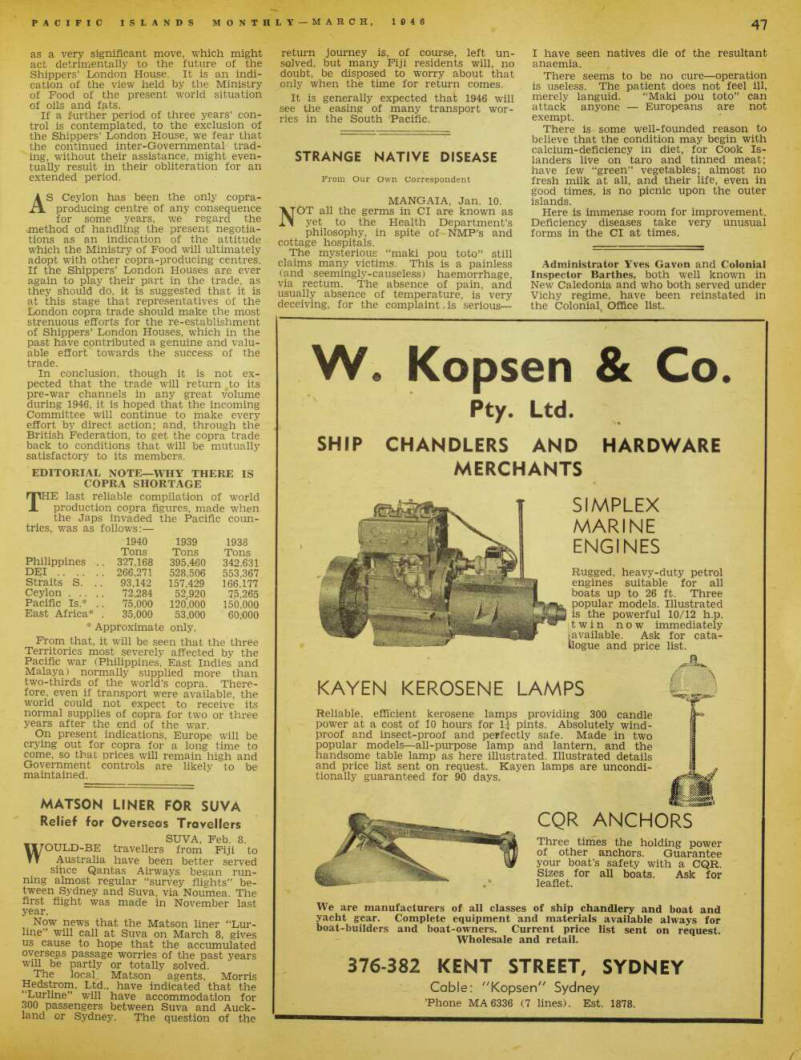
rpHE last reliable compilation of world X production copra figures, made when the Japs invaded the Pacific coun tries, was as follows:
From that, it will be seen that the three Territories most severely affected by the Pacific war (Philippines, East Indies and Malaya) normally supplied more than two-thirds of the world’s copra. There fore, even if transport were available, the world could not expect to receive its normal supplies of copra for two or three years after the end of the war.
On present indications, Europe will be crying out for copra for a long time to come, so that prices will remain high and Government controls are likely to be maintained.
1940 1939 1938 Tons Tons Tons Philippines .. 327,168 395,460 342,631
Dei 266,271
528,506 553,367 Straits S. .. 93,142 157,429 166,177 Ceylon 72,284 52,920 75.265 Pacific Is.* .. 75,000 120,000 150,000 East Africa* . 35,000 53,000 60,000 * Approximate only.