Agriculture
p. 22 · Read in the full issue
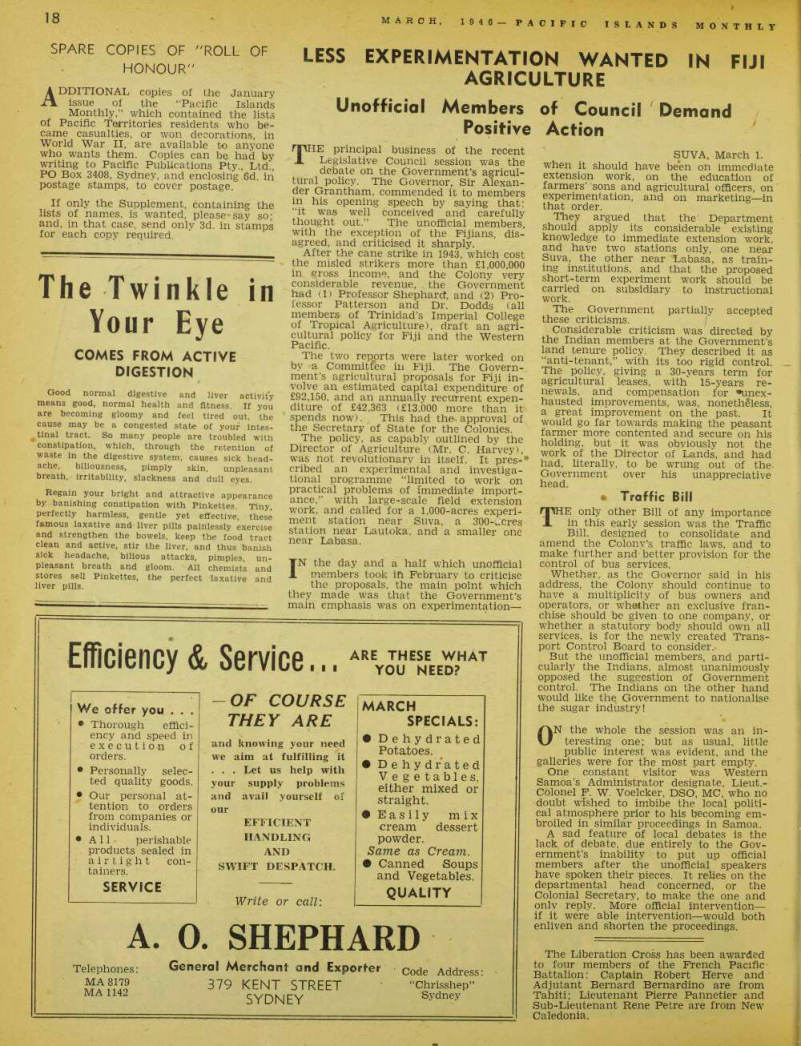
Less Experimentation Wanted In Fiji
Unofficial Members of Council Demand Positive Action
rIE principal business of the recent Legislative Council session was the debate on the Government’s agricul tural policy. The Governor, Sir Alexan der Grantham, commended it to members in his opening speech by saying that: “it was well conceived and carefully thought out.” The unofficial members, with the exception of the Fijians, dis agreed, and criticised it sharply.
After the cane strike in 1943, which cost the misled strikers more than £1,000,000 in gross income, and the Colony very considerable revenue, the Government had (1) Professor Shephard, and (2) Pro fessor Patterson and Dr. Dodds (all members of Trinidad’s Imperial College of Tropical Agriculture), draft an agri cultural policy for Fiji and the Western Pacific.
The two reports were later worked on by a Committee in Fiji. The Govern ment’s agricultural proposals for Fiji in volve an estimated capital expenditure of £92,150, and an annuallv recurrent expen diture of £42,363 (£13,000 more than it spends now). This had the*, approval of the Secretary of State for the Colonies.
The policy, as capably outlined by the Director of Agriculture (Mr. C. Harvey), was not revolutionary in itself. It pres cribed an experimental and investiga tional programme “limited to work on practical problems of immediate import ance,” with large-scale field extension work, and called for a 1,000-acres experi ment station near Suva, a station near Lautoka, and a smaller one near Labasa.
IN the day and a half which unofficial members took in February to criticise the proposals, the main point which they made was that the Government’s main emphasis was on experimentation—
SUVA, March 1. when it should have been on immediate extension work, on the education of farmers’ sons and agricultural officers, on experimentation, and on marketing—in that order.
They argued that the' Department should apply its considerable existing knowledge to immediate extension work, and have two stations only, one near Suva, the other near Labasa, as train ing institutions, and that the proposed short-term experiment work should be carried on subsidiary to instructional work.
The Government partially accepted these criticisms.
Considerable criticism was directed by the Indian members at the Government’s land tenure policy. They described it as “anti-tenant,” with its too rigid control.
The policy, giving a 30-years term for agricultural leases, with 15-years re newals, and compensation for •unex hausted improvements, was, nonetheless, a great improvement on the past. It would go far towards making the peasant farmer more contented and secure on his holding, but it was obviously not the work of the Director of Lands, and had had, literally, to be wrung out of the- Government over his unappreciative head.
• Traffic Bill
rE only other Bill of any importance in this early session was the Traffic Bill, designed to consolidate and amend the Colony’s traffic laws, and to make further and' better provision for the control of bus services.
Whether, as the Governor said in his address, the Colony should continue to have a multiplicity of bus owners and operators, or whether an exclusive fran chise should be given to one company, or whether a statutory body should own all services, is for the newly created Trans port Control Board to consider.
But the unofficial members, and parti cularly the Indians, almost unanimously opposed the suggestion of Government control. The Indians on the other hand would like the Government to nationalise the sugar industry!
ON the whole the session was an in teresting one; but as usual, little public interest was evident, and the galleries were for the most part empty.
One constant visitor was Western Samoa’s Administrator designate, Lieut.- Colonel P. W. Voelcker, DSO, MC, who no doubt wished to imbibe the local politi cal atmosphere prior to his becoming em broiled in similar proceedings in Samoa.
A sad feature of local debates is the lack of debate, due entirely to the Gov ernment’s inability to put up official members after the unofficial speakers have spoken their pieces. It relies on the departmental head concerned, or the Colonial Secretary, to make the one and only reply. More official intervention— if it were able intervention—would both enliven and shorten the proceedings.
The Liberation Cross has been awarded to four members of the French Pacific Battalion; Captain Robert Herve and Adjutant Bernard Bernardino are from Tahiti; Lieutenant Pierre Pannetier and Sub-Lieutenant Rene Petre are from New Caledonia.