Shangri
pp. 14-15 · Read in the full issue
LA
A HITHERTO unknown valley was be lieved to have been discovered in mid-1945 when an American trans port plane crashed into a high valley in Dutch New Guinea. The valley was called the “Hidden Valley,” or Shangri-La, and was featured in articles and pictures in American, British and Australasian pub lications. We published an article and photographs in July issue of “PIM.”
Comparison of photographs later re vealed, however, that the “Hidden Valley” had been visited previously—bv the Arch bold Expedition in 1938—and had been called the Grand Valley of the Balim River.
We published this fact last November, and now publish a series of photographs taken by the expedition in 1938 and kindly made available to us by the Archbold Expedition, of the American Museum of
Natural History, who also supply the following data: — EARLY in the exploration of the Grand Valley by the Archbold Expedition it was found that the Catalina-type flying-boat “Guba,” used by the party could be landed near the lower end of the valley. A base camp was established there, supplies were flown in to this land ing place, and from it the whole party of 100 men was flown out of the valley when its work was done.
The Archbold Expedition was carried out with the co-operation and assistance of the Netherlands Indies Government and was known officially as the “Indisch- Amerikaansche Expeditie.” The Indies Government provided a military covering party of 50 officers and men for the pro tection of the expedition, and attached two men to the scientific staff.
The object of the expedition was to col lect and study mammals, birds, insects and plants.
The Grand Valley was discovered on June 23, 1938. on a reconnaissance flight from Hollandia to the Snow Mountains, in the remote interior. The first ground examination of the valley was made by exploration patrols of the expedition led by Staff Captain C. G. J. Terrink and Lieut. V. J. E. M. van Arcken, of the Netherlands Indies Army.
Teerink’s patrol set out from Lake Hab bema, high up in the Snow Mountains, where the expedition had established its main inland camp and air-freighting base, nearly 11,000 feet above sea level, van Arcken made his way in from the Idenburg, a big river on the lowlands to the north of the valley.
These patrols were supplied by para chutes dropped from the “Guba.”
Later, the scientific party moved down into the new valley and for three months lived and travelled amongst the natives and made collections and observations which added greatly to the still very im portant knowledge’ of the New Guinea flora and fauna, and threw light on the culture and customs of one of the most interesting peoples of the island.
Nearly everywhere in the valley the natives were very friendly toward the ex pedition, which they greeted with pacific gestures and repeated calls of “Nap” or “Wah.” They brought great quantities of
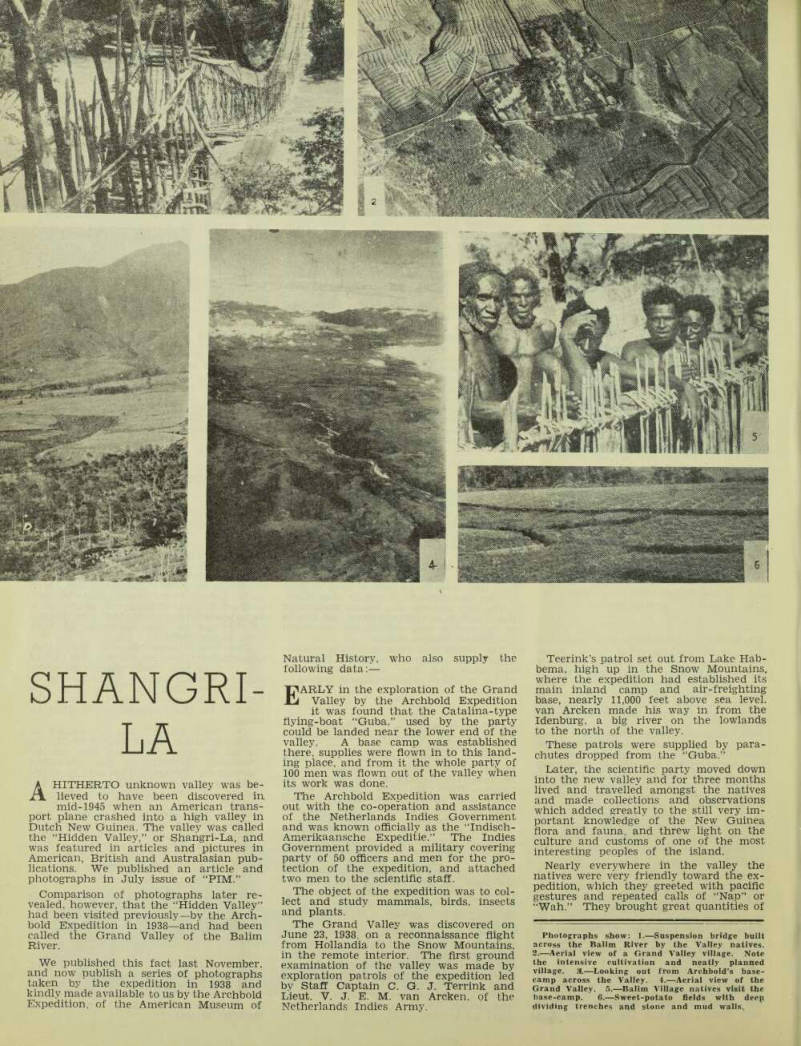
Photographs show: 1.—Suspension bridge built across the Balim River by the Valley natives. 2.—Aerial view of a Grand Valley village. Note the intensive cultivation and neatly planned village. 3. —Looking out from Archbold’s base camp across the Valley. 4.—Aerial view of the Grand Valley. 5.—Balim Village natives visit the base-camp. 6.—Sweet-potato fields with deep dividing trenches and stone and mud walls.
sweet potatoes and other food for sale, for little white cowrie shells, hunted birds and mammals for the scientists, and even assisted in carrying supplies and equipment from camp to camp.
Upon their entry into the valley the white men of the Archbold party were put through blood-sprinkling rites and initiation ceremonies which cemented friendly relations with the local natives.
However, the population of between 100,000 people was split into many com munities, sometimes hostile toward their neighbours, sometimes living in peace; and, upon entering the domains oi each community, ' fresh diplomatic relations had to be entered into with representa tives of the local people.
Burnt villages were seen, and war parties on the move; but in only one section of the valley did the expedition fail to establish itself on good terms.
There the people, although in irequent contact with expedition parties travelling through their territory, always remained aloof, and on several occasions threatened hostilities.