Twenty-One
p. 44 · Read in the full issue
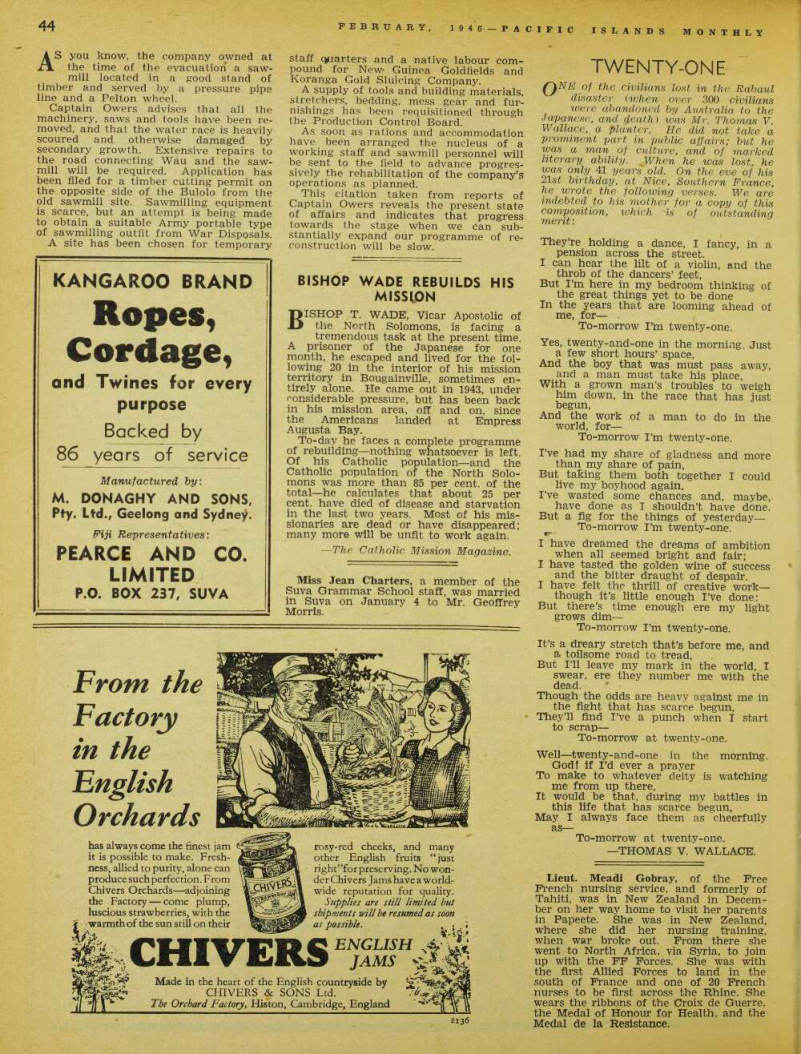
ONE of the civilians lost in the Rabaul disaster (when over 300 civilians were abandoned by Australia to the Japanese, and fleath) was Mr. Thomas V.
Wallace, a planter. He did not take a prominent part in public affairs; but he was a man of culture, and of marked literary ability. JVhen he was lost, he was only 41 years old. On the eve of his 21sf birthday, at Nice, Southern France, he wrote the following verses. We are indebted to his mother for a copy of this composition, which is of outstanding merit: They’re holding a dance, I fancy, in a pension across the street.
I can hear the lilt of a violin, and the throb of the dancers’ feet, But I’m here in my bedroom thinking of the great things yet to be done In the years that are looming ahead of me, for— .
To-morrow I’m twenty-one.
Yes, twenty-and-one in the morning. Just a few short hours’ space, And the boy that was must pass away, and a man must take his place, With a grown man’s troubles to weigh him down, in the race that has just begun, And the work of a man to do in the world, for— To-morrow I’m twenty-one.
I’ve had my share of gladness and more than my share of pain, But taking them both together I could live my boyhood again.
I’ve wasted some chances and, maybe, have done as I shouldn’t have done.
But a fig for the things of yesterday— To-morrow I’m twenty-one.
I have dreamed the dreams of ambition when all seemed bright and fair; I have tasted the golden wine of success and the bitter draught of despair.
I have felt the thrill of creative work— though it’s little enough I’ve done: But there’s time enough ere my light grows dim— To-morrow I’m twenty-one.
It’s a dreary stretch that’s before me, and a, toilsome road to tread, But I’ll leave my mark in the world, I swear, ere they number me with the dead.
Though the odds are heavy against me in the fight that has scarce begun, They’ll find I’ve a punch when I start to scrap— To-morrow at twenty-one.
Well —twenty-and-one in the morning.
God! if I’d ever a prayer To make to whatever deity is watching me from up there, It would be that, during my battles in this life that has scarce begun, May I always face them as cheerfully as— To-morrow at twenty-one.
Thomas V. Wallace.
Lieut. Meadi Gobray, of the Free French nursing service, and formerly of Tahiti, was in New Zealand in Decem ber on her way home to visit her parents in Papeete. She was in New Zealand, where she did her nursing training, when war broke out. From there she went to North Africa, via Syria, to join up with the FF Forces. She was with the first Allied Forces to land in the south of France and one of 20 French nurses to be first across the Rhine. She wears the ribbons of the Croix de Guerre, the Medal of Honour for Health, and the Medal de la Resistance.