Vatukoulan Valleys
pp. 26-27 · Read in the full issue
The Fijian Becomes A Miner
And a Member of a New Community in the Vatukoulan Valleys
By Judy Tudor
rERE was the usual hiatus Between getting into the bus at Tavua, and the start of the seven-mile jour ney out to the goldmines. A small Fijian girl lost sixpence outside one of the stores, and spent 10 minutes in frantic search, while bus passengers and driver' offered advice. The sixpence was not found and, reconciled at last to her loss,, she climbed back inside and we were off on the dry, dusty, snaking road to Vatukoula.
I had been told that I “must see the mines” and here I was off to see them.
But I had had too much sun the pre vious day and this, too, promised to be a scorcher. My knees began to buckle in anticipation as we rounded the last bend, shot through a Fijian mine “vil lage” ground and wound up hills and past stores, machine-shops, clubs, and suburban villas for 10 minutes, until -foe reached my objective—the office on the brow of a mountain.
So this is how they mined in Fiji; that pulsing township, sprawled over the valleys. I had been told that it was a “millionaire’s mine”; I was now pre pared to believe it.
The office interior was, by comparison with the white heat of the road, cool, and the general manager of the two Theodore companies, Loloma and Em peror, immediately set my mind at rest concerning the task of visiting his domain. There was, he said, his own technical adviser to show me round, and his own car and driver to drive us.
“Now,” he said, “I believe you want to go underground?” Technical Adviser, whom I had met the previous day, had suggested as much, and I had agreed that it might be interesting.
“We have made it a rule never to let women go underground. Anyhow, you wouldn’t like it and you would have no idea what you were looking at. It would be much better to concentrate on the social side of affairs—the schools, the hospital and the community life of the work-people generally. See the mill and the open cut by all means—but, no, underground wouldn’t interest you at all.”
“You mean the ‘woman’s angle’?” Pos sibly I looked unenthusiastic at the pros pect; and, after a moment’s pause, he hastened to say, “Well, yes. But if you have a quarter of an hour to spare after you’ve seen everything else maybe you could go down just for a quick trip— for the experience.”
WE let it go at that, and my escort and I started on our rounds. There is mighty little of the squalor and dirt of the old-fashioned mining town about Vatukoula. Everything, so far as it is compatible with utility, is plan ned to give pleasure to the eye as well as to the pocket.
I had already gathered from conver sations in the office, that the companies exercised a sort of benevolent dictator ship over the Vatukoulan valleys, and that, on the whole, the inhabitants thrived on it. There are schools for the Euronesians, for the European child ren. and a large one for the 400 Fijian children. The Fijians pay one-quarter of the cost of their school, the com panies one-quarter, and the Fiji Govern ment one-half.
There is a maternity hospital for Fijian women, a native medical prac titioner, and an ambulance to take all emergency cases to the hospital in the neighbouring town of Ba. Houses are rented to employees at a nominal figure, and electricity and water are supplied to the Europeans. Sports are encour aged among all sections of the com munity, and particularly among the Fijians, who take an avid interest in all games.
WE visited the tremendous open-cut, now almost worked out, but where giant electric excavators still tear tons of gold-bearing rock from the face of the workings: and the mill itself, where the complicated and inexplicable (to the novice) processes of turning lead grey lode into gold bricks, are carried out.
One can appreciate the vastness of the enternrise; the organising ability of E.
G. Theodore, who took hold when Vatu koula was nothing but dry, brown hill sides, in which gold was known to exist in crude state; and the scientific and technical knowledge necessary to turn the ore into commercial gold. There is romance enough in that and the story of the discovery of gold there, when looked at objectively, but there is extremely little in the actual processes of the mill itself; it is too bewildering, too vast.
I have known the thrills of alluvial goldmining: chasing elusive colours up New Guinea’s streams for days, and weeks; the good “prospect” suddenly re
vealed in some hitherto untried stream— . the heavy grains of yellow metal that wink back from the black sand in a deftly-handled prospecting dish; the nightly “wash-up” of a primitive sluice box. All that is real and intimate part of the gold lust that is almost one of man’s fundamental urges.
But there is nothing of that lure Vatukoula. The mill might be process ing pudding or some other prosiac com modity.
First, it is a grey substance studding a soft quartz, then a mass of pulped rock, or a simmering mud-bath, or a clear liquid—but never real honest-to-good ness gold. I examined that mine from its murky depths to its last refining pro cess, but the only recognisable metal I saw was in a few small gold slugs in the assayer’s office.
Over £6.000,000 worth of gold has come out of Vatukoula, I am told; but after the first frenzied efforts to grasp how the identifiable lode becomes so many gold bricks, I gave up; and the how and the wherefore of the technical processes I witnessed remains to me as clear as the sludgy by-products of the mine itself.
BUT the Theodore interests, one begins to realise, are determinedly a Fijian enterprise. A few Indians are em ployed as motor drivers, but the bulk of the labour is supplied by Fijians from all over the Colony, who work under European supervision. I saw them as sisting the assayer and copying accur ately plans of the mine workings, em ployed as miners and as labourers above ground, while their wives and children lived in model villages near-by.
The Fijian worker is supplied with a house, is paid well, gets a basic ration for himself and his wife; his health is cared for and so are his social pleasures.
But this did not satisfy wholly the large question-mark that was beginning to form itself in my mind: why did the Fijians leave home to do this sort of work, obviously so alien to their own traditional way of life?
I had been instructed that the Fijian has no love of money—if having money means routine employment; that all are landholders, sharing in community rights that suffice for their simple needs, and that the genesis of the present “Indian problem” is due to their aversion to hir ing themselves out as workers. Obser vations lead to the same general con clusions.
Why, then, were 1,200 Fijians living contentedly at Vatukoula, working what, to them were long hours, sometimes dur ing the night, and at a job far removed from that which one would believe they were fitted by nature, culture and en vironment?
No labour contracts exist between management and employee; the manage ment is free to dismiss a man when it wishes: the employee is free to go when he wishes. The conditions of work and pay are good, but in return the com panies demand efficient service. Most of the Fijians employed at the mines, nevertheless, have been there for years— many since the mines began operations eight or 10 years ago.
Both the general manager and my escort had tried to explain to me the fotal fascination that mining had for the Fijians, but I still could not see it. Per haps the answer lay underground.
BY tacit consent, we somehow found ourselves at the head of Smith shaft, where two small wire cages whizzed madlv into the earth, or ap peared abruptly on the surface and were delivered of ore-filled trucks.
“Half a tick while I see if it is OK."
My companion left me for a few mom
rope over a hole 600 feet deep. I began heave o nt e n’am°e r l' the the 1 depths no U good “£ son that I could name, except curiosity “d the desire to have a question I began to wonder, as well, whether I
and met some of the European over
Sef ‘^: s 0 Sith^eal
regret, “I should have liked you to have seen that. rpnlv was The whole atmosphere was unnatural,
were a claustrophobia subject and whether or not, once down, I would run around making mewing noises or otherwise make an exhibition of myself.
But before I could do anything about my growing doubt the TA had returned. ‘Tu’s OK,” he said cheerily, "we can go down in a moment. Here you are—your helmet and lamp.”
I put on a bakelite crash-helmet and took the small lamp he handed me. The greatest danger, I was to find, was that I should set either myself or my companion alight with the naked flame of the lamp.
We were joined by TA’s Fijian assistant, and the three of us crowded into the small cage. Someone pulled a signal rope and we were off. "This is it,” I thought, gloomily; but my friend had apparently warned the winchman that a female of the species was to descend on this first trip to the 10th level, and we went down with the decorum of a department-store lift. On subsequent jaunts between levels, not knowing that he was not delivering ore trucks, we received the full benefit of the more usual technique of winchmanship; one moment you are standing in a slightly swaying cage; the next, the bottom has fallen out of the world and you with it.
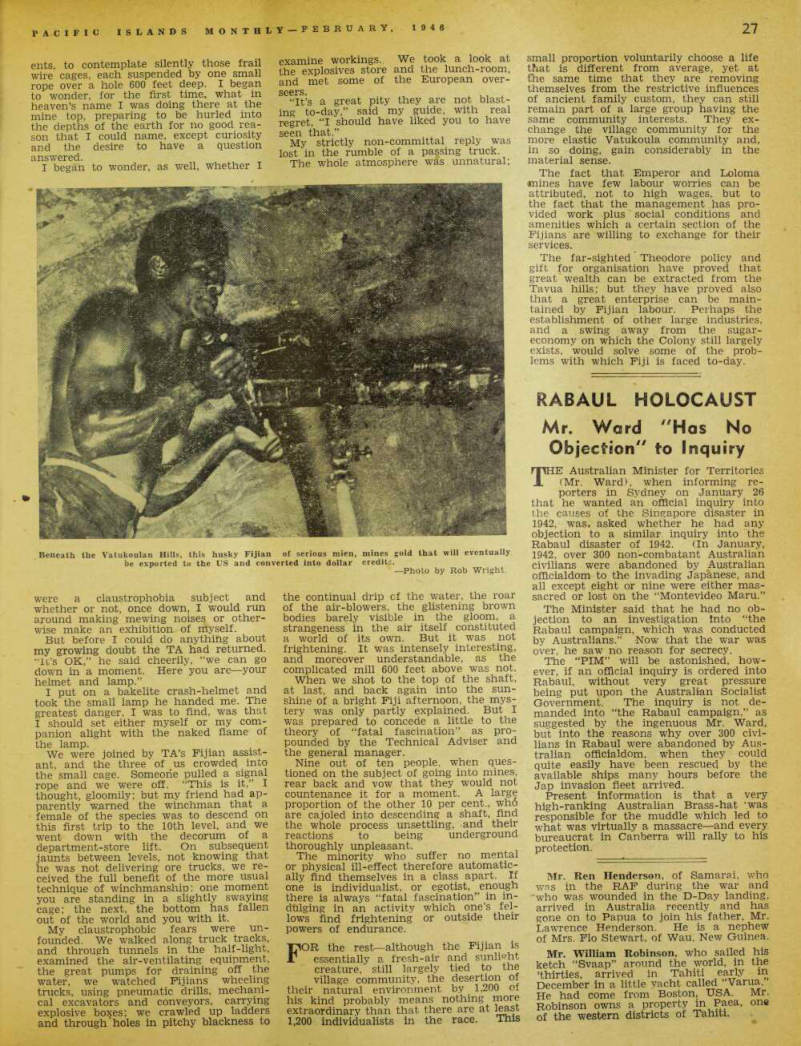
My claustrophobic fears were unfounded. We walked along truck tracks, and through tunnels in the half-light, examined the air-ventilating equipment, the great pumps for draining off the water, we watched Fijians wheeling trucks, using pneumatic drills, mechanical excavators and conveyors, carrying explosive boxes; we crawled up ladders and through holes in pitchy blackness to
the continual drip cf the water, the roar of the air-blowers, the glistening brown bodies barely visible in the gloom, a strangeness in the air itself constituted a world of its own. But it was not frightening. It was intensely interesting, and moreover understandable, as the complicated mill 600 feet above was not.
When we shot to the top of the shaft, at last, and back again into the sun shine of a bright Fiji afternoon, the mys tery was only partly explained. But I was prepared to concede a little to the theory of "fatal fascination” as pro pounded by the Technical Adviser and the general manager, Nine out of ten people, when ques tioned on the subject of going into mines, rear back and vow that they would not countenance it for a moment. A large proportion of the other 10 per cent., who are cajoled into descending a shaft, find the whole process unsettling, and their reactions to being underground thoroughly unpleasant, The minority who suffer no mental or physical ill-effect therefore automatic ally find themselves in a class apart. If one is individualist, or egotist, enough there is always "fatal fascination” in in dulging in an activity which one’s fel lows find frightening or outside their powers of endurance, . ... . .. w ITVDR the rest—although the Fijian £ essentially a fresh-air and sunlight creature, still largely tied to tne village community, the desertion oi their natural environment by 1,200 oi his kind probably means nothing more extraordinary than that there are at least 1,200 individualists in the race. inis
small proportion voluntarily choose a life that is different from average, yet at the same time that they are removing themselves from the restrictive influences of ancient family custom, they can still remain part of a large group having the same community interests. They ex change the village community for the more elastic Vatukoula community and, in so doing, gain considerably in the material sense.
The fact that Emperor and Loloma mines have few labour worries can be attributed, not to high wages, but to the fact that the management has pro vided work plus' social conditions and amenities which a certain section of the Fijians are willing to exchange for their services.
The far-sighted Theodore policy and gift for organisation have proved that great wealth can be extracted from the Tavua hills; but they have proved also that a great enterprise can be main tained by Fijian labour. Perhaps the establishment of other large industries, and a swing away from the sugar economy on which the Colony still largely exists, would solve some of the prob lems with which Fiji is faced to-day.
Beneath the Vatukoulan Hills, this husky Fijian of serious mien, mines gold that will eventually be exported to the US and converted into dollar credits. —Photo by Rob Wright.