When "Maiwara" Became "Van Rees"
pp. 64-66 · Read in the full issue
An Amusing Story of the Early Days of World War II
By Brett Hilder
THE capture of the BP steamer Matunga” by the German raider ‘Wolf,” near Rabaul, in 1917, had always seemed to me to be the classic example of successful raiding.
While it was customary and easy to blame the captain, the Navy, the owners or the Government, it was impossible to prevent the same thing happening again.
I was not worried, personally, because I was sure that when war did come it would find me serving in a well-armed warship, as I had belonged to the Naval Reserve for 10 years.
Imagine my added interest, therefore when the outbreak of war found me master of the “Maiwara,” a small, slow coal-burning steamer, lying at the open and undefended port of Rabayl, focal point of the area through which large fast German cargo-liners must pass on their way to the friendly ports of Japan, after slipping out of Australian ports a couple of days before the outbreak of war.
Such a vessel could so easily catch, and probably ram, a slower vessel, if he hadn’t sufficient arms to attempt a cap ture. I came to the conclusion that the only deterrent would be the disguise of the ship as a strong-minded neutral, such as Dutch, or even Japanese!
Ml Phil. Coote, the local manager, promised me all the paint or other materials needed, and was also prevailed
upon to part with one dozen rifles, as a second string to my bow in case the neutral disguise did not work.
Next came the job of squaring off the Government. Mr. Harold Page said that he would have to get Canberra’s and the Navy’s approval, and that would take time . . .
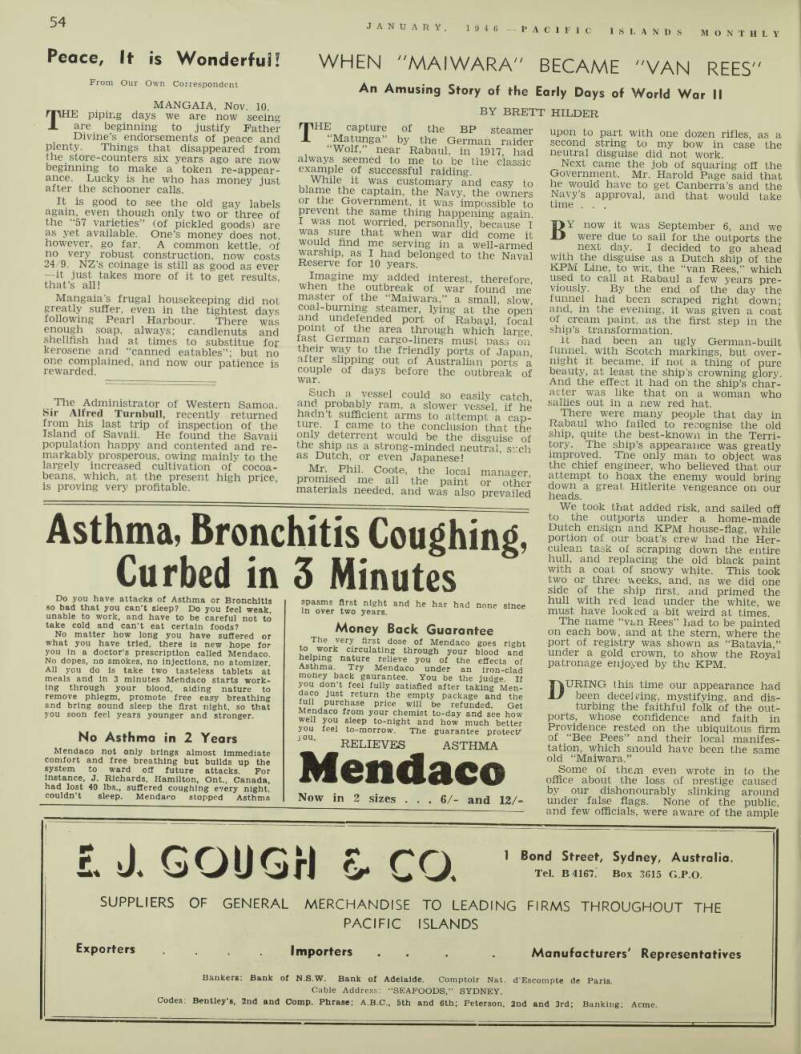
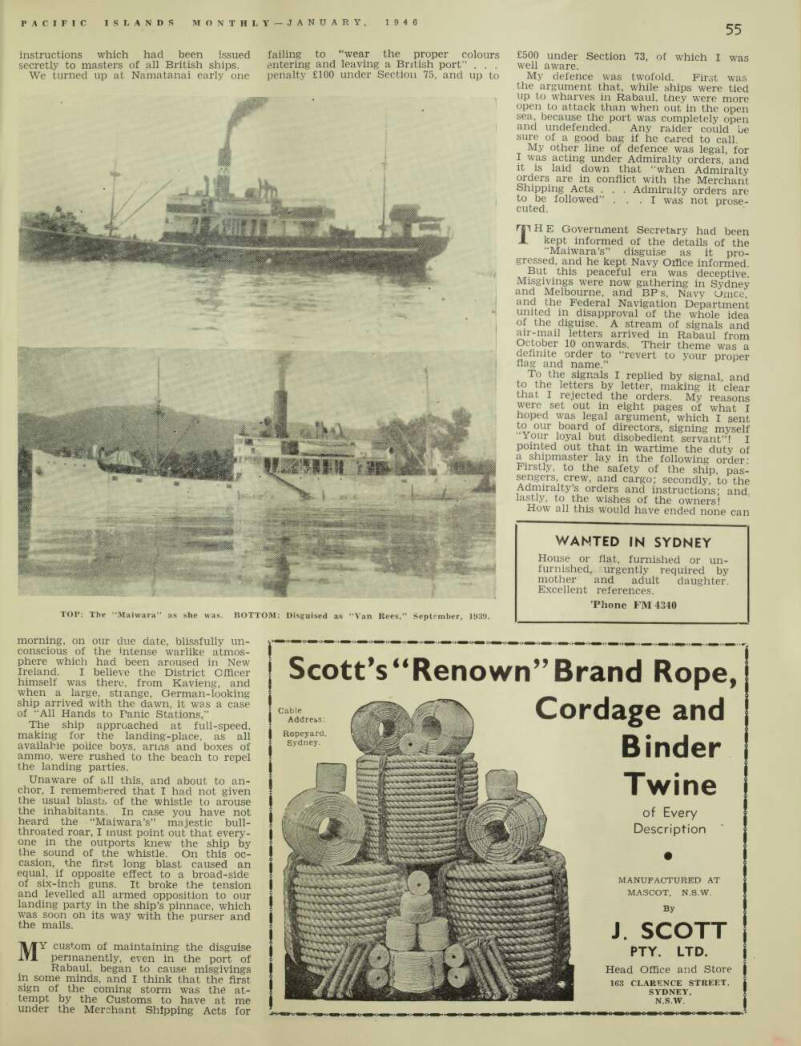
BY now it was September 6, and we were due to sail for the outports the next day. I decided to go ahead with the disguise as a Dutch ship of the KPM Line, to wit, the “van Rees,” which used to call at Rabaul a few years pre viously. By the end of the day the funnel had been scraped right down; and, in the evening, it was given a coat of cream paint, as the first step in the ship’s transformation.
It had been an ugly German-built funnel, with Scotch markings, but over night it became, if not a thing of pure beauty, at least the ship’s crowning glory.
And the effect it had on the ship’s char acter was like that on a woman who sallies out in a new red hat.
There were many people that day in Rabaul who failed to recognise the old ship, quite the best-known in the Terri tory. The ship’s appearance was greatly improved. The only man to object was the chief engineer, who believed that our attempt to hoax the enemy would bring down a great Hitlerite vengeance on our heads.
We took that added risk, and sailed off to the outports under a home-made Dutch ensign and KPM house-flag, while portion of our boat’s crew had the Her culean task of scraping down the entire hull, and replacing the old black paint with a coat of snowy white. This took two or three weeks, and, as we did one side of the ship first, and primed the hull with red lead under the white, we must have looked a bit weird at times.
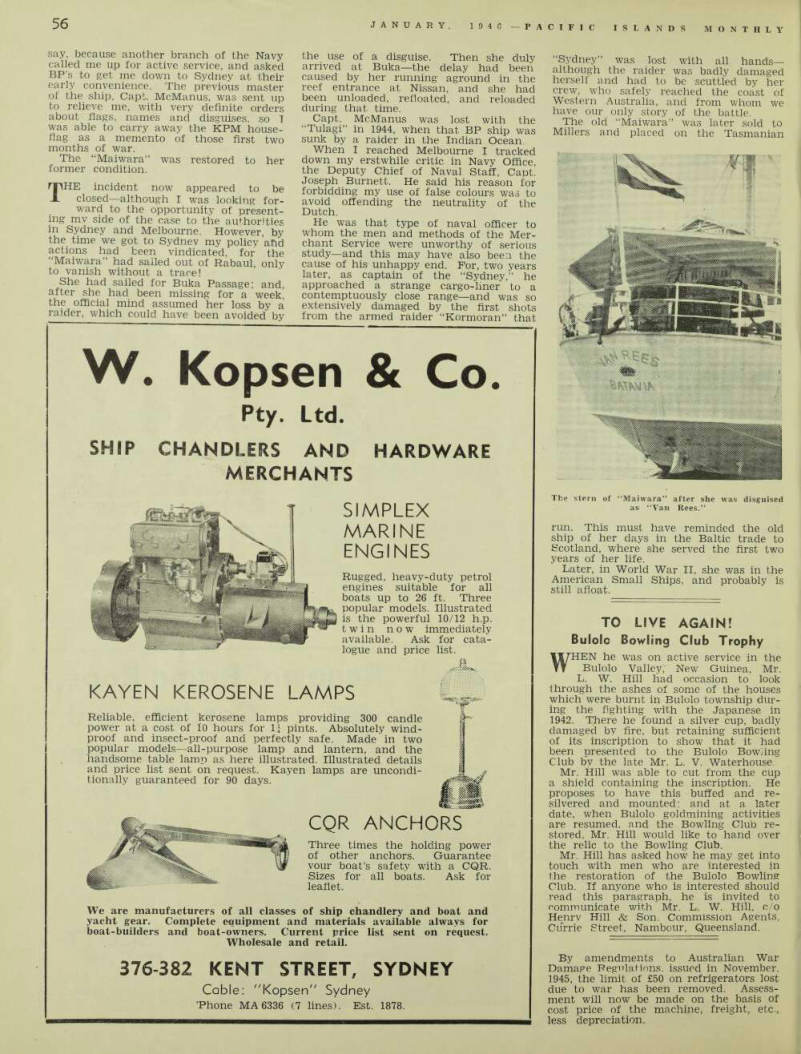
The name “van Rees” had to be painted on each bow, and at the stern, where the port of registry was shown as “Batavia,” under a gold crown, to show the Royal patronage enjoyed by the KPM.
DURING this time our appearance had been deceiving, mystifying, and dis turbing the faithful folk of the out ports, whose confidence and faith in Providence rested on the übiquitous firm of “Bee Pees” and their local manifes tation, which snould have been the same old “Maiwara.”
Some of them even wrote in to the office about the loss of prestige caused by our dishonourably slinking around under false flags. None of the public, and few officials, were aware of the ample
instructions which had been issued secretly to masters of all British ships.
We turned up at Namatanai early one
morning, on our due date, blissfully un conscious of the intense warlike atmos phere which had been aroused in New Ireland. I believe the District Officer himself was there, from Kavieng, and when a large, strange, German-looking ship arrived with the dawn, it was a case of “All Hands to Panic Stations,”
The ship approached at full-speed, making for the landing-place, as all available police boys, arms and boxes of ammo, were rushed to the beach to repel the landing parties.
Unaware of all this, and about to an chor, I remembered that I had not given the usual blasts of the whistle to arouse the inhabitants. In case you have not heard the “Maiwara’s” majestic bull throated roar, I must point out that every one in the outports knew the ship by the sound of the whistle. On this oc casion, the first long blast caused an equal, if opposite effect to a broad-side of six-inch guns. It broke the tension and levelled all armed opposition to our landing party in the ship’s pinnace, which was soon on its way with the purser and the mails.
MY custom of maintaining the disguise permanently, even in the port of Rabaul, began to cause misgivings in some minds, and I think that the first sign of the coming storm was the at tempt by the Customs to have at me under the Merchant Shipping Acts for
failing to “wear the proper colours entering and leaving a British port” . . . penalty £lOO under Section 75, and up to
£5OO under Section 73, of which I was well aware.
My defence was twofold. First was the argument that, while ships were tied up to wharves in Rabaul, they were more open to attack than when out in the open sea, because the port was completely open and undefended. Any raider could be sure of a good bag if he cared to call.
My other line of defence was legal, for I was acting under Admiralty orders, and it is laid down that “when Admiralty orders are in conflict with the Merchant Shipping Acts . , . Admiralty orders are to be followed’' ... I was not prose cuted.
HE Government Secretary had been . kept informed of the details of the “Maiwara’s” disguise as it pro gressed, and he kept Navy Office informed.
But this peaceful era was deceptive.
Misgivings were now gathering in Sydney and Melbourne, and BP s, Navy omce. and the Federal Navigation Department united in disapproval of the whole idea of the diguise. A stream of signals and air-mail letters arrived in Rabaul from October 10 onwards. Their theme was a definite order to “revert to your proper flag and name.”
To the signals I replied by signal, and to the letters by letter, making it clear that I rejected the orders. My reasons were set out in eight pages of what I hoped was legal argument, which I sent to our board of directors, signing myself Your loyal but disobedient servant” l I pointed out that in wartime the duty of a shipmaster lay in the following order: Firstly, to the safety of the ship, pas sengers, crew, and cargo; secondly, to the Admiralty’s orders and instructions; and, lastly, to the wishes of the owners!
How all this would have ended none can
TOP: The “Maiwara” as she was. BOTTOM: Disguised as “Van Rees,” September, 1939.
say, because another branch of the Navy called me up for active service, and asked BP’s to get me down to Sydney at their early convenience. The previous master of the ship, Capt. McManus, was sent up to relieve me, with very definite orders about flags, names and disguises, so I was able to carry away the KPM house flag as a memento of those first two months of war.
The “Maiwara” was restored to her former condition.
THE incident now appeared to be closed—although I was looking for ward to the opportunity of present ing my side of the case to the authorities in Sydney and Melbourne. However, by the time we got to Sydney my policy ahd actions had been vindicated, for the “Maiwara” had sailed out of Rabaul, only to vanish without a trace!
She had sailed for Buka Passage: and, after she had been missing for a week, the official mind assumed her loss by a raider, which could have been avoided by
the use of a disguise. Then she duly arrived at Buka—the delay had been caused by her running aground in the reef entrance at Nissan, and she had been unloaded, refloated, and reloaded during that time.
Capt. McManus was lost with the “Tulagi” in 1944, when that BP ship was sunk by a raider in the Indian Ocean, When I reached Melbourne I tracked down my erstwhile critic in Navy Office, the Deputy Chief of Naval Staff, Capt.
Joseph Burnett. He said his reason for forbidding my use of false colours was to avoid offending the neutrality of the Dutch.
He was that type of naval officer to whom the men and methods of the Mer chant Service were unworthy of serious study—and this may have also been the cause of his unhappy end. For, two years later, as captain of the “Sydney,” he approached a strange cargo-liner to a contemptuously close range—and was so extensively damaged by the first shots from the armed raider “Kormoran” that
“Sydney” was lost with all hands— although the raider was badly damaged herself and had to be scuttled by her crew, who safely reached the coast of Western Australia, and from whom we have our only story of the battle.
The old “Maiwara” was later sold to Millers and placed on the Tasmanian
run. This must have reminded the old ship of her days in the Baltic trade to Scotland, where she served the first two years of her life.
Later, in World War 11, she was in the American Small Ships, and probably is still afloat.
The stern of “Maiwara” after she was disguised as “Van Rees.”