Experiences in Fiji and Ceylon.
pp. 50-51 · Read in the full issue
Value Of Dairy Cattle In Tropical
Islands
FROM the soft trade winds of Fiji to the mountain mists of Nuwara Eliya, in Ceylon, was a considerable change for Mr. C. R. Turbet, MRCVS.
BVSc, senior veterinary officer, Fiji, who has been loaned to the Ceylon Govern ment as Specialist in Animal Husbandry for three years.
The part played by Mr. Turbet in the successful development of animal hus bandry in Fiji, and his report on Agri cultural Rehabilitation and Development of the Solomon Islands, as a result of his mission to that Territory in 1944, no doubt influenced the Secretary of State for the Colonies in making his choice of an officer for Ceylon.
It may be news to some that the cattle of Fiji are considered by world authori ties to be about the best in the tropics, and that the dairy industry and animal husbandry in that country are well developed in proportion to the size of the Colony, and as compared with other tropical Islands Territories.
THE dairy industry in Fiji really commenced after 1919 when the returned soldiers dairy settlement scheme was established at Tailevu.
For several years the industry lan guished, because of the octopus growth of the weed curse “Clidemia hirta,” which grew at such a rate that two clearings each year were needed to keep the pas ture open for grazing.
The cost of this weeding was a millstone around the necks of the farmers: using
up a large part of the proceeds of their efforts, and so reducing their standard of living that it took a stout heart, indeed, for these pioneers to carry on.
The successful control of the curse by biological means was a great victory for the entomologists, and paved the way for the rapid development of the dairying industry.
During the days of the curse, there was much unjust and ill-founded criticism of the TDS, on the part of some unofficial members of the Fiji Legislative Council, and members of the public. Events have proved how wrong those criticisms were.
The £90,000 or so spent by Government from public funds turned out a good in vestment.
Before World War II, the dairy industry was providing all the needs of the Colony in fresh milk, butter and ghee. This asset proved of utmost value during the war period. To-day, the industry must be considered as well established.
IN contrast with the happy state of the animal industries of Fiji, Ceylon (a tropical island about four times the size of Fiji, and having a human popu lation of over 6,000,000, and over 1,000.000 cattle) has been very backward in develop ing the usefulness of its animal popula tion. The Government and the people of Ceylon have recently become conscious of this fact, so that to-day there is consider able enthusiasm for the development of animal industries and the greater use of animals in diversified farming.
As a result of this new interest and the demand for dairy and other animal products arising out of the threatened food shortage occasioned by the war, the Ceylon Government imported over 1,000 dairy cattle from Australia during 1943-44 as a nucleus in opening up a dairy-farm ing industry in the highlands of Ceylon.
Unfortunately, as in Fiji, the venture did not go well at first—owing, in this case, to lack of earlier preparation to receive the animals and of experienced animal husbandrymen. The effect of tick fever on non-immune animals had also not been taken into consideration, so that heavy mortality from this cause was ex perienced.
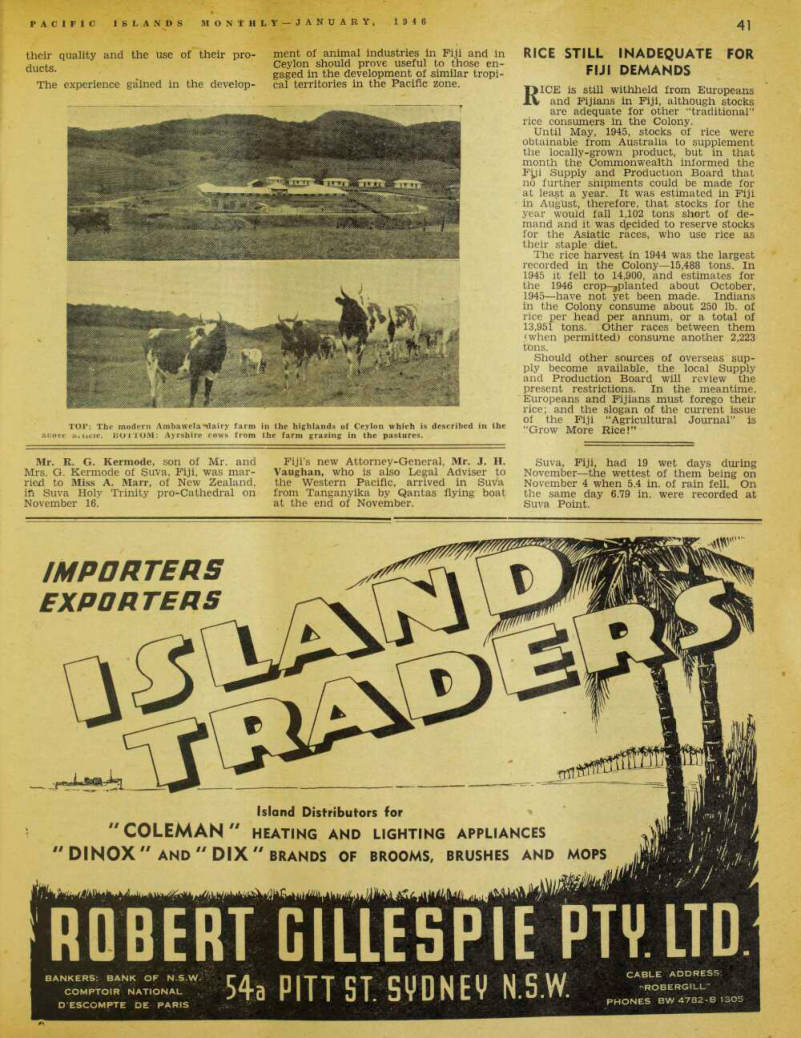
These earlier difficulties have been over come by the establishment of up-to-date dairy farms at Ambawela and Bopatalawa, at elevations of over 5,000 feet.
The Government of Ceylon has not spared expense in providing several millions of rupees for the development and maintenance of the farms, until they be come productive. Tick fever losses are now negligible, as a result of the elimina tion of ticks by dipping. As a further pro tection, artificial immunisation is being practised on young stock.
As in Fiji, efforts to establish commer cial dairy farming in Ceylon have had the usual surfeit of public criticism.
This, however, is now subsiding with the realisation that the Government means business, and that the venture will succeed.
APART from dairying in the uplands of Ceylon the acceptance of the fact that the keeping of animals in a system of diversified farming is essential for the maintenance of soil fertility, and the good health of the people, has led to a much greater interest being taken in the care of animals, the improvement of
their quality and the use of their pro ducts.
The experience gained in the develop
ment of animal industries in Fiji and in Ceylon should prove useful to those en gaged in the development of similar tropi cal territories in the Pacific zone.
TOP: The modern Ambawela dairy farm in the highlands of Ceylon which is described in the above article. BOTTOM: Ayrshire cows from the farm grazing in the pastures. ===
Mr. R. G. Kermode, son of Mr. and Mrs. G. Kermode of Suva, Fiji, was mar ried to Miss A. Marr, of New Zealand, in Suva Holy Trinity pro-Cathedral on November 16.
Fiji’s new Attorney-General, Mr. J. H.
Vaughan, who is also Legal Adviser to the Western Pacific, arrived in Suva from Tanganyika by Qantas flying boat at the end of November. ===