The Strange Case Of The Missing Hoo-Hah
pp. 34-43 · Read in the full issue

“Pim” Short Story :
By Russell N. Thomas
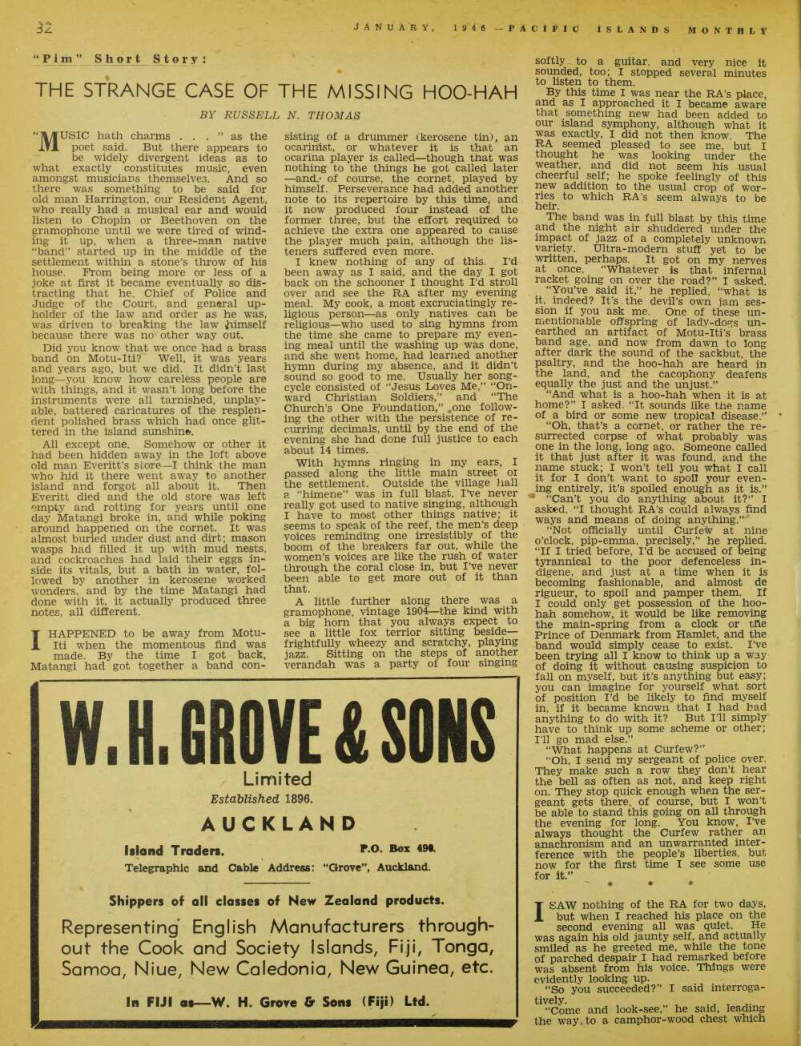
“IV|USIC hath charms ...” as the 111 poet said. But there appears to be widely divergent ideas as to what exactly constitutes music, even amongst musicians themselves. And so there was something to be said for old man Harrington, our Resident Agent, who really had a musical ear and would listen to Chopin or Beethoven on the gramophone until we were tired of wind ing it up, when a three-man native “band” started up in the middle of the settlement within a stone’s throw of his house. From being more or less of a joke at first it became eventually so dis tracting that he, Chief of Police and Judge of the Court, and general up holder of the law and order as he was, was driven to breaking the law himself because there was no other way out.
Did you know that we once had a brass band on Motu-Iti? Well, it was years and years ago, but we did. It didn’t last long—you know how careless people are with things, and it wasn’t long before the instruments were all tarnished, unplay able, battered caricatures of the resplen dent polished brass which had once glit tered in the island sunshine*.
All except one. Somehow or other it had been hidden away in the loft above old man Everitt’s store —I think the man who hid it there went away to another island and forgot all about it. Then Everitt died and the old store was left empty and rotting for years until one day Matangi broke in, and while poking around happened on the cornet. It was almost buried under dust and dirt; mason wasps had filled it up with mud nests, and cockroaches had laid their eggs in side its vitals, but a bath in water, fol lowed by another in kerosene worked wonders, and by the time Matangi had done with it, it actually produced three notes, all different.
I HAPPENED to be away from Motu- Iti when the momentous find was made. By the time I got back, Matangi had got together a band con
sisting of a drummer (kerosene tin), an ocarinist, or whatever it is that an ocarina player is called —though that was nothing to the things he got called later —and,- of course, the cornet, played by himself. Perseverance had added another note to its repertoire by this time, and it now produced four instead of the former three, but the effort required to achieve the extra one appeared to cause the player much pain, although the lis teners suffered even more.
I knew nothing of any of this. I’d been away as I said, and the day I got back on the schooner I thought I’d stroll over and see the RA after my evening meal. My cook, a most excruciatingly re ligious person—as only natives can be religious—who used to sing hymns from the time she came to prepare my even ing meal until the washing up was done, and she went home, had learned another hymn during my absence, and it didn’t sound so good to me. Usually her song cycle consisted of “Jesus Loves Me,” “On ward Christian Soldiers,” and “The Church’s One Foundation,” ,one follow ing the other with the persistence of re curring decimals, until by the end of the evening she had done full justice to each about 14 times.
With hymns ringing in my ears. I passed along the little main street of the settlement. Outside the village hall a “himene” was in full blast. I’ve never really got used to native singing, although I have to most other things native; it seems to speak of the reef, the men’s deep voices reminding one irresistibly of the boom of the breakers far out, while the women’s voices are like the rush of water through the coral close in, but I’ve never been able to get more out of it than that.
A little further along there was a gramophone, vintage 1904 —the kind with a big horn that you always expect to see a little fox terrior sitting beside— frightfully wheezy and scratchy, playing jazz. Sitting on the steps of another verandah was a party of four singing
softly to a guitar, and very nice it sounded, too; I stopped several minutes to listen to them.
By this time I was near the RA’s place, and as I approached it I became aware that something new had been added to our island symphony, although what it was exactly, I did not then know. The RA seemed pleased to see me, but I thought he was looking under the weather, and did not seem his usual cheerful self; he spoke feelingly of this new addition to the usual crop of wor ries to which RA’s seem always to be heir.
The band was in full blast by this time and the night air shuddered under the impact of jazz of a completely unknown variety. Ultra-modern stuff yet to be written, perhaps. It got on my nerves at once. “Whatever is that infernal racket going on over the road?” I asked.
“You’ve said it,” he replied, “what is it, indeed? It’s the devil’s own jam ses sion if you ask me. One of these un mentionable offspring of lady-dogs un earthed an artifact of Motu-Iti’s brass band age, and now from dawn to long after dark the sound of the sackbut, the psaltry, and the hoo-hah are heard in the land, and the cacophony deafens equally the just and the unjust.”
“And what is a hoo-hah when it is at home?” I asked. “It sounds like the name of a bird or some new tropica! disease.”
“Oh, that’s a cornet, or rather the re surrected corpse of what probably was one in the long, long ago. Someone called it that just after it was found, and the name stuck; I won’t tell you what I call it for I don’t want to spoil your even ing entirely, it’s spoiled enough as it is.” : “Can’t you do anything about it?” I asked. “I thought RA’s could always find ways and means of doing anything.”
“Not officially until Curfew at nine o’clock, pip-emma, precisely,” he replied.
“If I tried before, I’d be accused of being tyrannical to the poor defenceless in digene, and just at a time when it is becoming fashionable, and almost de rigueur, to spoil and pamper them. If I could only get possession of the hoo hah somehow, it would be like removing the main-spring from a clock or the Prince of Denmark from Hamlet, and the band would simply cease to exist. I’ve been trying all I know to think up a way of doing it without causing suspicion to fall on myself, but it’s anything but easy; you can imagine for yourself what sort of position I’d be likely to find myself in, if it became known that I had had anything to do with it? But I’ll simply have to think up some scheme or other; I’ll go mad else.”
“What happens at Curfew?”
“Oh, I send my sergeant of police over.
They make such a row they don’t hear the bell as often as not, and keep right on. They stop quick enough when the ser geant gets there, of course, but I won’t be able to stand this going on all through the evening for long. You know, I’ve always thought the Curfew rather an anachronism and an unwarranted inter ference with the people’s liberties, but now for the first time I see some use for it.” * * * I SAW nothing of the RA for two days, but when I reached his place on the second evening all was quiet. He was again his old jaunty self, and actually smiled as he greeted me, while the tone of parched despair I had remarked before was absent from his voice. Things were evidently looking up.
“So you succeeded?” I said interroga tively.
“Come and look-see,” he said, leading the way. to a camphor-wood chest which
stood in the passage, and which he un locked. Unwrapping something from several layers of old newspaper he un covered what had undoubedly at some time been a cornet.
“Behold, the hoo-hah,” he said. * * * MATANGI’S professed to be very much upset at the theft; she went to the RA’s office to report it, and gave a most circumstantial account of how on her return to her house after being absent for a few minutes she saw someone carrying something, which might have been the hoo-hah, dodge around the side of the house. But, alas—by the time she got there he had clean disappeared.
No. she couldn’t identify him. and could not even say for certain whether what he had been carrying was the hoo-hah or not.
The RA questioned her on various points, and then wrote it all down.
Several natives in the office who were listening were much impressed.
But Matangi’s wife was not nearly as much unset as Matangi, who refused to be comforted. His only consolation was his wife’s sympathy for his loss and her solicitude in his misfortune which he. had somehow not expected. But then women are always quite unpredictable, anyway. Just at this time, too, she had received, so she said, a present of £2 from some obscure relation on another island.
Matangi had never heard of this relation, but as his wife bought tins of beef for them both from the store, he was not dis posed to be too curious about this un expected windfall.
But what Matangi will never know is that the £2 came from the RA, who had conspired with Matangi’s wife, unlawfully and with malice aforethought, to steal from him an instrument of music, to wit, one hoo-hah aforementioned.