Far-Seeing Ng
p. 24 · Read in the full issue
Policy
Pays Dividends
Tribute to the Memory of Gen.
Wisdom
Brig.-General E. A.
Wisdom had retired from active life some years before his death on December 9, the cadet system which he introduced into the Mandated Territory, after World War I, paid handsome dividends in World War 11.
The following article, by Allan Dawes,
of the Melbourne “Herald,” pays tri bute to General Wisdom who, between 1921 and 1932, served as Australia’s first Administrator in the Mandated
Territory of New Guinea.
WITH the death of Brig.-Gen. E. A.
Wisdom, following close on the re cent release of the news about the torpedoing of the “Montevideo Maru,” passes the last of the nucleus of the original Australian Civil Administration of Mandated New Guinea.
The former Administrator will be mourned by many men, now firmly at the helm in field and magisterial posts in New Guinea, who owe careers of splendid service to the system which the Commonwealth introduced in the Mandated Territory under General Wis dom as the first Civil Administrator of the Territory.
They mourn, too, the loss of scores of colleagues and senior officers, for the recently-published casualty list of the “Montevideo Maru” made pretty well a clean sweep of the top-ranking officers of the Administration.
Among these were the Government Secretary, Mr. H. H. Page; the Trea surer, Mr. H. O. Townsend; and Mr.
Gerald Hogan, Crown Law Officer—last survivors of the original administrative executive, which went to work on the Mandate when the Military Administra
tion of New Guinea ceased in 1921.
The cadet system, introduced under the Wisdom regime, was responsible for building up in New Guinea a field ser vice of zealous, sincere and able young Australians whose work for the Mandate earned in 1930 the expressed congratula tion of the Permanent Mandates Com mission.
General Wisdom retired in 1932.. He himself set out the idea of the New Guinea system. “Our idea,” he said, “has been to build up a service modelled on the Indian Civil Service, with a similar system of entrance, and affording oppor tunities for Australian boys to enter on a life’s career.”
Not only in peace, where they have won the respect and affection of hun dreds of thousands of natives, but in war, thfse men have proved their worth and the far-sightedness of Wisdom and the men associated with him in the adminis tration of New Guinea.
From their ranks were selected many of the men of the AIB who went in ahead of the Army in New Guinea, the spotters and spies who foiled the Japan ese before we fought him; and ANGAU, which used the native as friend and ally; the service which undermined the Japan ese by sapping his strength from within.
The seeds of our strength in war were sown in those far-off days when Austra lia undertook its mandate to administer this one-time German territory as a sacred trust for civilisation and to “pro mote to the utmost, the material, moral and social well-being of the inhabitants.”
GENERAL WISDOM was broken hearted at the loss of his old friends of the New Guinea service. He tried to keep his confidence through the years of the war that they would “turn up somewhere.”
But only a few months ago: “I some how don’t think I’ll ever see Page again,” he told me. “If Page is still in the land of the living, he’d be making his pre sence felt. He never took anything lying down.”
The same could most certainly be said for Wisdom,'whose forthrightness put him
on the wrong side of the Red Tape Tapirs of Canberra.
One or two of his minutes live in Departmental history. “The hysterical ravings of a frustrated female” was his endorsement of a woman tourist’s report on the natives in a certain district. There were others equally to the point.
His actions spoke as eloquently as his words. He left no part of his territory unvisited, whether or not it was officially under control.
Australian soldiers who have marched over the mountains of New Guinea mud will appreciate the fact that he hoofed it over the Wau-Edie Creek country, too —as a man of 56 or more.
He took the White Man’s burden seri ously, gained the affection of the natives, never lost an ounce of dignity, kept the affection of Servicemen and planters alixe, never relaxed an inch of the regu lations.
Evan Wisdom has left enduring prints on Australia’s history, enduring affection in the hearts of the men, who like him self, have been making it.
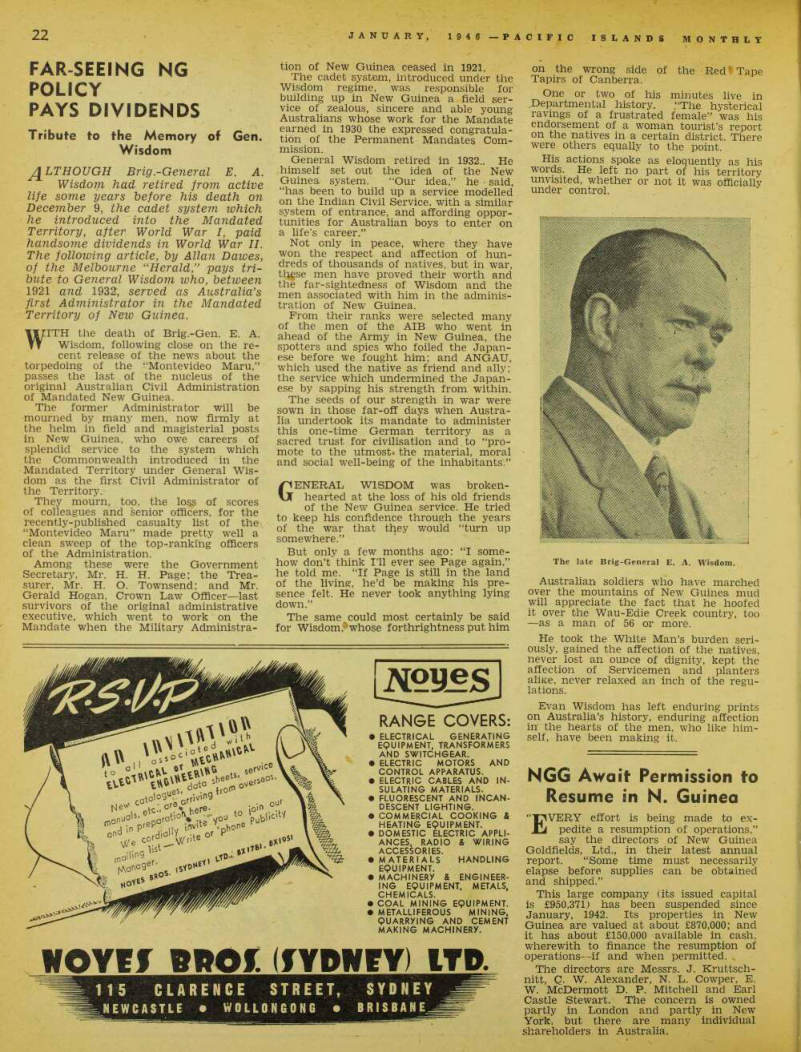
The late Brig-General E. A. Wisdom.