Pageantry In Nukualofa
pp. 13-14 · Read in the full issue
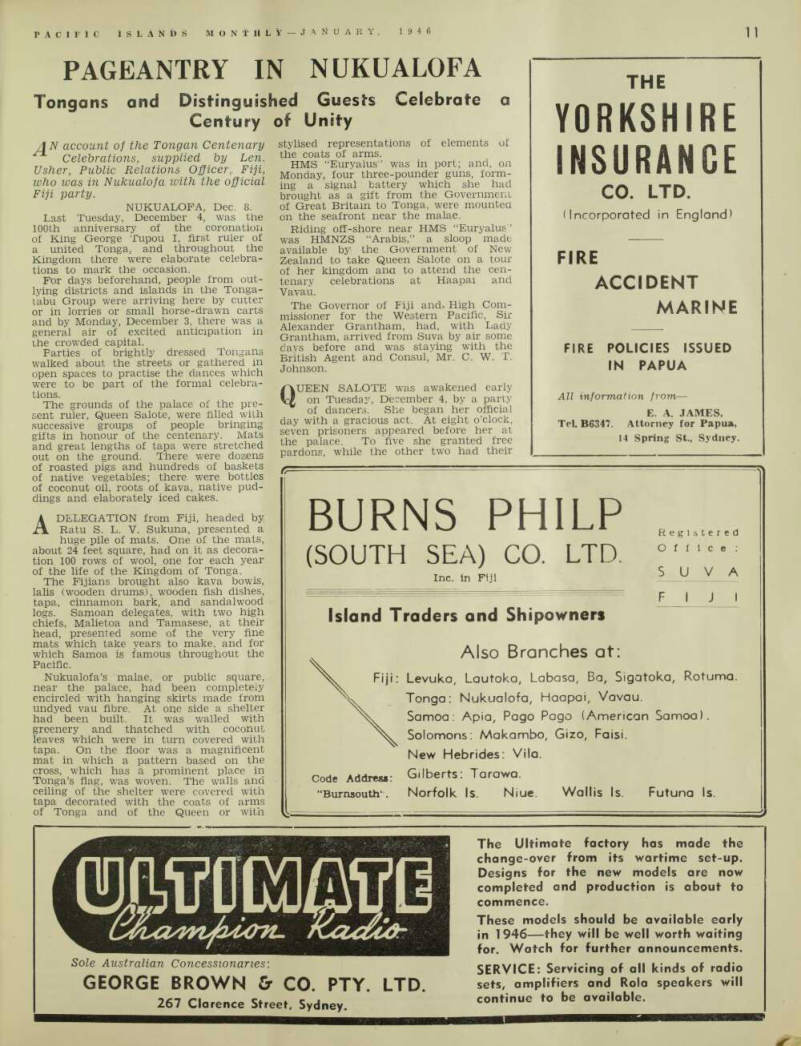
Tongans and Distinguished Guests Celebrate a Century of Unity
A N account of the Tongan Centenary
Celebrations, supplied by Len.
Usher, Public Relations Officer, Fiji,
who was in Nukualofa with the official
Fiji party.
Nukualofa, Dec. 8.
Last Tuesday, December 4, was the 100 th anniversary of the coronation of King George Tupou I, first ruler of a united Tonga, and throughout the Kingdom there were elaborate celebra tions to mark the occasion.
For days beforehand, people from out lying districts and islands in the Tonga tabu Group were arriving here by cutter or in lorries or small horse-drawn carts and by Monday, December 3, there was a general air of excited anticipation in the crowded capital.
Parties of brightly dressed Tongans walked about the streets or gathered in open spaces to practise the dances which were to be part of the formal celebra tions.
The grounds of the palace of the pre sent ruler, Queen Salote, were filled with successive groups of people bringing gifts in honour of the centenary. Mats and great lengths of tapa were stretched out on the ground. There were dozens of roasted pigs and hundreds of baskets of native vegetables; there were bottles of coconut oil, roots of kava, native pud dings and elaborately iced cakes.
A DELEGATION from Fiji, headed by Ratu S. L. V. Sukuna, presented a huge pile of mats. One of the mats, about 24 feet square, had on it as decora tion 100 rows of wool, one for each year of the life of the Kingdom of Tonga.
The Fijians brought also kava bowls, lalis (wooden drums), wooden fish dishes, tapa, cinnamon bark, and sandalwood logs. Samoan delegates, with two high chiefs, Malietoa and Tamasese, at their head, presented some of the very fine mats which take years to make, and for which Samoa is famous throughout the Pacific.
Nukualofa’s malae, or public square, near the palace, had been completely encircled with hanging skirts made from undyed vau fibre. At one side a shelter had been built. It was walled with greenery and thatched with coconut leaves which were in turn covered with tapa. On the floor was a magnificent mat in which a pattern based on the cross, which has a prominent place in Tonga’s flag, was woven. The walls and ceiling of the shelter were covered with tapa decorated with the coats of arms of Tonga and of the Queen or with
stylised representations of elements of the coats of arms.
HMS “Euryalus M was in port; and, on Monday, four three-pounder guns, form ing a signal battery which she had brought as a gift from the Government of Great Britain to Tonga, were mounted on the seafront near the malae.
Riding off-shore near HMS “Euryalus ’ was HMNZS “Arabis,” a sloop made available byi the Government of New Zealand to take Queen Salote on a tour of her kingdom ana to attend the cen tenary celebrations at Haapai and Vavau.
The Governor of Fiji and. High Com missioner for the Western Pacific, Sir Alexander Grantham, had, with Lady Grantham, arrived from Suva by air some days before and was staying with the British Agent and Consul, Mr. C. W. T.
Johnson.
QUEEN SALOTE was awakened early on Tuesday, December 4, by a party of dancers. She began her official day with a gracious act. At eight o’clock, seven prisoners appeared before her at the palace. To five she granted free pardons, while the other two had their
sentences reduced from life to ten years’ imprisonment.
During the morning Sir Alexander Grantham and Mr. Johnson, and later, the Queen’s Ministers, paid official calls at the palace.
MEANWHILE, Tongans were gathering in thousands on the malae.. The palace guard paraded, and in line with them was a guard of sailors and another of Royal Marines from the war ships. Opposite the official shelter a choir of about 500 was drawn up. The singers were in white, with fine mats fastened round their waists with lengths of sinnet. The people seated on the ground nearby in the bright sunshine also wore mats or fibre skirts. In the official shelter were Tongan nobles or senior officials and, with them, were the Fijian and Samoan chiefs and their wives.
The Governor of Fiji, with Lady Grantham and Mr. Johnson, arrived just before eleven o'clock; he was re ceived with full honours. Then the Queen’s car drove through a decorated gateway and, as Her Majesty, a tall, dig nified figure, stepped on to a special mat leading to the official platform, the band played the Tongan National Anthem.
This was the signal for the beginning
of a salute of 21 guns fired in the Queen’s honour by HMS “Euryalus.”
Sir Alexander Grantham read to the Queen a message of greeting sent to her by His Majesty King George VI. A Tongan translation by the Premier, Ata, followed and then Sir Alexander pre sented to the Queen the insignia of Dame Grand Cross of the Order of the British Empire. A national service of commemoration then began.
Among the hymns included was one chosen because it was a favourite of King George Tupou I. The great choir sang superbly the “Hallelujah Chorus’’ from Handel’s “Messiah.”
The Queen spoke to her people and greetings from Fiji and Samoa were given by Ratu Sukuna and the Hon.
Malietoa.
As the Queen left the malae at the end of the service, the guns of the newly presented signal battery fired their first salute on Tongan soil.
In the afternoon the Queen and mem bers of the various official parties re turned to see the first of the native dances which went on then almost con tinuously throughout the afternoon, and during the next two days and nights.
AS,. the light failed Tongans began to gather along the foreshore, taking with them closely-bound bundles of coconut sheaths. At eight o’clock a signal gun was fired and each bundle quickly became a lighted torch.
Splashes of flame, spaced at intervals of a foot or two, stretched along the coast for over six miles. The searchlights of HMS “Euryalus” had been sweeping the sky for some minutes, forming a mag nificent background of broad light to the flaring torches pin-pointed along the shore.
Suddenly a salvo of rockets was fired from the ship and, as the white and coloured stars fell in a brilliant cascade, the Tongans who were following excitedly behind marching bands along the lighted coastal road, or dancing with their torches around the flagpole, near the malae, shouted their approbation.
It was a night to be spoken of for years to come.
December 5 was to have been given up to dancing on the malae. Forty-three separate dances had been planned, but heavy rain fell in the afternoon and some of them had to be postponed.
However, they began again at daylight the following morning, and then con tinued almost without a break until late on Friday night. Most of the dances were lakalakas, in which both men and women take part.
The whole town was filled by day and night- with almost continuous sound.
When the dancers slept was, to strangers to Tonga, a minor mystery.
On the Thursday (December 6) there was a sports meeting, and on the follow ing day, in perfect sailing weather, a regatta was held.
The official Nukualofa celebrations ended on the night of Friday, December 7, with a State dance at the Govern ment College Hall.
To-day, December 8, the Crown Prince of Tonga presented gifts to his mother, Queen Salote, in recognition of his hav ing had conferred on him the hereditary Tungi lands, bearing with them the title of Tungi, which he assumed during the celebrations. The gifts were on the grand scale.
A count made while they were stul being assembled revealed over 300 roasted pigs, together with great piles of native vegetables and fruits, lengths of tapa. over 100 kava roots, and some hundreds of native puddings.