Wife Of Ng Administrator
p. 10 · Read in the full issue
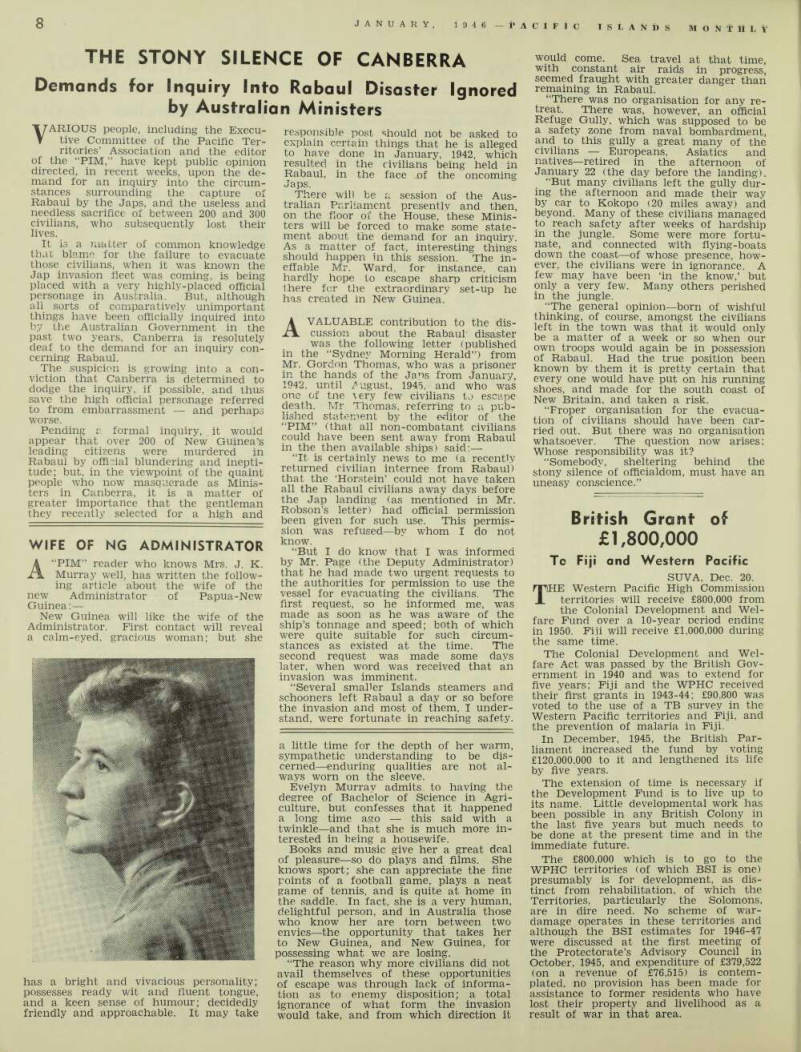
A “PIM” reader who knows Mrs. J. K.
Murray well, has written the follow ing article about the wife of the new Administrator of Papua-New Guinea:— New Guinea will like the wife of the Administrator. First contact will reveal a calm-eyed, gracious woman; but she
has a bright and vivacious personality; possesses ready wit and fluent tongue, and a keen sense of humour; decidedly friendly and approachable. It may take
a little time for the depth of her warm, sympathetic understanding to be dis cerned —enduring qualities are not al ways worn on the sleeve.
Evelyn Murray admits to having the degree of Bachelor of Science in Agri culture, but confesses that it happened a long time ago this said with a twinkle —and that she is much more in terested in being a housewife.
Books and music give her a great deal of pleasure—so do plays and films. She knows sport; she can appreciate the fine points of a football game, plays a neat game of tennis, and is quite at home in the saddle. In fact, she is a very human, delightful person, and in Australia those who know her are torn between two envies—the opportunity that takes her to New Guinea, and New Guinea, for possessing what we are losing.
“The reason why more civilians did not avail themselves of these opportunities of escape was through lack of informa tion as to enemy disposition; a total ignorance of what form the invasion would take, and from which direction it
would come. Sea travel at that time, with constant air raids in progress, seemed fraught with greater danger than remaining in Rabaul.
“There was no organisation for any re treat. There was, however, an official Refuge Gully, which was supposed to be a safety zone from naval bombardment, and to this gully a great many of the civilians Europeans, Asiatics and natives—retired in the afternoon of January 22 (the day before the landing).
“But many civilians left the gully dur ing the afternoon and made their way by car to Kokopo (20 miles away) and beyond. Many of these civilians managed to reach safety after weeks of hardship in the jungle. Some were more fortu nate, and connected with flying-boats down the coast —of whose presence, how ever, the civilians were in ignorance. A few may have been ‘in the know,’ but only a very few. Many others perished in the jungle.
“The general opinion—born of wishful thinking, of course, amongst the civilians left in the town was that it would only be a matter of a week or so when our own troops would again be in possession of Rabaul. Had the true position been known by them it is pretty certain that every one would have put on his running shoes, and made for the south coast of New Britain, and taken a risk, “Proper organisation for the evacua tion of civilians should have been car ried out. But there was no organisation whatsoever. The question now arises; Whose responsibility was it?
“Somebody, sheltering behind the stony silence of officialdom, must have an uneasy conscience.”