From Annie's To Aggie's
pp. 46-48 · Read in the full issue
And Some Points East of Apia
By Judy Tudor
Out Of Apia. Oct. 26.
SOMEONE on this ship has suggested that I call this article (in the best traditions of modern journalism) “I Covered the Waterfront”—the waterfront in question being Apia’s, which most of us have covered in our several ways in the past three days.
At one end of it is the Casino Hotel, run by Mrs. Annie Jones; and at the other end (about a mile distant, in the cool of evening, and ten miles in the blazing heat of day) is the rival establish ment run by Mrs. Aggie Gray. Everyone in and out of Apia calls them “Annie” and “Aggie”; therefore I feel no breach of etiquette or disrespect for two well-known matrons by doing likewise. Notwith standing the hospitality at those, two ends, it is nothing short of amazing, how often one is impelled, in a three-days’ visit to the port, to stagger along that hot, white road between the two points, with nothing but a half-way ice-cream parlour by way of refreshment.
If, in the last month, I have been sar castic about the lashings of cold beer and other beverages laid on in Fiji I could be equally sarcastic at the lack of same in Western Samoa, where the tem peratures are higher and the thirst
correspondingly longer.
To be sure, the Territory is not en tirely dry; but one must go through the rigmarole of applying for a grog issue from the Government doctor, who pre scribes a fitting amount of “medicine.”
There may be some merit in these liquor permits: but why go through the farcical business of hanging them on the peg of health? They could as easily be issued by the Customs Department on a set per capita basis without any of the Scotsbyterian hocus-pocus indulged in at the present time.
In spite of the liquor restrictions, how ever, Apia appears to have some kind of night-life, even if it is practically in visible to the naked eye of the visitor,
and bears but a dim resemblance to the writings of Maugham. My pal of the headlines, who is doing a holiday round trip from Suva, says he and friend have been searching for a “real Apia bash” (bash being the current Fijian for wild party) since they got here, but with small success.
Maybe they didn’t know where to look.
We were to sail at the crack of to-day’s dawn. The dawn cracked and one, two and three hours went by, and breakfast came and went, and still we rolled at anchor in Apia Harbour. There was an air of suppressed tension about the ship; intermittently, an officer would appear and gaze shorewards with knit brows; and wild rumours circulated freely.
It transpired that a cook and two sea men had found their Apia bash. A house to-house search of the bush-gin palaces
had been in progress since the small hours; and, finally, the culprits, the cook showing signs of the bash literally, stag'gered on board.
The Paintings of Charles McPhee
I FIRST saw an oil painting by Charles McPhee in Suva. It was done, I was told, by “a young bloke in Samoa.” At Aggie Gray’s, in Apia, I met him and saw several more of his paintings. (See cover photo, this issue.) Charles McPhee is a quiet young man with a shy manner and no real apprecia tion of the worth of his own talent to reproduce on canvas the atmosphere of the Islands. So far, all his serious paint ing has been in Western Samoa; but one does not have to know that Terri tory to feel that his work is authentically South Seas. The Pacific has not been without painters; but few, particularly-■ the transitory kind, have succeeded in reproducing the shimmering pastel hazi ness or the clear-cut yet subdued out lines of the Pacific scene.
Those who like their figures elongated and their art reduced to free eyes and angles and patterns resembling the bath room tiles, purporting to reveal the con tortions of the artist’s naked soul, will find little in McPhee’s work to hold them.
He is a realist who paints as he sees, with natural skill and fine feeling, and is no product of city artiness. He gradu
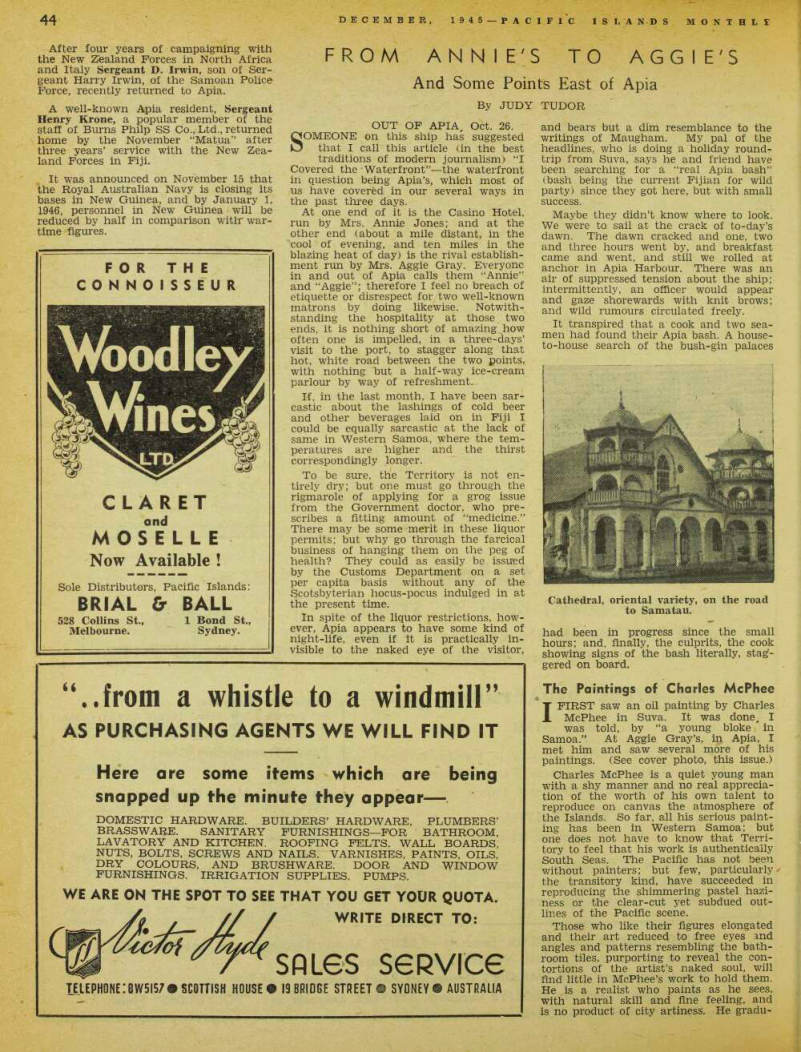
Cathedral, oriental variety, on the road to Samatau.
ated to painting for the best of all reasons —that after much trial and error this was the medium through which he found real self-expression.
In his studio at Samatau is a water colour (he now paints mostly in oils) of a prospector’s hut in Western Aus tralia —his first venture into art —and in its totally different way, it has that un canny feeling of place which is so strik ing to-day in his paintings of Western Samoa.
McPhee was born in Western Austra lia, and, as a young man there, tried prospecting, station work, farming and all the usual sidelines of a born wan derer; but, from the time he painted that prospector’s hut, until he began to paint in Western Samoa, he left serious art alone. He beachcombed along Queensland’s Barrier Reef, and did showcard designing and ticket-writ ing in Melbourne, and designed for Ray Neon Signs in Sydney and Auckland.
From Auckland, in 1937, he visited Samoa, and the following year returned there permanently. He tried his hand at most things, including fruit-growing and the local police force, but appar ently he is a man of single purpose; and suddenly, and without preliminaries, de cided to give up the prosaic habit of earning a conventional living and devote his whole time to painting. His method was to disappear for weeks at a time to some isolated spot, and there paint until his inspiration gave out; but, at present, he is building a permanent studio at Samatau, several miles beyond the main road terminus at Mulifanua.
During the “invasion” of 1942-44, his paintings were snapped up as soon as completed, by enthusiastic Americans, and at one stage he was attempting to mass-produce the portraits of importun ate Marines, at the rate of two a day.
Inevitably, he soon came to the end of
his tether, and then did not touch a brush for eight months.
At present, he is back at the job, paint ing better than ever, and preparing for an exhibition in Auckland, where his work already has received oonsiderable attention. His paintings of Samoans, particularly children, are excellent; but, personally, I would still settle for one of those small pieces of blue and green Samoa which he has indelibly recorded upon canvas.
By Bus To Samatau
APIA’S waterfront, as I have indicated, can be covered pretty thoroughly per boot. To see something of the country beyond those wild metropolitan limits, it is necessary to (a) board a schooner or cutter, or (b) hire a car, or (c) proceed by what is affectionately known in Fiji as a wog-waggon (which is actualy a native-operated and largely patronised bus).
Having no time for (a) and too many Scots ancestors for (b), we (three of us from the ship, and Charles McPhee) set out in (c) to go 26 miles to road’s end at Mulifanua, and from that point we persuaded the bus driver for a few shill ings to go the remaining four miles to Samatau, where we were to picnic. This, you will observe, is the tropical Pacific, where everything goes—even the seduc tion of the bus-driver from his patrons.
I hate to think of the reactions of his NZ or Australian counterpart if asked to take an hour’s jaunt down a bush track, picnic an hour and then a further hour to trundle back to his daily route.
Samoa’s buses are one up on Fiji for utility-without-comfort. For one thing, you sit sideways along the length of the bus, on a hard board bench; but, out of consideration for the weaker frame of the European body, a cushion of sorts had been produced at the garage. All we had to do was to persuade some out
size Samoans already installed that it really was for us.
So, into the already blazing heat of the morning we set off, the bus with its human freight—including one girl who looked, in the words of the poet, as if she would be brought to bed at any moment —careering madly down the centre of the narrow road, its driver playing games of bluff with other drivers coming in the opposite direction.
In respect to the girl in the delicate state of health, McPhee remarked: “I was coming out here once and a girl died in the bus.”
“Good Lord!” we exclaimed, “What did you do?”
“Oh, nothing. The women on either side of her just kept her propped up until they got to their destination.
There wasn’t very much else you could do.” (Continued Next Page)
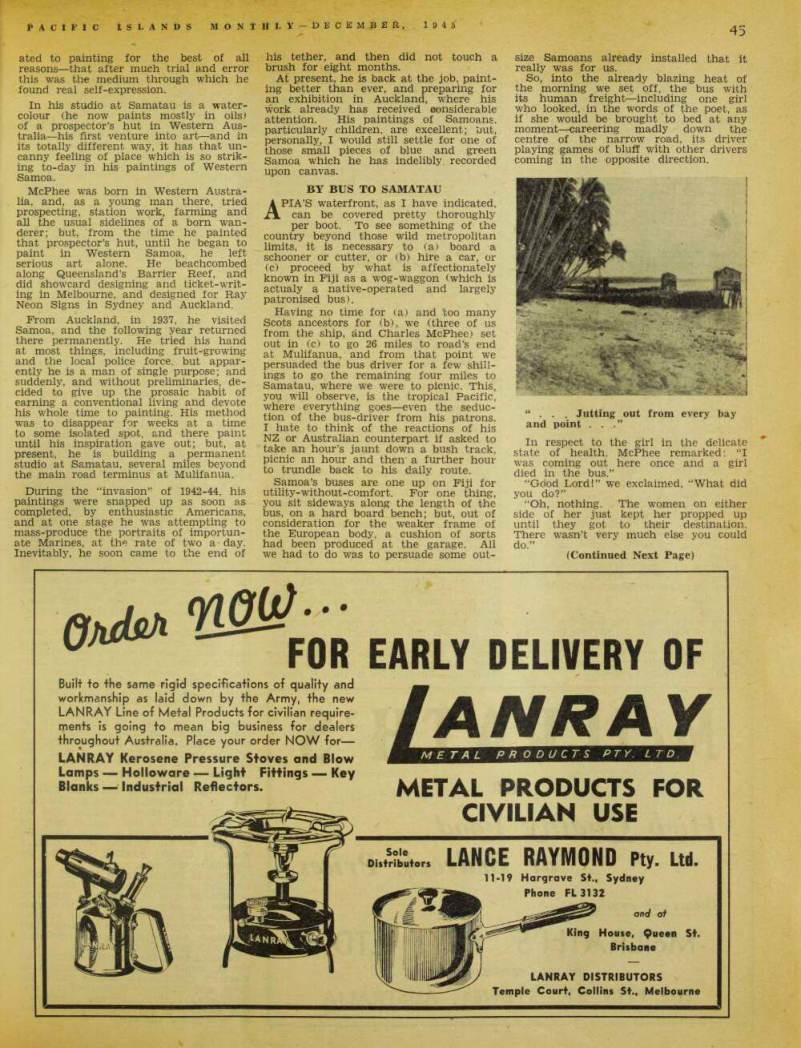
“ . . . Jutting out from every bay and point ...”
The fine sandy beaches along the road to Mulifanua, the blue sea, the distant Islands and the never-ending grace of the coconuts, we can attribute to God.
But the prodigious assortment of churches of cathedral dimensions, many of which have started off as Noble Edi fices in Stone (or concrete) and petered out into hasty makeshifts of corrugated iron in every variety of architecture (in cluding Oriental) and every stage of incompleteness, ail of which is mute testimony to inter-village Christian rivalry—and, keping numerical pace with them, the village lavatories, built out on short jetties or causeways over the local beach—these are the misguided works of man alone. I wondered how Charles McPhee, who paints the Samoan scene has been able to escape adding one of these architectural gems to his pictures.
The surfeit of churches was a new one to me; but the lavatories were not. They are—or were—common enough in Papua, where, after Doctor S. M. Lambert’s hookworm campaign, they were regarded as the surest prevention of the disease.
The beautiful little island of Samarai had a fine line of these privvies, as the good doctor calls them, but they were on the off-side of the island, well con structed and each at the end of about half a mile of jetty.
The Samoan counterpart has evidently been left to the Samoans, who got tired long before the jetty reached low-water mark—and I miss my guess if a spring tide reaches many of them —and con structed the sentry-box at the end from any available oddment of tin or wood.
Weather —and above all, time—has had its way with all of them, and the Lambert-pattern privvies (Samoan style) to-day reveal a great deal more than they conceal. Away they stretch as far as the eye can see, jutting <Dut from every small bay and point and ruin ing one of the Pacifiic’s most beautiful coast-lines. I hope the Samoan’s health is benefited thereby, because it is sheer useless sacrifice of beauty for utility, if it is not.
At Mulifanua, we shed our last Samoan passenger and began the final leg of our journey to Samatau. To say we travelled by road, would be plain exaggeration.
The track—and even that term flattered it—had been made by jeep and that, I judged, some time before.
It took us almost as long to do this four miles as it had to cover the previous 26, but in between bumps and lurches and dodging trailing undergrowth we at least had the opportunity of seeing Samoa away from the model villages close to Apia. The few small villages through which we passed had churches and no cathedrals; and if there were corresponding privvies, then they were decently hidden from sight, in building a studio on the beach at Samatau, and starting a large garden in the neighbourhood, Charles McPhee hopes to encourage the visits of others who would like to write or paint Samoa, The days when the wanderer could foist himself on the long-suffering Islander are things of the past—particularly in Samoa, where the Samoans have out grown most of the respect they might have had once for the European.
On the other hand, living in Apia, apart from affording little real worth to the observer of native life, can be ex pensive. The Samatau studio, then, would probably be a happy compromise and an excellent vantage point from which to study friend Samoan on his native heath,
Back To The Waterfront
QAMOA’S citizens, by and large, fore >3 see a boom in post-war tourist traf fic and in commerce. Maybe they are right, at that; the Americans seemed to like the place. But there are a few things needed before Samoa can think of tourists in paying quantities, the catering for which is a highly specialised business.
Although Samoa has, from the Euro pean point of view, been on the map for some 224 years, and Apia has never had a wharf, it still might be a good idea to have one now, before this expected boom descends from the blue, ships lie out between two reefs, and unload into ii ght ers, while the ships’ crews keep their eyes on the wea ther, rea dy to up anchor and away at the first sign of danger Even ln calm wea there a big swell rolls in from the sea, and p a ssengers decanting themselves into launches are in constant danger of tak ing a plunge, or having their legs ground off between the pitching boat and the ship’s gangway. Apart from the tourist angle, if Western Samoa is to have the happy future some of its more enthusias tic citizens forecast for it, then it should
by all means have a wharf —whatever the reasons there are against it.
Other simple little improvements would be the erection of a few seats along Apia’s maddening waterfront where poor weary travellers would rest their blis tered feet; the repeal of her archaic liquor laws; the provision of extra accom modation and, above all, the recovery of the native population from the present spasm of political growing pains.
Personally, I see no good reason why the Samoans, if they wish to live their own kind of lives, should encourage tourists, who are an unattractive, albeit profitable, proposition in the mass. But if the! Samoans do wish it, then they will have to revive those gracious Polynesian manners and cultivate a more amiable expression than the surly one worn at present.
There are two schools of thought in Samoa to-day; first, pro-Samoan (in cluding Europeans, who have married into Polynesian families) which says: Let us throw out all European interests and those who work for them and fight for the same measure of self-govern ment as Tonga; let us manage our own affairs, foreign and domestic; and, sec ondly, conservative opinion which de scribes the Samoans as having gone to the dogs, as having become a gang of cut-throats and thieves and deter minedly anti-British. Devotees of Opinion II say that if the Samoans can not be entirely free, then they would pre fer to be American; and they prove Samoan depravity by quoting such cases as the recent beating up of a visiting British warship’s officer by nine Samoans.
But although these two opinions flour ish in varying degrees throughout the whole community, it is at the same time universally believed that, by some mir acle, Samoa is to be graced by a period of great prosperity in the near future.
Several new industries are in the open secret stage, although nothing can be said about them officially. But why, if the Samoan labour and political set-ups are as uncertain as reported, any inves tor would be fool enough to put money into the country, passes all understand ing.
The trend of world opinion is for more and more self-determination for native races, and it has yet to be proved whether that is a good or bad thing. But I think there is a lesson for the Samoans in Tonga, which has suffered considerably through the war years in not being tied closely to a larger nation; and a lesson for those who are leaning over back wards, to see virtue in brown skins, in the unfinished condition of Samoa’s crop of cathedrals, which in the original in tention are tremendous, but in their final execution are but poor shadows of the builders’ good intentions.
D|7T]STERN SAMOA has been nothing fV but a pain in the neck to New Zea land ever since it was parcelled out as a Mandate in 1920; and if half the rumours are founded on fact there still is more trouble brewing there than a score of Chiefly goodwill visits to the Dominion can cure.
There is an abundance of food, cloth ing and consumer goods in Samoa at present, most of it American. Again, if rumour is correct, there are thousands of part-American babies in the villages.
The Samoans liked Americans and American ways and American dollars — they still speak in those terms.
Perhaps then, the happiest solution, all round, would be the amalgamation of Western and Eastern Samoa under the Stars and Stripes. Geographically and traditionally, they are one territory only interfering European politicians saw fit to separate the two.