Christmas Island
pp. 36-38 · Read in the full issue

Crabs
Extraordinary Phenomena in the Indian Ocean
mHERE are several Christmas Islands.
X One of them is a little phosphate island, approximately eight miles by 12, rising to a height of 1,000 feet, situ ated in the Indian Ocean, about four days’ sea journey from Singapore, and the same distance from Cocos Keeling, of “Emden” fame.
The only contact with the outside world in pre-war days, with the exception of phosphate boats, was the company’s ship, “The Islander,” which did six-weekly trips between Singapore and the island, and six-monthly trips to Cocos Keeling.
In some places the island rises pre cipitously to a considerable height, sheer out of the sea, where the water is very deep; but in others there are rocky shores
and, here and there, a few small sandy inlets.
The European settlement, comprising six or seven houses erected on 4-feet piles, has been built on a wide, flat stretch between a steep pebbly shore and a jungle-clad rise of approximately 300 or 400 feet. In a line with the European settlement, at one end, are> the Malay quarters; and, at the other, and much further removed, are the phosphate works and coolie lines.
The Europeans numbered about two dozens in the ’thirties, and included a District Officer and a doctor. There were some 60 Malays and several hun dred Chinese.
LIKE most tropical islands, Christmas is the home of a great variety of crabs.
There is the huge robber crab, which spends his leisure in shady ledges in the jungle, or lurks in caves on the coast and, when hungry, climbs to the top of a palm in search of coconuts, which he
extracts from the husk and then bores into with his powerful claws.
Another variety, in size as large as the ordinary edible crab of Australia, and a bright red in colour, lives in great num bers in the jungle, and is quite un obstrusive—until the first rains of the season, which start about mid-November.
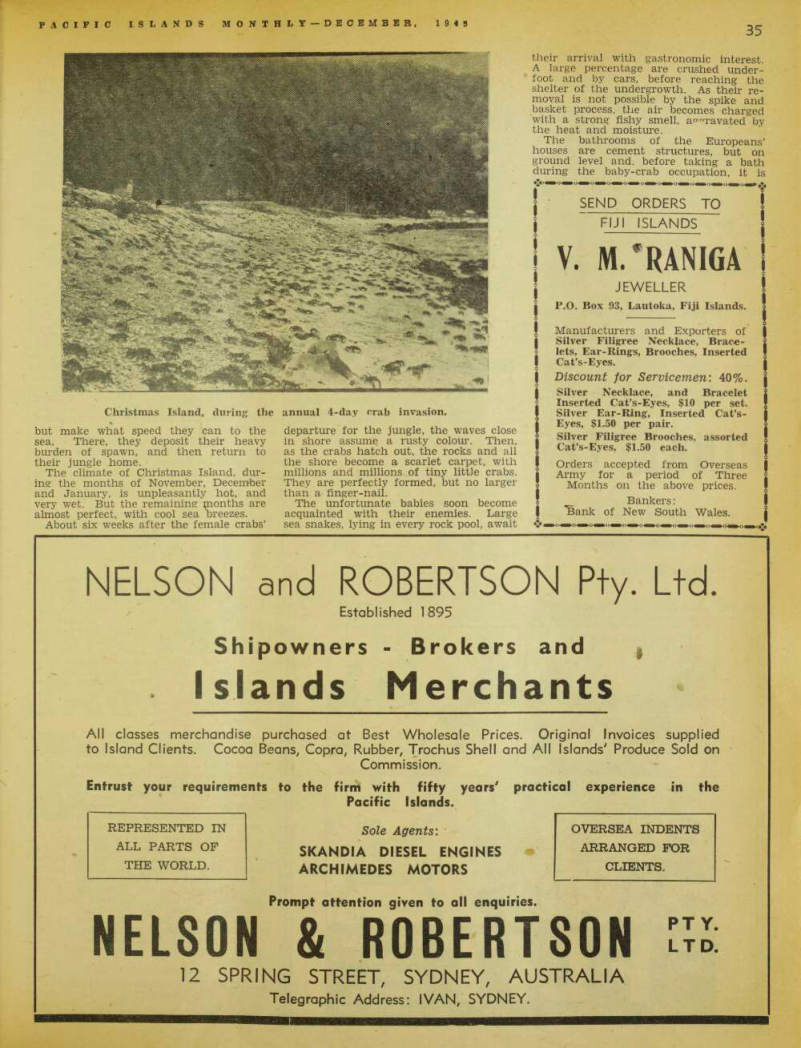
Then the male crabs begin a universal migration to the coast, approaching with a continuous rustling noise like a bush fire, and eating everything possible en route.
The drains are seething with them, one on top of another —everywhere there is just one moving mass of crabs. Quite often, rather than go aroUnd an obstacle, these male crabs will go over it, and the ungainly creatures were often seen in the eaves of the two-storied island club; but whether they made a safe landing on the other side is uncertain.
For four days the invasion continues.
Gardens are ruined and the ground swept clean of leaves and vegetation. A few crabs come into the house, and they will eat any rags or clothes within their reach.
A road runs along in front of the settlement, and a passing car will crush hundreds of the creatures. So coolies, armed with spikes and baskets, are em ployed to remove the dead bodies, which quickly become most offensive in the moisture and hot sun.
On the fourth day, the crabs are more numerous than ever—some still on their way to the shore, others on the return trek.
A LITTLE later the female crabs, laden with spawn, begin to arrive from the jungle. They are just as numer ous, but not so aggressive as their hus bands. There is nothing left for them to eat, so they do not dally on the way,
but make what speed they can to the sea. There, they deposit their heavy burden of spawn, and then return to their jungle home.
The climate of Christmas Island, dur ing the months of November, December and January, is unpleasantly hot, and very wet. But the remaining months are almost perfect, with cool sea breezes.
About six weeks after the female crabs’
departure for the jungle, the waves close in shore assume a rusty colour. Then, as the crabs hatch out, the rocks and all the shore become a scarlet carpet, with millions and millions of tiny little crabs.
They are perfectly formed, but no larger than a finger-nail.
The unfortunate babies soon become acquainted with their enemies. Large sea snakes, lying in every rock pool, await
their arrival with gastronomic interest.
A large percentage are crushed under foot and by cars, before reaching the shelter of the undergrowth. As their re moval is not possible by the spike and basket process, the air becomes charged with a strong fishy smell, by the heat and moisture.
The bathrooms of the Europeans’ houses are cement structures, but on ground level and, before taking a bath during the baby-crab occupation, it is
Christmas Island, during the annual 4-day crab invasion.
necessary to sweep the walls and floor of the bathroom, which are swarming with crabs, and push the heap of little intruders well away from the door. Not that that is much use—they are drop ping from the ceiling again almost be fore one is in the bath.
At this time the weather is extremely hot, and it is not a pleasant period for Europeans, as there is nothing in the gardens, and eggs are so strongly flav oured (caused by the hens eating the little crabs) that they are unpalatable.
The intermittent journeyings of the crabs, to and from the sea, take approxi mately two months; and then, for the next ten months, they remain hidden in the jungle and the settlement is free of these strange Crustacea until the next
rainy season.