New Order In Territories
pp. 8-60 · Read in the full issue
Government Controls all Ships and Native Stores
MOST of the Papuan plantations are closed down, and likely to remain so. No return of native labourers is expected much before February or March.
The new Administrator and his lieu tenants are slowly bringing some order out of the chaos they found when they arrived in Port Moresby. But much re mains to be done. Old residents are frankly critical. They see “far too many theorists and far too much anthropology” in the new set-up.
There is no indication of when civi lians, traders and private enterprise gen erally will return to the Territories.
There are two great obstacles in the way. The first is politics, the second transport. - Even if the new Administration is anxious to restore normal conditions, it cannot move far or fast without Mr.
Ward’s permission; and Mr. Ward is most determined to discourage private enter prise—especially the enterprise of the Big Firms. While those ideas persist, the rate of recovery will be slow and painful.
Transport is an example. Nothing much can happen until there is ample transport. The obvious thing to do was to pass the job of supplying transport on to the organisations which are equipped to provide and handle transport. But Mr.
Ward would have none of it. He has re tained control of the Burns Philp ships, and all other ships used in the Terri tories; the Australian Government has acquired scores of little ships, for carry ing on coastal transport; and he now has appointed Burns Philp & Co. and Steam ships Trading Co. agents for and opera tors of those vessels.
The “Marella” ran recently from Syd ney to the Territories with cargo and pas sengers. Because she departed from the BP wharf, manned by BP officers and bearing the old familiar check pattern on her funnel, everyone imagined that the BP services were being resumed. Not at all! The “Marella,” owned by BP, is running in the service of the Australian Government and Mr. Ward; and BP are merely “agents” for the vessel, getting their commission on what the vessel car ries. like any other agent. That applies to practically all the ships operating in and to New Guinea.
If there is insufficient transport, or if it is inefficiently scheduled, that is the responsibility of the Government, not of the Big Firms—who, as shipowners, have been wiped out, for the present.
The same confusion and uncertainty is seen in relation to the trading stores.
At first, Mr. Ward planned to keep the Big Firms out altogether, and leave all trading to the Government-owned Production Control Board. But it would not work.
So now the Big Firms are to be per mitted to operate stores—but all native trade must be controlled in some form or other by the FCB. The main lines sold to natives may be sold only on condi tions fixed by the PCB; all purchases of native produce are controlled by the PCB.
In these circumstances, the Big Firms are showing little interest in trading. The European trade, alone, is not worth the effort and expense of re-establishing the stores.
The Minister continues to promise that soon the return of civilians to the Ter ritories will be expedited. But, clearly, there can be neither place nor opportu
nity for civilians while the Minister’s policies are bent in every case to the same purpose the discouragement of private enterprise and the strict limita tion of profits.
New Administrator’S Heavy
Task
From a Special Correspondent
Port Moresby, Dec. 6.
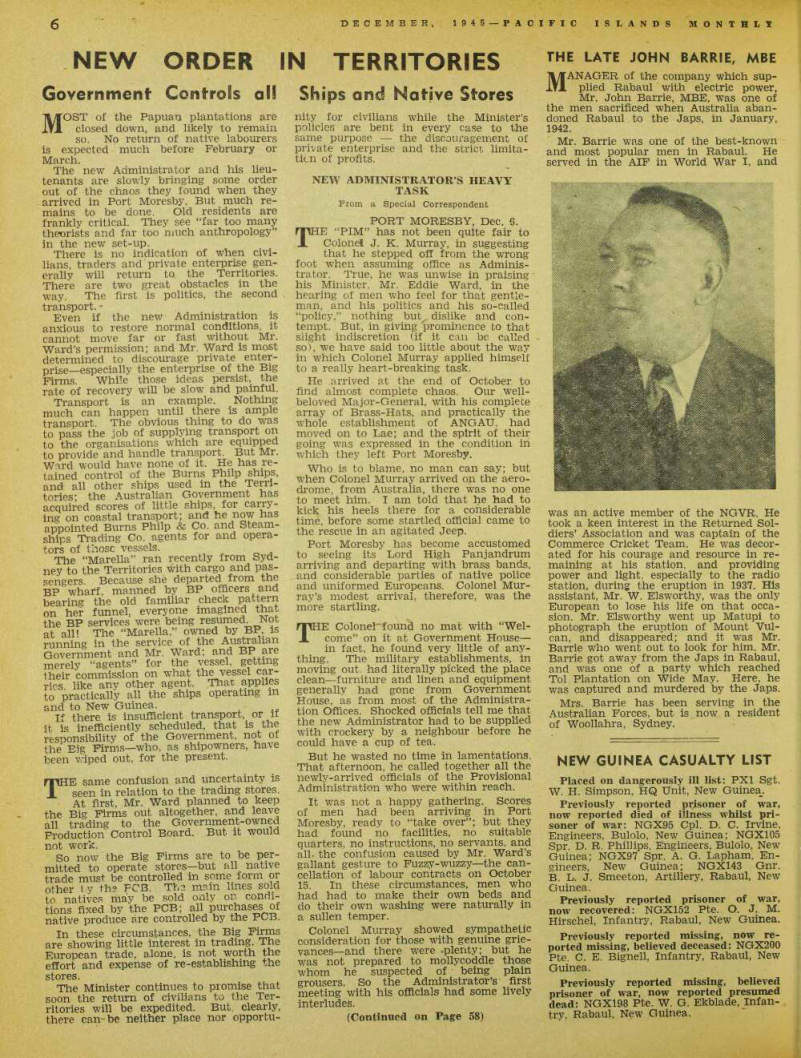
The “PIM” has not been quite fair to X Colonel J. K. Murray, in suggesting that he stepped off from the wrong foot when assuming office as Adminis trator. True, he was unwise in praising his Minister, Mr. Eddie Ward, in the hearing of men who feel for that gentle man, and his politics and his so-called “policy,” nothing but dislike and con tempt. But, in giving prominence to that slight indiscretion (if it can be called so), we have said too little about the way in which Colonel Murray applied himself to a really heart-breaking task.
He arrived at the end of October to find almost complete chaos. Our well beloved Major-General, with his complete array of Brass-Hats, and practically the whole establishment of ANGAU, had moved on to Lae; and the spirit of their going was expressed in the condition in which they left Port Moresby.
Who is to blame, no man can say; but when Colonel Murray arrived on the aero drome, from Australia, there was no one to meet him. I am told that he had to kick his heels there for a considerable time, before some startled official came to the rescue in an agitated Jeep.
Port Moresby has become accustomed to seeing its Lord High Panjandrum arriving and departing with brass bands, and considerable parties of native police and uniformed Europeans. Colonel Mur ray’s modest arrival, therefore, was the more startling.
The Colonel found no mat with “Welcome” on it at Government House — in fact, he found very little of any thing. The military establishments, in moving out, had literally picked the place clean —furniture and linen and equipment generally had gone from Government House, as from most of the Administra tion Offices. Shocked officials tell me that the new Administrator had to be supplied with crockery by a neighbour before he could have a cup of tea.
But he wasted no time in lamentations.
That afternoon, he called together all the newly-arrived officials of the Provisional Administration who were within reach.
It was not a happy gathering. Scores of men had been arriving in Port Moresby, ready to “take over”; but they had found no facilities, no suitable quarters, no instructions, no servants, and all the confusion caused by Mr. Ward’s gallant gesture to Fuzzy-wuzzy—the can cellation of labour contracts on October 15. In these circumstances, men who had had to make their own beds and do their own washing were naturally in a sullen temper.
Colonel Murray showed sympathetic consideration for those with genuine grie vances—and there were plenty; but he was not prepared to mollycoddle those whom he suspected of being plain grousers. So the Administrator’s first meeting with his officials had some lively interludes.
(Continued on Page 58)
rE early confusion was appalling. A number of men knew what they had to do, and set about doing it; but very many others did not know what their duties were to be, and could get no direc tions. The fault lay in Canberra, not in Port Moresby. Canberra could not make up its mind concerning certain heads of Departments.
There was the Government Secretary ship, for instance. It was reported in November that Mr. Robert Melrose would fill the job, and so it was published. The names of others were bandied about. As the Government Secretaryship is one of the key positions, the uncertainty was
unfortunate. Late in November, it was known that the appointee was Mr. Steve Lonergan. Why could that not have been announced earlier? As the late Mr.
Harold Page’s assistant and deputy, Mr.
Lonergan was the obvious choice for the job.
A NUMBER of men from the old regimes did not like the new set-up at all. Some quarrelled with the status and work allotted to them —some with the general atmosphere. Naturally, there has been much jealousy displayed in the amalgamation of the two former services.
Some men have resigned already— others are threatening to do so. Some have genuine grievances—some are merely thin-skinned.
In the deplorable circumstances, the new Administrator is displaying much tact and patience, and he Is a tireless worker. He asks nothing from his assist ants in the way of hard work that he does not give himself. The complaints that are made against him seem to stem back to the one general criticism—that he is too much of a scholar and a gentle man. Those qualities are quite accept able in these Territories—provided they are attached to a man who, when occa sion requires, is rough and tough. Colonel Murray can be severe—but he is neither rough nor tough.
Nonetheless, the consensus of well balanced opinion here is that, if he Is given half a chance by the bureaucrats and professional politicians of Canberra, he will make a success of his very diffi cult job. rERE seems to have been some re sentment because “the new Adminis trator is a Roman Catholic.” Why there should be resentment. Heaven alone knows. Sir Hubert Murray was a Catho lic. and no one seemed to fret about it.
As a mater of fact, Colonel Murray is not a Catholic. He came from one of those numerous families in which religions are mixed. He acquired his early edu cation in Roman Catholic schools; but then, it appears, the other side of the
family took charge, and J. K. Murray entered adult life as a Presbyterian. I understand he still is a Presbyterian.
Not that it matters here. In the Terri tories, more than in most places, “a man’s a man for a’ that.”
SOME of our old, hands are inclined to criticise the Administration’s agri cultural policy. Natives are being urged to plant the tubers of the sweet potato (Kaima, or Kaukau) instead of sections of the vines. But the native knows what he is doing. If he plants the tubers (which give better crops) the rats destroy a proportion of the tubers. Plant ing of vines, which rats, do not attack, gives more reliable crops.
The natives are being urged to plant various things, presumably to provide a basis of barter and exchange. But little has been done to show the native the wisdom of extended planting. His age old custom is to plant just enough for his foreseen requirements—and he will take some shifting from that policy.
We learn that the Director of Agricul ture here is Mr, Cottrell Dormer, who is well known in the Central Pacific, where he was adviser on agriculture to the Government of Tonga.
His work probably was known to Colonel Murray some time ago, as Mr.
Dormer has been living for some time in Brisbane, where Colonel Murray had charge of the Queensland College of Agriculture.
Interesting news has come from Rabaul.
Our men, investigating the miles and miles of tunnels which the Japs con structed in the hillsides all around Rabaul, have discovered a large part of the invaluable and irreplaceable records of the old New Guinea Departments of Health and of Agriculture. These re cords should be of tremendous value to the new Administration.
Gloomy View Of Territories’
Future
MR. J. FULFORD, who left Sydney in November to join the staff of the new Provisional Administration in Papua, has resigned from the service and returned to Australia.
“Papua has gone so far downhill under recent conditions that it will be 15 or 20 years before we shall see the Territory again as we knew it before the war,” he writes. “But there may come a quick change if the Australian taxpayer wants to know what he is getting for the huge funds being poured into the Territories.
“I expect that a number of other offi cers will resign soon and return to Aus tralia.”