Escape From
pp. 48-50 · Read in the full issue
Rabaul
Jim Peterson's Account of Tol Massacre
ONE by one, stories of miraculous escapes from the Japanase mur derers and beasts who invaded New Guinea in January, 1942, are becoming known. Here is the story of how James Peterson got away from Rabaul, and how he escaped the Tol massacre by a few minutes.
Mr. Peterson and his wife, Helen, are well-known in the South Seas. He is a Burns Philp man; and he and his wife have lived in the Ellice Islands (at Funa futi), in Fiji (for 15 years—the last of which were at Sigatoka) and at Rabaul.
Mr. Peterson was transferred to Rabaul in August, 1941—but Mrs. Peterson was not allowed to accompany him. In Rabaul he became a corporal in the New Guinea Volunteer Rifles, of unforgettable renown.
When the Japs came, early on January 23. 1942, Peterson was in a mortar de tachment on the beach near Mount Vulcan. The defenders fought as' long as they could, but the invaders were in great strength; and, by the afternoon, the men of the Australian 22nd Battalion, and the NGVR, had abandoned the de fence, and it was every man for himself in the jungle. Peterson ~ot away with his rifle, ammunition and the clothes he wore.
With an officer, Peterson set off along an inland track, for a large native vil lage, Lemingi. Hundreds of men were
straggling along the track, abandoning arms and equipment as the going got tougher. Five days later, they reached Lemingi, got some food, and rested. Then Peterson and three others headed south westward. They struggled through broken jungle and mountains for days—they were lucky in finding rice and tinned food in an abandoned Chinese trade store. There were parties of fugitives all over this region.
EVENTUALLY, they came out on to Tol Plantation, which is spread along Zungen Point, in Wide Bay.
They found only a few men there, with plenty of pigs, goats and fowls, and they decided to wait there for rescue. But within 24 hours, some 300 fugitive men had arrived on Tol.
Peterson’s party decided that such a congregation almost certainly would bring Japs down upon them. They collected some food, and left early the following morning.
Assisted by food from another aban doned store, they moved steadily around Wide Bay towards Kiep. Jap forces had come into the bay, and in the following week they had two exceedingly narrow escapes.
Near Kiep, they were overtaken by natives who told them, in general terms, about the massacre at Tol; and, later, they were joined by a party of Austra lians from Tol, some of them badly wounded. This is the exact account they gave to Peterson, who repeated it to John Quinn, who published it in “Sydney Sun” on September 16: FIFTEEN minutes after Peterson’s party left Tol, five Jap barges loaded with troops came into Wide Bay, and the Japs began to wade ashore, on to
the plantation. The 300 Australians scat tered into the plantation and jungle; but the Japs pursued them, and 120 were taken prisoner.
The Japs stripped them down to their trousers and then burnt their equip
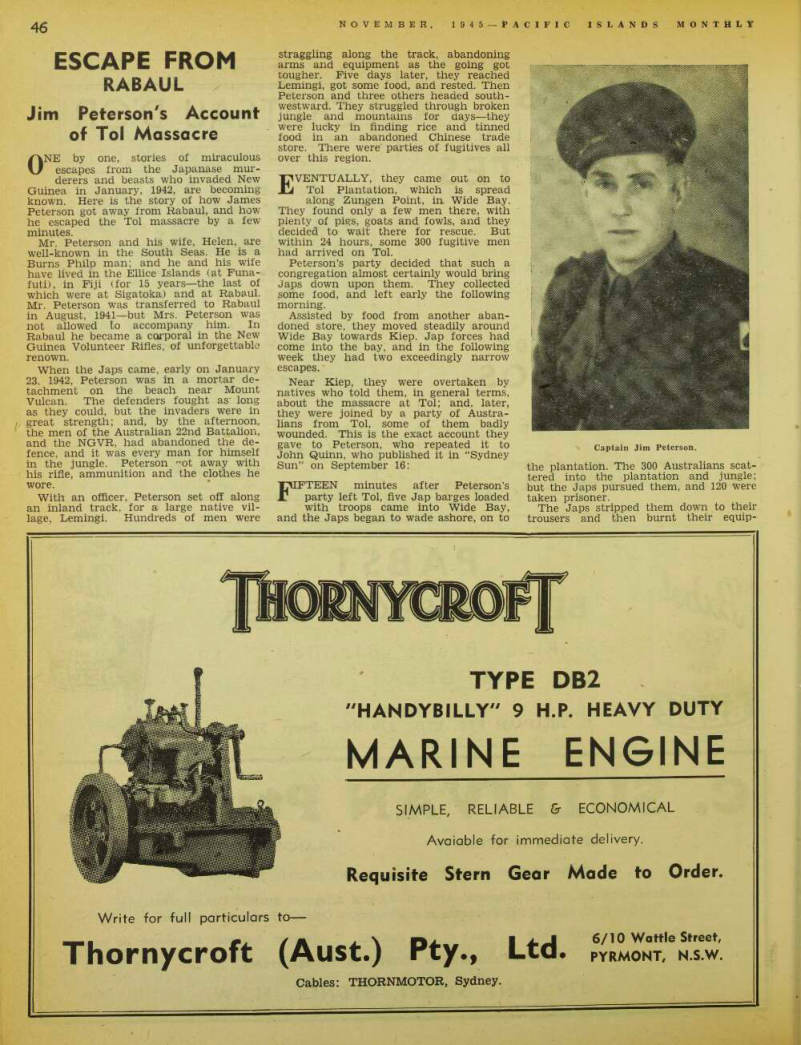
Captain Jim Peterson.
ment, clothing, and pay books on the beach. Apart from that, they did not harm them, but gave the prisoners cigarettes and food.
The Japs set up wireless on the beach.
Early next morning, a message came through that seemed to bewilder them.
They rushed around in excitement and the commanding officer came hurrying down. As far as the prisoners could make out, he sent a message for the previous signal to be repeated. It came.
After it was read, the Australians were lined up, their hands placed behind their backs and their thumbs bound together with fishing-line. Rope was linked through their arms until they formed a human chain.
All except one man. There was not enough rope for him, but he was pushed into line and marched off with the others.
The guards hustled them along the tracks of the jungle. Rounding the bend,
the man who had not been tied dropped to one side into a hollow. As the doomed men passed him, they whispered: “Keep your head down, mate. They can see your hat.” That man escaped.
They had gone a little way when they were halted. The rope was cut, divid ing them into small parties. Then the Japanese bayoneted or shot all of them.
After the butchery, an officer came along the line and any man who stirred was shot. The Japanese went away.
From the bush crept the Australians, who had witnessed the massacre, to look for survivors.
Peterson said that he believed there were four others apart from the three he met. , , j Another party found the man who had dropped beside the track. For days he had wandered with his hands tied behind behind him. He lived on grubs and beetles he had picked up with his teeth.
PETERSON’S party then pushed on to Jacquinot Bay, taking wounded men with them. It was a nightmare journey, over very broken country, with out supplies. The men were mostly sick and starving when they got to Malmal Plantation, on Jacquinot Bay. They were given help and supplies by a Ger man woman, the wife of a man who had been interned, and who was living there by herself. More men arrived, having struggled through from Wide Bay.
They set up a first-aid post on the beach —but many died.
Fearing Jap attacks, they struggled on. with a party of 90, to Grina, some 20 miles away. Another 20 men died.
On Easter Monday, a native runner came through with a message that, that night, a boat would come to Malmal Plantation, to help them. Carrying their sick, they made their way back to the plantation in eight hours.
A launch named “Mascot” had come from Port Moresbv to look for survivors.
It signalled the “Lakatoi,” in charge of Ivan Champion, well-known Papuan ad ministrative official, which was waiting in the Trobriands.
Champion brought the “Lakatoi” into Jacquinot Bay, and l5O escapees aboard —a most risky and daring feat.
Fortunately, the weather was thick and misty, and they were not observed by the
Japs, who were swarming along that coast. There were anxious moments, while the “Lakatoi” dodged the Japs around Gasmata, further westwards—but eventually the whole party got safely across the Bismarck Sea to Papua.
Jim Peterson joined the Australian Forces, became a captain in ANGAU and, on last reports, was serving in Bougainville.