Labour Problem In Samoa
pp. 28-29 · Read in the full issue
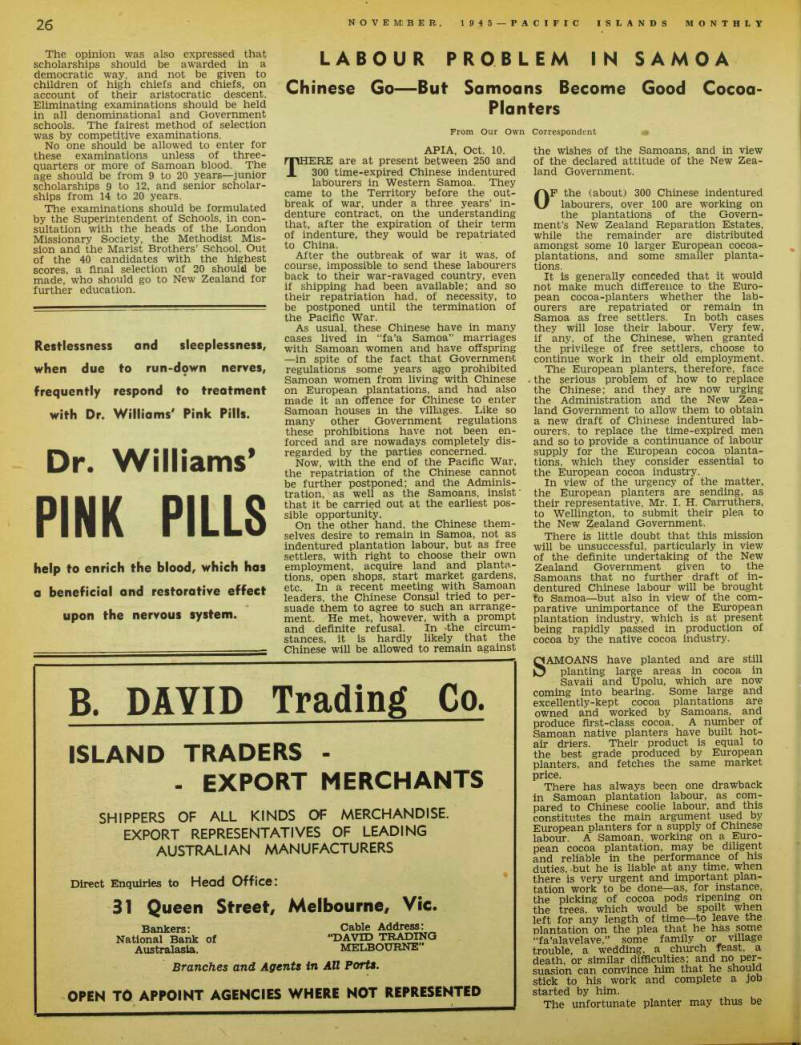

Chinese Go—But Samoans Become Good Cocoa- Planters
From Our Own Correspondent
Apia, Oct. 10.
rERE are at present between 250 and 300 time-expired Chinese indentured labourers in Western Samoa. They came to the Territory before the out break of war, under a three years’ in denture contract, on the understanding that, after the expiration of their term of indenture, they would be repatriated to China.
After the outbreak of war it was, of course, impossible to send these labourers back to their war-ravaged country, even if shipping had been available; and so their repatriation had, of necessity, to be postponed until the termination of the Pacific War.
As usual, these Chinese have in many cases lived in “fa’a Samoa” marriages with Samoan women and have offspring —in spite of the fact that Government regulations some years ago prohibited Samoan women from living with Chinese on European plantations, and had also made it an offence for Chinese to enter Samoan houses in the villages. Like so many other Government regulations these prohibitions have not been en forced and are nowadays completely dis regarded by the parties concerned.
Now, with the end of the Pacific War, the repatriation of the Chinese cannot be further postponed; and the Adminis tration, as well as the Samoans, insist that it be carried out at the earliest pos sible opportunity.
On the other hand, the Chinese them selves desire to remain in Samoa, not as indentured plantation labour, but as free settlers, with right to choose their own employment, acquire land and planta tions, open shops, start market gardens, etc. In a recent meeting with Samoan leaders, the Chinese Consul tried to per suade them to agree to such an arrange ment. He met, however, with a prompt and definite refusal. In the circum stances, it is hardly likely that the Chinese will be allowed to remain against
the wishes of the Samoans, and in view of the declared attitude of the New Zea land Government.
OF the (about) 300 Chinese indentured labourers, over 100 are working on the plantations of the Govern ment’s New Zealand Reparation Estates, while the remainder are distributed amongst some 10 larger European cocoa plantations, and some smaller planta tions.
It is generally conceded that it would not make much difference to the Euro pean cocoa-planters whether the lab ourers are repatriated or remain in Samoa as free settlers. In both cases they will lose their labour. Very few, if any, of the Chinese, when granted the privilege of free settlers, choose to continue work in their old employment.
The European planters, therefore, face the serious problem of how to replace the Chinese; and they are now urging the Administration and the New Zea land Government to allow them to obtain a new draft of Chinese indentured lab ourers. to replace the time-expired men and so to provide a continuance of labour supply for the European cocoa planta tions, which they consider essential to the European cocoa industry.
In view of the urgency of the matter, the European planters are sending, as their representative, Mr. I. H. Carruthers, to Wellington, to submit their plea to the New Zealand Government.
There is little doubt that this mission will be unsuccessful, particularly in view of the definite undertaking of the New Zealand Government given to the Samoans that no further draft of in dentured Chinese labour will be brought to Samoa—but also in view of the com parative unimportance of the European plantation industry, which is at present being rapidly passed in production of cocoa by the native cocoa industry.
SAMOANS have planted and are still planting large areas in cocoa in Savaii and Upolu, which are now coming into bearing. Some large and excellently-kept cocoa plantations are owned and worked by Samoans, and produce first-class cocoa. A number of Samoan native planters have built hot air driers. Their product is equal to the best grade produced by European planters, and fetches the same market price.
There has always been one drawback in Samoan plantation labour, as com pared to Chinese coolie labour, and this constitutes the main argument used by European planters for a supply of Chinese labour. A Samoan, working on a Euro pean cocoa plantation, may be diligent and reliable in the performance of his duties, but he is liable at any time, when there is very urgent and important plan tation work to be done —as, for instance, the picking of cocoa pods ripening on the trees, which would be spoilt when left for any length of time—to leave the plantation on the plea that he has some “fa’alavelave,” some family or village trouble, a wedding, a church feast, a death, or similar difficulties; and no Per suasion can convince him that he should stick to his work and complete a job started by him.
The unfortunate planter may thus be
left without the necessary labour to com plete his urgent work; and, in many cases, being unable to procure other lab our, faces heavy losses. The planter, of course, can rely on Chinese labourers to be always available when needed. rE Samoans realise that this draw back constitutes a serious obstacle to the employment of Samoans on European plantations and some way has to be found to remedy this. They have suggested that a Labour Office be set up by Samoan leaders, with authority from the Administration to regulate and organise the supply of Samoan labour to the European planters, as well as to other employers of labour, and that all labour be engaged and controlled through this Labour Office.
It is also planned to compel any% Samoan labourer who wants to leave his employment or change his work, for any reason, to give sufficient notice to en able the employer to replace him without serious inconvenience.
The Labour Office would also, in con sultation with employers and the Ad ministration, fix wages and conditions for Samoan labourers and undertake to supply to planters the required labourers from districts where there is a surplus of native labour.
It is reported that the New Zealand Government has already agreed to such an arrangement and that this Labour Office is to be started in the near future.
It will be interesting to watch this development, which is something un precedented in the history of Samoa, and which, if successful, would un doubtedly benefit all parties concerned, employers as well as workers.