Effort to Restore Discipline to PI Regiment
p. 24 · Read in the full issue
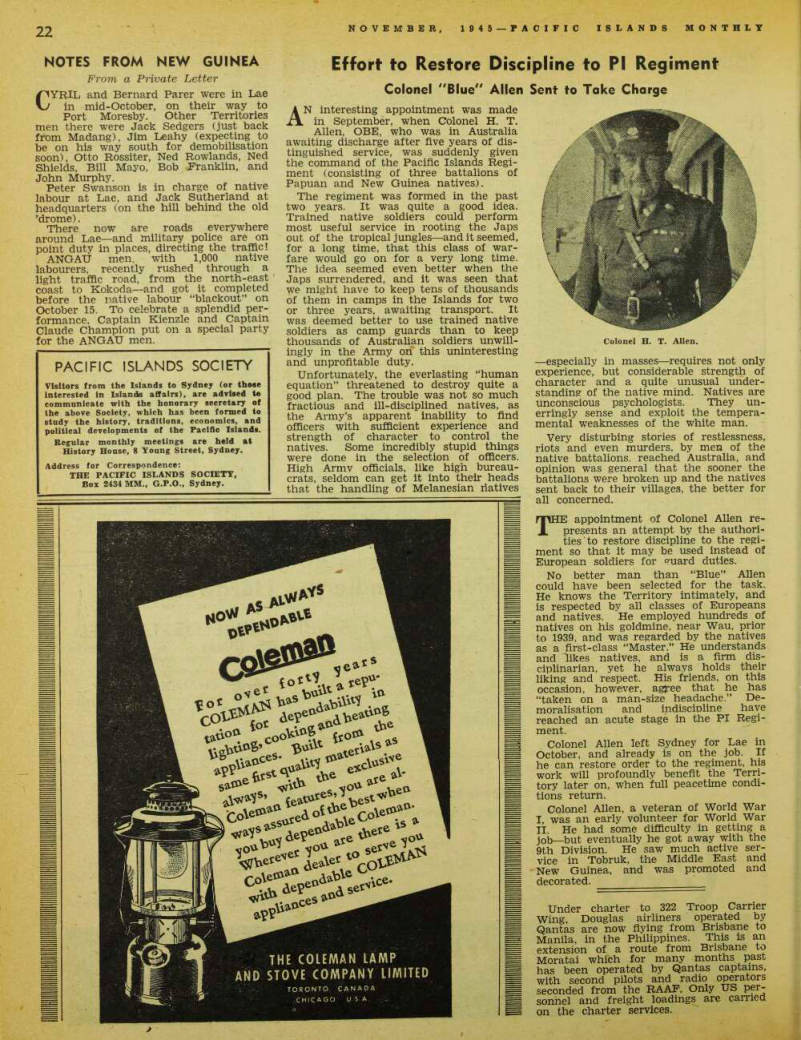
Colonel "Blue" Allen Sent to Take Charge
AN interesting appointment was made in September, when Colonel H. T.
Allen, OBE, who was in Australia awaiting discharge after five years of dis tinguished service, was suddenly given the command of the Pacific Islands Regi ment (consisting of three battalions of Papuan and New Guinea natives).
The regiment was formed in the past two years. It was quite a good idea.
Trained native soldiers could perform most useful service in rooting the Japs out of the tropical jungles—and it seemed, for a long time, that this class of war fare would go on for a very long time.
The idea seemed even better when the Japs surrendered, and it was seen that we might have to keep tens of thousands of them in camps in the Islands for two or three years, awaiting transport. It was deemed better to use trained native soldiers as camp guards than to keep thousands of Australian soldiers unwill ingly in the Army on this uninteresting and unprofitable duty.
Unfortunately, the everlasting “human equation” threatened to destroy quite a good plan. The trouble was not so much fractious and ill-disciplined natives, as the Army’s apparent inability to find officers with sufficient experience and strength of character to control the natives. Some incredibly stupid things were done in the selection of officers.
High Army officials, like high bureau crats, seldom can get it into their heads that the handling of Melanesian natives
—especially in masses —requires not only experience, but considerable strength of character and a quite unusual under standing of the native mind. Natives are unconscious psychologists. They un erringly sense and exploit the tempera mental weaknesses of the white man.
Very disturbing stories of restlessness, riots and even murders, by men of the native battalions, reached Australia, and opinion was general that the sooner the battalions were broken up and the natives sent back to their villages, the better for all concerned. mHE appointment of Colonel Allen re- JL presents an attempt by the authori ties to restore discipline to the regi ment so that it may be used instead of European soldiers for guard duties.
No better man than “Blue” Allen could have been selected for the task.
He knows the Territory intimately, and is respected by all classes of Europeans and natives. He employed hundreds of natives on his goldmine, near Wau, prior to 1939, and was regarded by the natives as a first-class “Master.” He understands and 'likes natives, and is a firm dis ciplinarian, yet he always holds their liking and respect. His friends, on this occasion, however, agjree that he has “taken on a man-size headache.” De moralisation and indiscipline have reached an acute stage in the PI Regi ment.
Colonel Allen left Sydney for Lae in October, and already is on the job. If he can restore order to the regiment, his work will profoundly benefit the Terri tory later on, when full peacetime condi tions return.
Colonel Allen, a veteran of World War I, was an early volunteer for World War 11. He had some difficulty in getting a job—but eventually he got away with the 9th Division. He saw much active ser vice in Tobruk, the Middle East and New Guinea, and was promoted and decorated.
Under charter to 322 Troop Carrier Wing, Douglas airliners operated by Qantas are now flying from Brisbane to Manila, in the Philippines. This is an extension of a route from Brisbane to Moratai which for many months past has been operated by Qantas captains, with second pilots and radio operators seconded from the RAAF. Only US per sonnel and freight loadings are carried on the charter services.
Colonel H. T. Allen.