Something Brewing In The Canefields
p. 23 · Read in the full issue
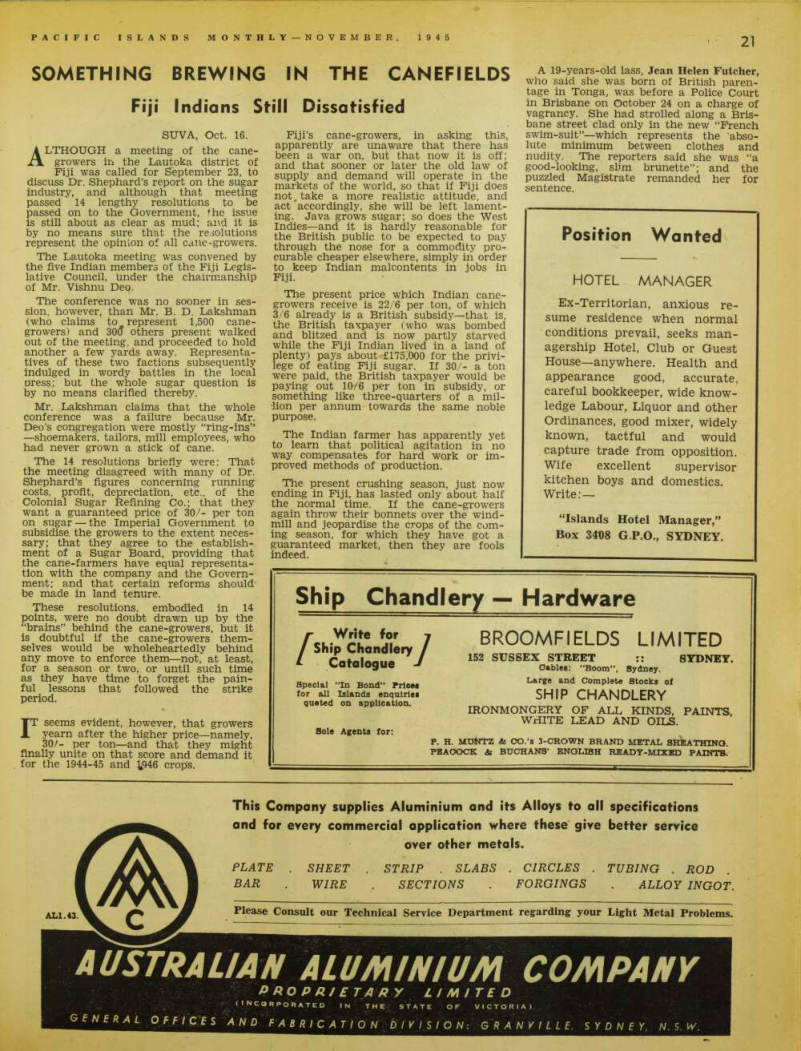
Fiji Indians Still Dissatisfied
Suva, Oct. 16.
ALTHOUGH a meeting of the cane growers in the Lautoka district of Fiji was called for September 23, to discuss Dr. Shephard’s report on the sugar industry, and although that meeting passed 14 lengthy resolutions to be passed on to the Government, the issue is still about as clear as mud; and it is by no means sure that the resolutions represent the opinion of all cane-growers.
The Lautoka meeting was convened by the five Indian members of the Fiji Legis lative Council, under the chairmanship of Mr. Vishnu Deo.
The conference was no sooner in ses sion, however, than Mr. B. D. Lakshman (who claims to represent 1,500 cane growers) and 300 others present walked out of the meeting, and proceeded to hold another a few yards away. Representa tives of these two factions subsequently indulged in wordy battles in the local press; but the whole sugar question is by no means clarified thereby.
Mr. Lakshman claims that the whole conference was a failure because Mr.
Dec’s congregation were mostly “ring-ins” —shoemakers, tailors, mill employees, who had never grown a stick of cane.
The 14 resolutions briefly were: That the meeting disagreed with many of Dr.
Shephard’s figures concerning running costs, profit, depreciation, etc., of the Colonial Sugar Refining Co.; that they want a guaranteed price of 30/- per ton on sugar the Imperial Government to subsidise the growers to the extent neces sary; that they agree to the establish ment of a Sugar Board, providing that the cane-farmers have equal representa tion with the company and the Govern ment; and that certain reforms should be made in land tenure.
These resolutions, embodied in 14 points, were no doubt drawn up by the “brains” behind the cane-growers, but it is doubtful if the cane-growers them selves would be wholeheartedly behind any move to enforce them—not, at least, for a season or two, or until such time as they have time to forget the pain ful lessons that followed the strike period. • IT seems evident, however, that growers yearn after the higher price—namely, 30/- per ton—and that they might finally unite on that score and demand it for the 1944-45 and V*46 crops.
Fiji’s cane-growers, in asking this, apparently are unaware that there has been a war on, but that now it is off; and that sooner or later the old law of supply and demand will operate in the markets of the world, so that if Fiji does not. take a more realistic attitude, and act accordingly, she will be left lament ing. Java grows sugar; so does the West Indies—and it is hardly reasonable for the British public to be expected to pay through the nose for a commodity pro curable cheaper elsewhere, simply in order to keep Indian malcontents in jobs in Fiji.
The present price which Indian cane growers receive is 22/6 per ton, of which 3/6 already is a British subsidy—that is, the British taxpayer (who was bombed and blitzed and is now partly starved while the Fiji Indian lived in a land of plenty) pays about £175,000 for the privi lege of eating Fiji sugar. If 30/- a ton were paid, the British taxpayer would be paying out 10/6 per ton in subsidy, or something like three-quarters of a mil lion per annum towards the same noble purpose.
The Indian farmer has apparently yet to learn that political agitation in no way compensates for hard work or im proved methods of production.
The present crushing season, just now ending in Fiji, has lasted only about half the normal time. If the cane-growers again throw their bonnets over the wind mill and jeopardise the crops of the com ing season, for which they have got a guaranteed market, then they are fools indeed.
A 19-years-old lass, Jean Helen Futcher, who said she was born of British paren tage in Tonga, was before a Police Court in Brisbane on October 24 on a charge of vagrancy. She had strolled along a Bris bane street clad only in the new “French swim-suit”—which represents the abso lute minimum between clothes and nudity. The reporters said she was “a good-looking, slim brunette”; and the puzzled Magistrate remanded her for sentence.