"Bulamakau"
p. 64 · Read in the full issue
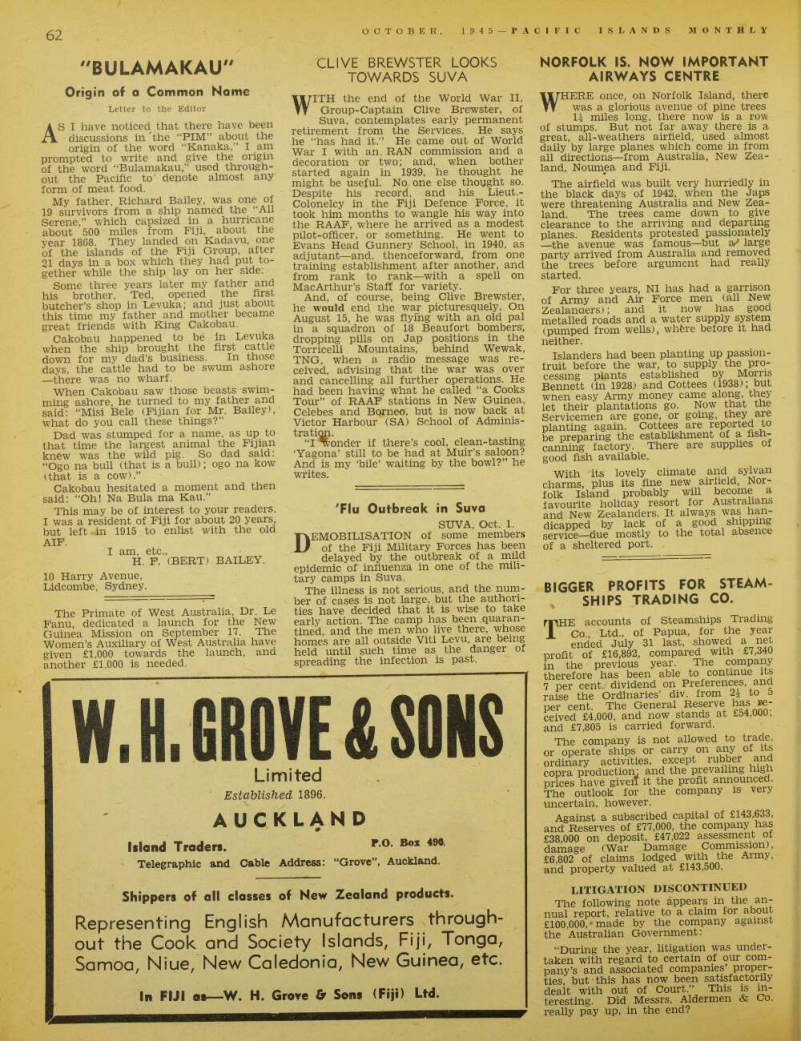
Origin of a Common Name
Letter to the Editor
AS I have noticed that there have been discussions in 'the “PIM” about the origin of the word “Kanaka,” I am prompted to write and give the origin of the word “Bulamakau,” used through out the Pacific to denote almost any form of meat food.
My father, Richard Bailey, was one of 19 survivors from a ship named the “All Serene,” which capsized in a hurricane about 500 miles from Fiji, about the year 1868. They landed on Kadavu, one of the islands of the Fiji Group, after 21 days in a box which they had put to gether while the ship lay on her side.
Some three years later my father and his brother, Ted, opened the first butcher’s shop in Levuka; and just about this time my father and mother became great friends with King Cakobau.
Cakobau happened to be in Levuka when the ship brought the first cattle down for my dad’s business. In those days, the cattle had to be swum ashore —there was no wharf.
When Cakobau saw those beasts swim ming ashore, he turned to my father and said: “Misi Bele (Fijian for Mr. Bailey), what do you call these things?”
Dad was stumped for a name, as up to that time the largest animal the Fijian knew was the wild pig. So dad said: “Ogo na bull (that is a bull); ogo na kow (that is a cow).”
Cakobau hesitated a moment and then said: “Oh! Na Bula ma Kau.”
This may be of interest to your readers.
I was a resident of Fiji for about 20 years, but left in 1915 to enlist with the old
Aif.
I am, etc.,
H. F. (Bert) Bailey.
10 Harry Avenue, Lidcombe, Sydney.
The Primate of West Australia, Dr. Le Fanu, dedicated a launch for the New Guinea Mission on September 17. The Women’s Auxiliary of West Australia have given £l,OOO towards the launch, and another £l,OOO is needed.