Governor-General
pp. 58-60 · Read in the full issue
Evacuees Appeal To Australian
Their Treatment by Minister and Prime Minister Bitterly Resented
OECAUSE, in their unanimous opinion, they were "up against a stone wall," members of the Pacific Territories 7 Association (evacuees from New Guinea and Papua), at a largely-attended meeting in Sydney Australia (the Duke of Gloucester), for assistance in returning to their homes.
fIIHE executive reported that, during the X preceding three months, although the Ministers and high officials had been appealed to no reassurance (or even information) could be obtained In regard to the time when they would be allowed to return to the Territories, or the prob able conditions of their return. Canberra
displayed the utmost indifference con cerning the plight of the hundreds of people whose homes and interests were in the Territories.
Speaker after speaker reminded the meeting of the events of the past years. They had assumed that, as the Territories people were the only Aus tralian civilians to be directly affected by Japanese invasion, the Australian Government would have been anxious to assist in their rehabilitation. They imagined that, as soon as the Japs were driven out, civilians would have been en couraged and assisted to return to their homes. Instead, two years after the Japs had been cleared out of the Territories south of the Markham, the Territories still were in military occupation. Instead of the districts, as they were liberated, being restored to the care of civilian Gov ernment and of civilians generally, all sorts of Government instrumentalities had been introduced and had taken control.
Only a few civilians had been allowed to return —the remainder apparently were to be kept out indefinitely. No commer cial concerns whatever had been ad mitted —Canberra’s policy apparently was that private enterprise should either be reduced to the utmost or kept out alto gether, while its place was taken by the Government-owned Production Control Board —which controls not only all pro duction, but all trading, all labour, and all transport.
It was pointed out that, for more than two years, Territorians had been appeal ing to the Minister for External Terri tories, Mr. Ward; but that gentleman had refused to see them, had fobbed off their written communications with assurances that “the matter will receive considera tion”; and finally had ignored their letters altogether. Then they had appealed to the Prime Minister —to Mr.
Curtin and, after his death, to Mr.
Chifley; but all they could get from those functionaries was that “the matters were under consideration.” Appeals for inter views with the Prime Minister were ignored.
IT was recalled that, over a year ago, a section of Territorians had moved for an appeal to Britain and the United States —an appeal that the control of those Territories be taken away from Australia, and placed in the hands of other authorities, with some sense of human rights and justice.
“You declined that proposal,” said one speaker, addressing the meeting. “You thought that you would get a better deal if you remained with Australia, and appealed, by special deputation, to the Prime Minister. Well, you appealed, and look at what you got. The Prime Minis ter will not even communicate with you.
And in the meantime, Ward and his anthropologists and missionaries are giv ing all their energies, and a big slice of the Australian taxpayers’ money, to poor, dear Fuzzy-wuzzy, the creation of the shoddy Australian press.
“We Europeans have all lost our homes and the results of a lifetime’s work, hun dreds of our civilians have been killed,
hundreds more have given pretty distinguished service in the armed forces— and yet we are treated this way by Australia. I never believed such a thing was possible.”
Mr. Clem Kirke, well-known Morobe resident, pointed out that, as British subjects, they had certain fundamental rights. The Throne was not a mere ornament—it was there as the final place of appeal to guard the liberties of the people. If there was tyranny and in justice, surely they had the right to appeal to the Governor-General of Australia.
Mrs. Wilmott (New Guinea) reminded the meeting that on a famous occasion in New South Wales, when a democratically elected Government ran amok, under Mr.
Lang, and seriously interfered with the
fundamental rights of the people, the Government was summarily dismissed by the State Governor, Sir Philip Game, Other speakers pointed out that the European residents of the Territories, be lieving themselves treated with injustice, had tried the few legal and constitutional means available to them to get relief, and had been ignored by the Federal Government. The only course now left open to them was to appeal to the Crown.
The meeting unanimously adopted a resolution, instructing the executive to take all steps necessary to place before the Governor-General, in proper form, a statement of the present unhappy condi tion of the Territories evacuees, and an appeal for assistance.
Report of the Executive
SINCE the last meeting of members, held in June, your executive have continued to press the Government for details of their plans for the future; but it is regretted that no definite results have been obtained. The three months can only be described as months of frustration.
The surrender of the Japanese has naturally focussed the attention of all exresidents on the likelihood of an early return to their homes and businesses in the Territories and they, of course, anticipated that the Federal Government would not lag in advising them of the plans prepared for the future of the Territories. It is apparent, however, that these exxpected plans, if in existence at all, are still far from finalisation. provision a t ATTivrT'NrT c 5T'P attont
Provibional Administration
The Bill for the setting up of a Provisional Civilian Administration for Papua and portion of the Territory of New Guinea was brought before, the House early in July. Your executive took all possible steps to organise opposition to this Bill, as they considered that the
re-establishment of Civil Administration on the.same basis and under the same laws as before the Japanese invasion would be in the best interests of the white residents as well as the native in habitants. In this regard Mr. C. I. H.
Campbell proceeded to Canberra to supply necessary Information to Opposition members and, although the Opposition were unable to defeat the measure, the opportunity presented itself for the cor rection of misleading statements made by the Government supporters.
It now devolves on your Association to keep continual watch on Ordinances which are put out under terms of the Bill, which provides that such Ordinances shall remain on the table of the House for a period of 15 sitting days. We have arranged for advance copies to be sup piied to ug in Qrder that & careful study may be made of same, and objections raised where considered necessary. „, AD hamapp att^hto
War Damage Commission Allows
Graiia Bubbidies
As is usual, we report good results from all our submissions to the Commission
munication covering the payment of an ex-gratia allowance in respect to damage caused “by abandonment” to agricultural properties has been received and is now promulgated for the information of mem bers:— The Commission is continuing to fina lise all claims as quickly as possible, and
and in this connection the following comto pay assessed losses in respect to private chattels.
Rehabilitation
civUians B evacuated t^rome^he il TerHtorles it is a matter of great regret that we have to. report our inability to obtain from the responsible Department any details of the scheme, if any, which the Government has prepared. We have submitted to the Government a request that fares of evacuees returning to the Terntories be paid bv the Government, and that special consideration be given covering freights and Customs duty on goods which are essential for replacement of
buildings and furnishings on return.
We are informed that these matters are receiving the attention of the Minister and we will, no doubt, be advised re garding them at some future date.
Return Of Civilians Generally
Your executive have continued to press the Government for some definite news as to the date when it is expected that civilians generally will be able to return to the Territories. Particular attention has been drawn to the Goldfield Area of New Guinea, and although this area is included in the Provisional Papua-New Guinea Territory it appears that there is little chance of early return of civi lians to this district. The main objection at the moment is the lack of transport, particularly in conjunction with the fact that the Lalu-Wau road is at present impassable. Your executive are keeping the matter under continual review.
Minister
Your executive have repeatedly tried to obtain an interview with the Minister to discuss matters of concern regarding the future of the Territories and their in habitants, both white and black, but with out result.
Mr. Ward, during the second reading of the Bill for Provisional Administration, stated the Government had plans in respect to the white settlers; but (Dwing to his apparent lack of time to discuss these matters with your representatives, it can only be concluded that the plans in regard to the white settlers are of such a nebulous nature that they will not stand the airing that W9UW arise in discussion with representatives with a knowledge of Territory conditions.
The Minister, when requested to receive a deputation from your executive, had re quested that representations be put in writing. This was done in a number of cases, and the net result was the usual reply—that the representations were re ceiving consideration, and we would be advised when a decision was reached. The following are a few of the matters sub mitted and treated as stated:
(a) Planters’ representation on the Production Control Board. (b) Rehabilitation. (c) Extension of the proposed term of indenture of native labourers.
Under the stress of necessity your exe cutive have appealed to the Prime Minis ter for an interview in order that some information of the Government’s pro posals can be obtained.
General
Our new Constitution which will come into force with the resumption of Civil Administration is now in course of print ing, and all members will be supplied with a copy.
Your treasurer elected at the last meet ing, Mr. P. Hinds, returned to Papua early in July; and, in accordance with the Constitution, your executive elected Mrs. V. Weatherall to the position of treasurer in his stead.
Proposed Pacific Club
On September 6, representatives from all Territory Associations and Clubs, as well as the Pacific Island Association, met to discuss a proposal to form a club in Sydney for residents of the Islands, ex residents and interested persons, and it was decided to proceed with the pre liminaries necessary to the formation of a club to be called the Pacific Club. In order to obtain some indication as to the membership which can be expected all members are being circularised, and we would ask all our members to reply as soon as possible after the receipt of the circular. Your executive are fully in accord with the proposals, and commend them to your consideration.
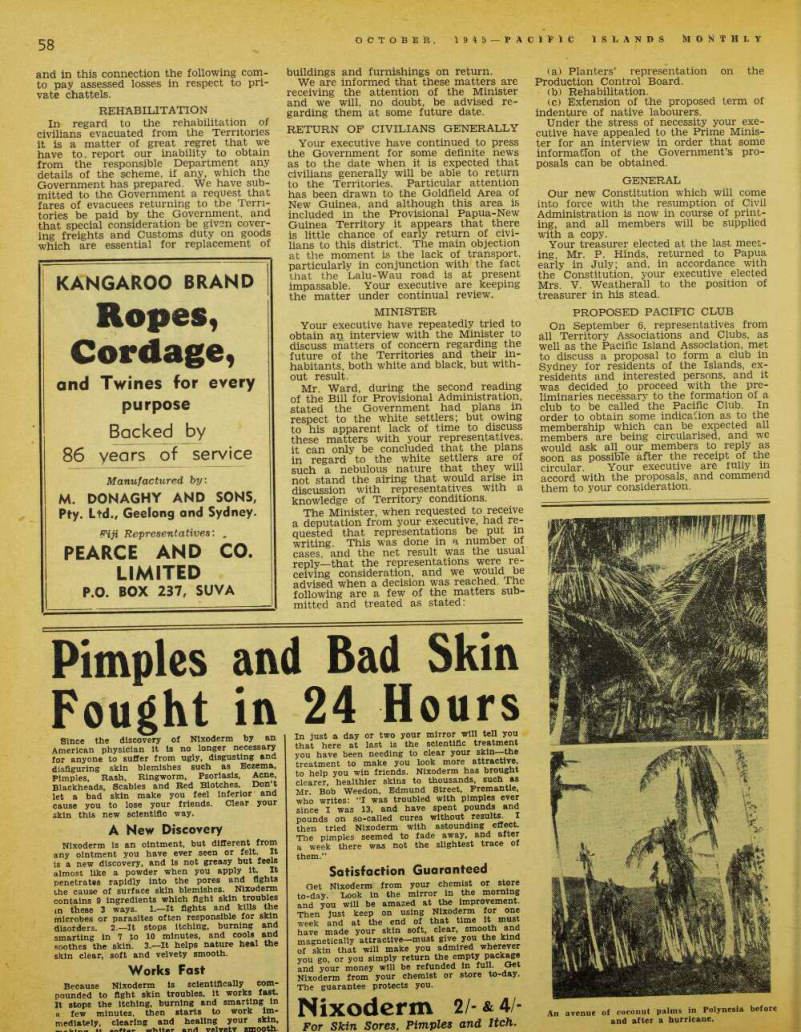
An avenue of coconut palms in Polynesia before and after a hurricane.