Black Wasps From
p. 48 · Read in the full issue
Zanzibar
To Save Samoan Coconuts
ANOTHER consignment of black wasps from Zanzibar has arrived in Apia, W. Samoa, to help combat the ravages of the rhinoceros beetle.
This is about the sixth shipment of the Zanzibar variety, but consignments of a different species of wasp have been sent from Mauritius and East Africa at regular intervals since 1939.
Mr. H. W. Simmonds, former Govern ment entomologist in Fiji, is responsible for the arrival of both the Zanzibar wasps and for the earlier species.
The rhinoceros beetle was accidentally introduced into Western Samoa about 1910 —it is believed, in the packing around some rubber stumps from Ceylon.
Its presence was first detected in Novem ber of that year in some coconuts, near the Customs House in Apia, and from there it spread with alarming rapidity.
By 1912 the whole of the western por tion of Upolu was affected, and soon after the beetle crossed the straits to Savaii and later reached Tutuila.
In 1926 it had reached an island of the Tongan Group, but very energetic measures had completely eradicated it by 1930. Wallis Island, 200 miles west of Samoa, has become infected In recent years, and if some drastic cure is not found soon it is only a matter of time before it will reach all islands in the groups adjacent to Samoa, and those hav ing commercial relations with the affected areas.
The pest is still absent from Fiji; but the Colony suffers delay in ship ping for the simple reason that between
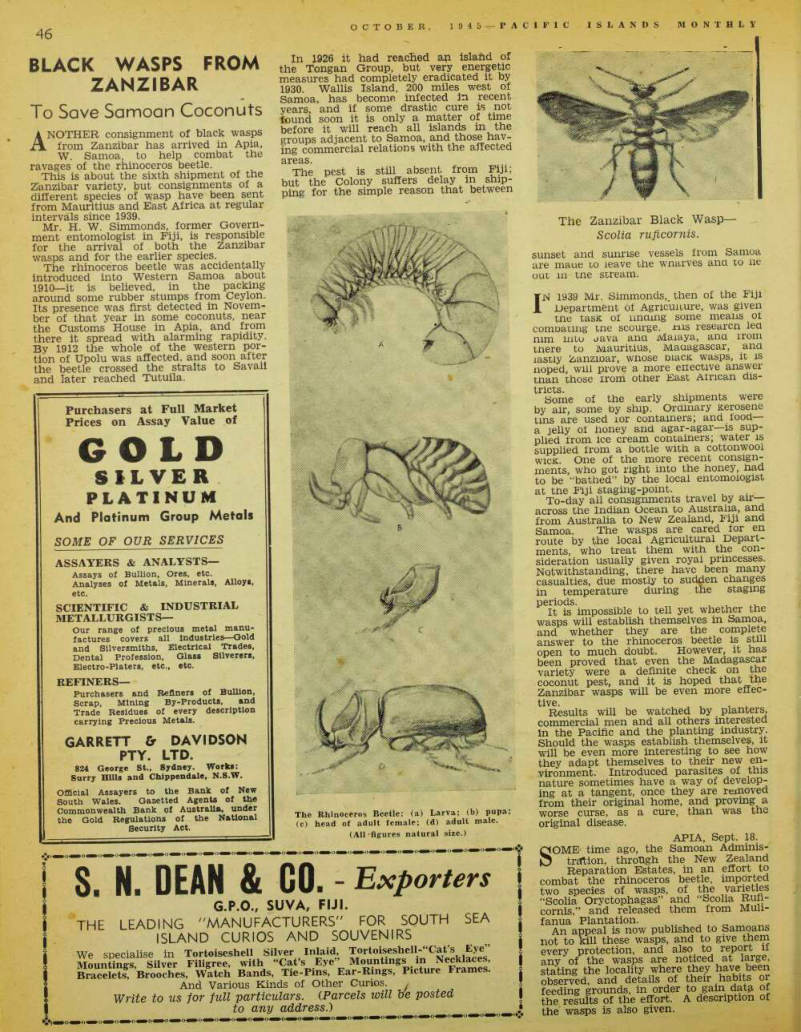
The Zanzibar Black Wasp— Scolia ruficornis.
sunset and sunrise vessels from Samoa are maue w leave the wnarves ana to ne out in tne stream.
IN 1939 Mr. Simmonds,. then of the Fiji Department of Agriculture, was given tne tasK of nnamg some means of comparing tne scourge, ms researcn lea mm into java ana Maiaya, ana irom tnere to Mauritius, Maaagascar, ana lastly Zanzioar, wnose biacK wasps, it is noped, will prove a more effective answer tnan those from other East African dis tricts Some of the early shipments were by air, some by ship. Ordinary Kerosene tins are used lor containers; and food — a jelly of honey and agar-agar—is sup plied from ice cream containers; water is supplied from a bottle with a cottonwool wick. One of the more recent consign ments, who got right into the honey, had to be “bathed” by the local entomologist at the Fiji staging-point. .
To-day all consignments travel by air — across the Indian Ocean to Australia, and from Australia to New Zealand, Fiji and Samoa. The wasps are cared for en route by the local Agricultural Depart ments, who treat them with the con sideration usually given royal princesses.
Notwithstanding, there have been many casualties, due mostly to sudden changes in temperature during the staging P It is impossible to tell yet whether the wasps will establish themselves in Samoa, and whether they are the complete answer to the rhinoceros beetle is still open to much doubt. However, it has been proved that even the Madagascar variety were a definite check on the coconut pest, and it is hoped that the Zanzibar wasps will be even more effecwill be watched by planters, commercial men and all others interested in the Pacific and the planting industry.
Should the wasps establish themselves, it will be even more interesting to see how they adapt themselves to their new en vironment. Introduced parasites of this nature sometimes have a way of develop ing at a tangent, once they are removed from their original home, and proving a worse curse, as a cure, than was the original disease.
APIA, Sept. 18.
SOME time ago, the Samoan Adminis tration, through the New Zealand Reparation Estates, in an effort to combat the rhinoceros beetle, imported two species of wasps, of the varieties “Scolia Oryctophagas” and “Scolia Run cornis,” and released them from Muli fanua Plantation.
An appeal is now published to Samoans not to kill these wasps, and to give them every protection, and also to report if any of the wasps are noticed at large, stating the locality where they have been observed, and details of their habits or feeding grounds, in order to gam data of the results of the effort. A description of the wasps is also given.
The Rhinoceros Beetle: (a) Larva; (b) pupa; (c) head of adult female; (d) adult male. (All figures natural size.)